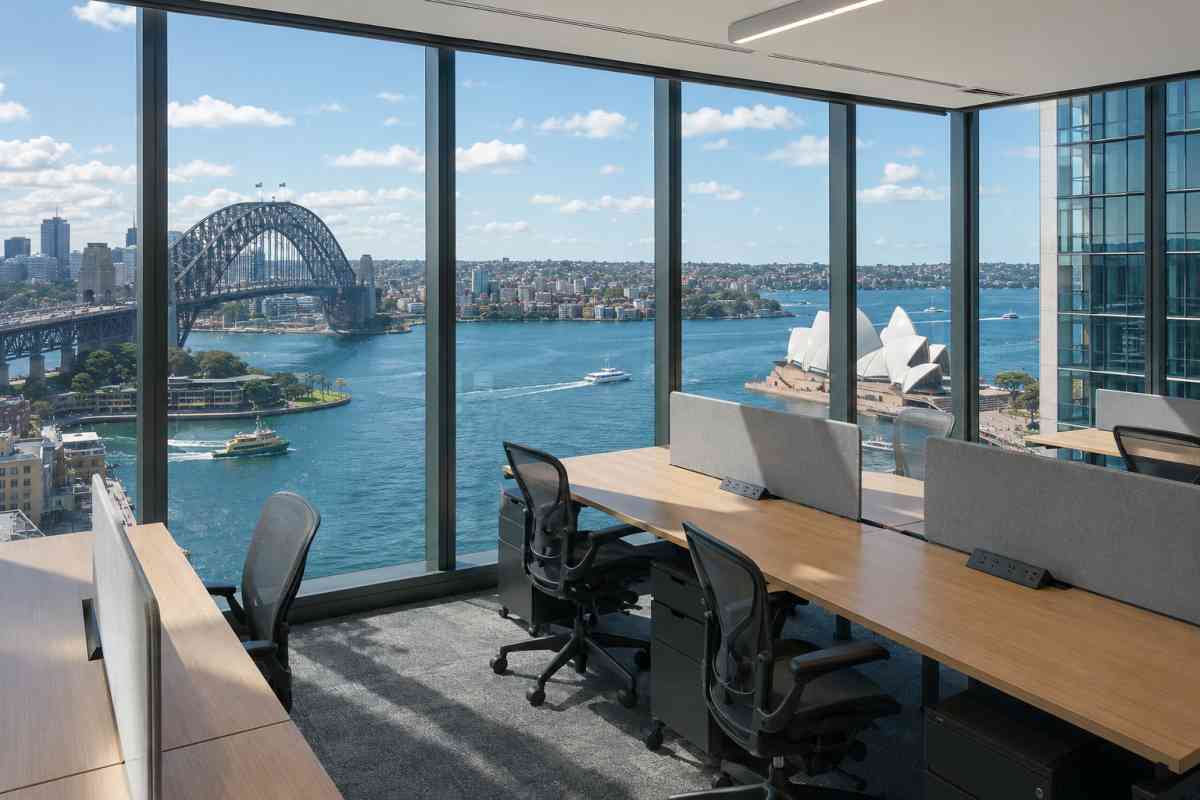
Sydney’s office market is showing signs of renewed activity in 2026, but the recovery is not evenly spread. Rising rents, limited high-quality space and a widening divide between prime and secondary buildings are forcing small and mid-sized businesses to think harder before signing their next lease.
For companies searching for office space in Sydney, the headline vacancy rate may look encouraging, with Sydney CBD vacancy sitting at 13.8% in January 2026, only marginally above 13.7% six months earlier.
On paper, that suggests tenants still have options. The reality is more complicated.
Demand is shifting toward better-quality offices with strong transport access, modern fit-outs, staff amenities, sustainability credentials and flexible layouts.
Older buildings are still carrying more vacancy, while prime assets are attracting stronger tenant interest.
That matters because office costs are not just a property issue. They affect hiring, wages, business expansion, CBD foot traffic, public transport use and the small businesses that rely on weekday workers.
Sydney Remains Australia’s Most Expensive Major CBD Office Market
Sydney continues to sit at the top of Australia’s major CBD office rental market.
Knight Frank’s Australian Office Indicators for Q1 2026 put Sydney prime net face rent at $1,443 per sqm per annum, ahead of Brisbane at $883, Melbourne at $767, Perth at $737, Adelaide at $572 and Canberra at $481.
On a net effective basis, which accounts for incentives, Sydney also remained the most expensive major market at $840 per sqm. Brisbane followed at $473, Melbourne at $401, Perth at $390, Adelaide at $323 and Canberra at $308.
| CBD market | Prime net face rent | Prime net effective rent | Vacancy |
|---|---|---|---|
| Sydney | $1,443/sqm | $840/sqm | 13.8% |
| Brisbane | $883/sqm | $473/sqm | 11.8% |
| Melbourne | $767/sqm | $401/sqm | 19.0% |
| Perth | $737/sqm | $390/sqm | 16.9% |
| Adelaide | $572/sqm | $323/sqm | 15.5% |
| Canberra | $481/sqm | $308/sqm | 10.2% |
The figures show the challenge for Sydney businesses. Melbourne has a higher vacancy rate and more leasing slack. Brisbane has lower vacancy and stronger rental growth.
Perth and Adelaide remain cheaper, while Canberra is tighter but still significantly cheaper than Sydney.
Sydney’s advantage remains its scale. The CBD offers access to clients, transport, professional services, finance, technology firms and a deep labour pool. The cost of that access, however, is high.
Vacancy Is High, But The Best Space Is Harder To Secure
The Property Council of Australia’s January 2026 Office Market Report showed national office vacancy rising from 15.2% to 15.9% over the six months to January 2026. Sydney’s CBD sat below Melbourne, Perth and Adelaide, but above Brisbane, Canberra and Hobart.
| CBD market | Vacancy, January 2026 |
| Hobart CBD | 5.2% |
| Canberra | 10.2% |
| Brisbane CBD | 11.8% |
| Sydney CBD | 13.8% |
| Darwin CBD | 14.7% |
| Adelaide CBD | 15.5% |
| Perth CBD | 16.9% |
| Melbourne CBD | 19.0% |
Sydney is not Australia’s tightest office market by vacancy, but it remains the most expensive among the major CBDs covered in Knight Frank’s rental data.
The split between building quality is also important. The Property Council reported Sydney prime vacancy at around 13.2%, compared with secondary vacancy of around 14.9%.
That gap reflects the continuing “flight to quality”, where tenants may take less space overall but want better space for staff, clients and business operations.
Tenant CS reported Sydney CBD effective rents in Q1 2026 at $1,163 per sqm for Premium offices, $986 for A-Grade and $732 for B-Grade.
| Sydney CBD grade | Effective rent |
| Premium | $1,163/sqm |
| A-Grade | $986/sqm |
| B-Grade | $732/sqm |
The gap matters for growing companies. A cheaper B-Grade office may reduce the rent bill in the short term, but it may also bring higher fit-out costs, weaker staff appeal, poorer building performance and less flexibility.
Leasing Activity Is Improving
CBRE reported 141 leasing enquiries in the Sydney CBD during Q1 2026, covering 125,230 sqm. That was 22.0% higher than Q1 2025 and 122.7% higher than Q4 2025.
CBRE also said no new office space was expected to be delivered to the Sydney CBD in 2026, with development activity set to slow.
That gives the market an unusual shape: vacancy remains elevated, but the supply of new, high-quality office space is limited.
The rise in enquiry does not mean every business is rushing back to large CBD floors. Many companies are still cautious. Hybrid work remains part of the market, and businesses are more disciplined about how much space they take.
But the figures do suggest more tenants are actively reviewing their office needs. For growing businesses, that means competition for the better buildings may become sharper, even while overall vacancy remains elevated.
Landlords Are Under Pressure To Prove Their Buildings Still Work
The shift in Sydney’s office market is also putting pressure on landlords and building owners.
It is no longer enough to offer floor space and wait for tenants to sign.
Businesses are looking more closely at how buildings operate day to day, how quickly maintenance issues are resolved, whether tenant requests are handled properly and whether older assets can meet modern expectations around flexibility, efficiency and staff experience.
That pressure is visible across the private property sector.
In March 2025, building operations platform Facilio said Kingsmede, a private property investment company with office and warehouse assets in NSW and Queensland, had selected its Connected CMMS platform to modernise operations across 30 properties.
The announcement pointed to a broader trend in commercial property: owners are trying to improve operational visibility, maintenance coordination and tenant service at a time when occupiers have become more selective.
For tenants, the issue is not which technology platform a landlord uses. The issue is whether the building is properly run. Poor maintenance, slow communication and ageing facilities can increase the real cost of a lease, even when the advertised rent looks competitive.
Why This Is A Public-Interest Issue
Office leasing is often treated as a commercial property story, but the effects reach beyond landlords and tenants.
When office rents rise, growing businesses have to make harder decisions about hiring, wages, expansion and location. Some delay moving.
Others choose smaller premises. Some move teams into suburban offices or flexible workspace instead of committing to larger CBD leases.
Those choices flow through the city.
Fewer workers in the CBD means less trade for cafes, restaurants, gyms, dry cleaners, retailers and service businesses that rely on weekday foot traffic. Public transport demand changes.
Older office buildings come under pressure to upgrade. Governments and councils are left trying to support city centres that no longer operate the way they did before hybrid work became normal.
Sydney’s office market is therefore a test of whether the CBD can remain a productive business centre, not just a high-cost address.
What Growing Businesses Should Prioritise
1. Total occupancy cost
Businesses should not judge a lease by headline rent alone.
The full cost includes rent, outgoings, incentives, fit-out, make-good obligations, utilities, parking, technology upgrades, legal costs and moving disruption.
A cheaper office can quickly become expensive if the building needs major work or if the lease terms are too rigid.
2. Flexibility
Growing companies should avoid leases that assume the business will look the same in three to five years.
Expansion rights, sublease rights, break options and fitted-space opportunities can be more valuable than a small discount on rent. Flexibility is especially important for companies still adjusting to hybrid work, AI adoption, automation and changing staff numbers.
3. Staff access
The office now has to justify the commute.
Buildings close to rail, light rail, bus routes, food options, gyms, childcare and client locations are more likely to support staff attendance. For employers competing for skilled workers, location is a workforce issue as much as a property issue.
4. Fit-out quality
Fit-out costs can be a major barrier for growing businesses.
A fitted or partly fitted office can reduce upfront capital costs and allow a business to move faster. This is particularly important for smaller firms that cannot afford to spend heavily before the lease even begins.
5. Building performance
Energy efficiency, ventilation, lifts, end-of-trip facilities, security, internet connectivity and sustainability ratings are now central to office selection.
For businesses working with enterprise clients, government agencies or listed companies, the quality and environmental performance of an office can also affect procurement, reputation and staff expectations.
The Risk For Smaller Companies
Large corporates usually have more bargaining power, specialist leasing advice and enough capital to absorb fit-out costs. Smaller businesses do not always have that protection.
A poor office decision can drain cash, restrict hiring or force another move before the business is ready. In a high-cost market such as Sydney, that risk is sharper.
This is why growing businesses should treat office leasing as a strategic decision, not an administrative task. The cheapest lease may not be the safest.
The most prestigious address may not be the smartest. The best option is the one that supports growth without locking the company into unnecessary cost.
Sydney’s Office Market Is Recovering, But Unevenly
Sydney’s CBD office market is not broken. It is, however, uneven. Vacancy remains high by historical standards, but demand is concentrating in better-quality buildings.
Rents are still rising in the prime market, and businesses that want well-located, modern space are facing higher costs than tenants in other major Australian CBDs.
For landlords, the message is clear: floor space alone is not enough. Buildings need to work harder, operate better and offer tenants a stronger reason to stay.
For tenants, the message is just as clear: understand the real cost, negotiate carefully and avoid taking space that looks affordable but does not support the business.
In 2026, Sydney office space is no longer just a question of rent per square metre. It is a question of how businesses grow, how staff use the city and whether the workplace can still compete with the convenience of working from anywhere.