

Artificial intelligence is quickly becoming one of the biggest business stories in the world, with AI start-ups now generating billions in revenue and transforming industries from banking and software engineering to music and medicine.
That momentum is clear in Forbes’ latest AI 50 list, which highlights the world’s leading privately held AI companies. After years of hype, the sector is now proving it can turn big ideas into real businesses.
At the centre of the boom are OpenAI and Anthropic, which together account for almost 80% of the $305.6 billion raised by companies on this year’s list.
OpenAI reportedly passed $25 billion in annualised revenue earlier this year, while Anthropic says its revenue run rate has topped $30 billion.
But the AI race is no longer just about chatbots. San Francisco-based Physical Intelligence has raised $1 billion to develop AI models for humanoid robots, while French company Mistral AI is winning business from governments and large corporations looking for alternatives to US tech firms.
Cambridge-based Suno is also making waves with AI-generated music tools. The boom is also creating huge winners outside the start-up sector.
Meanwhile, Meta is using AI to strengthen its advertising business through smarter targeting and recommendations, while AppLovin has emerged as one of the market’s biggest performers thanks to rapid growth in its AI advertising platform.
The sector is also changing fast. Data-labeling company Scale AI recently lost co-founder Alexandr Wang to Meta’s new superintelligence division, while xAI was absorbed into SpaceX in a deal valuing the combined business at about $1.25 trillion.
Despite growing consolidation, investor demand for AI companies remains intense, with billions still flowing into businesses hoping to shape the future of artificial intelligence.
The first-quarter earnings season just closed, and it settled a debate that has been running through Wall Street and Silicon Valley for the better part of three years: has AI spending translated into real growth, or was it always a capex-fueled illusion?
The answer, at least for a handful of companies, is unambiguous.
A tight group of technology firms is pulling away from the rest of the market, posting revenue growth rates that would have seemed fantastical even during the pandemic boom years.
Here is where the money actually went — and who earned it.
1. Nvidia: The Infrastructure Company the World Cannot Live Without
Jensen Huang called it last year when he said demand for compute would “accelerate and compound.” He was right.
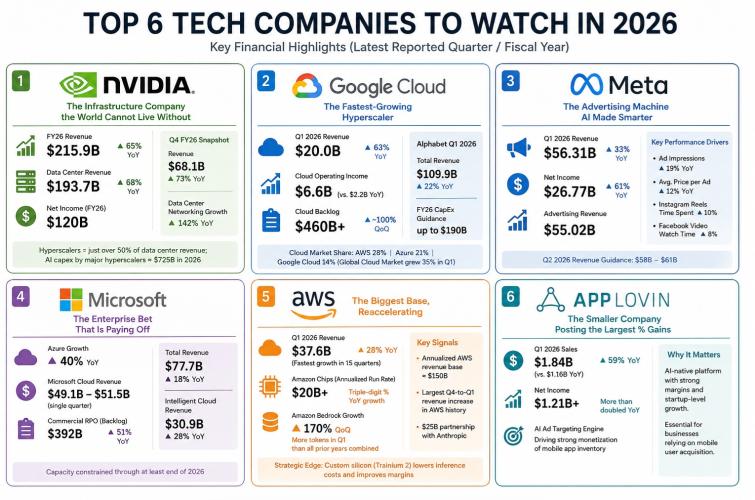
For Nvidia’s full fiscal year 2026, the company posted $215.9 billion in total revenue, up 65% from the prior year.
Data centre revenue alone reached $193.7 billion, growing 68% year over year, and in Q4 alone the company booked $68.1 billion in revenue, a 73% annual increase. Net income for the full year hit $120 billion.
These are not chip company numbers. They are what happens when one manufacturer becomes the gating factor for the most consequential infrastructure build in corporate history.
The Blackwell platform drove the acceleration, with data center networking revenue surging 142% as companies scaled their GPU clusters with NVLink interconnects.
Hyperscalers — Microsoft, Google, Amazon, Meta — accounted for just over half of data center revenue, but the other half came from enterprise customers, sovereign AI projects, and model builders, a diversification that matters because it shows the dependency is structural rather than concentrated.
For any business evaluating where to deploy technology budgets, the practical signal from Nvidia’s numbers is that the companies buying the most compute are winning the most customers.
The infrastructure race is not slowing; combined AI capital expenditure across the major hyperscalers is now tracking approximately $725 billion for 2026, up from earlier estimates of around $670 billion.
2. Google Cloud: The Fastest-Growing Hyperscaler, and It’s Not Close
Alphabet’s Q1 2026 results were striking for one reason above all others. Google Cloud grew 63% year over year to $20 billion in a single quarter, outpacing Microsoft Azure at 40% and Amazon AWS at 28%.
Cloud operating income rose from $2.2 billion to $6.6 billion in the same period. And the company’s Cloud backlog nearly doubled quarter on quarter to over $460 billion — that is contracted future revenue, not a projection.
Alphabet’s total Q1 revenue reached $109.9 billion, up 22% year over year, its fastest pace in two years. Full-year capital expenditure guidance was raised to as much as $190 billion, almost entirely directed at AI infrastructure.
The competitive dynamic here deserves attention. AWS still leads on market share at 28%, Azure sits at 21%, and Google Cloud holds 14% of a global market that itself grew 35% in Q1.
But Google is now adding more net new cloud revenue per quarter than AWS, on a base half AWS’s size.
Enterprise customers are signing multi-year contracts to access Google’s TPU infrastructure and Gemini API for model training workloads, and those contracts are showing up in a backlog figure that has basically no precedent in the company’s history.
For businesses selecting a cloud partner, the question used to be whether Google Cloud was mature enough. The Q1 results suggest that question is no longer relevant.
3. Meta: The Advertising Machine AI Made Smarter
Meta reported Q1 2026 revenue of $56.31 billion, up 33% year over year from $42.3 billion, its fastest quarterly growth since 2021. Net income reached $26.77 billion, up 61%.
Advertising revenue was $55.02 billion, driven by a 19% increase in ad impressions and a 12% increase in average price per ad.
What makes Meta’s numbers interesting is the mechanism behind them. More than 8 million advertisers are now using at least one of Meta’s generative AI creative tools.
Advertisers using video-generation features are seeing more than 3% higher conversion rates in tests. Instagram Reels time spent increased 10% in Q1 following ranking improvements, and Facebook’s total video watch time rose more than 8% globally, the largest quarter-on-quarter gain in four years.
User engagement is rising because AI is surfacing better content; better content drives more time on platform; more time on platform commands higher ad prices.
This is the advertising flywheel running at speed, and it explains why both volume and pricing metrics are moving upward simultaneously — a signal analysts describe as the clearest sign of advertising health possible.
Mark Zuckerberg has guided Q2 2026 revenue to $58 to $61 billion. The company’s full-year expense guidance was maintained at $162 to $169 billion, most of which is AI infrastructure investment that, unlike some competitors, is already demonstrably paying off in core business metrics.
4. Microsoft: The Enterprise Bet That Is Paying Off
Azure grew 40% year over year in Microsoft’s most recently reported quarter, contributing to Intelligent Cloud revenue of $30.9 billion, up 28%. Microsoft Cloud revenue crossed $50 billion in a single quarter for the first time, reaching $51.5 billion at one point and $49.1 billion in Q1.
Total revenue was $77.7 billion, up 18%, and the company’s commercial remaining performance obligation — the contracted backlog of future work — jumped 51% to $392 billion.
Microsoft’s growth story is somewhat different from Google’s or Meta’s because the mechanism is less about raw infrastructure and more about enterprise software lock-in.
Copilot is beginning to show up in segment numbers. Azure’s 40% growth is being partially constrained by supply, with the company acknowledging it expects to remain capacity-constrained through at least the end of 2026.
That is a high-class problem, but it is a real one — revenue that could be booked is being deferred because the data centers are not yet built.
The backlog number is what matters most for businesses evaluating Microsoft as a long-term partner. $392 billion in contracted revenue is not a quarterly headline; it is a decade’s worth of enterprise relationships already committed on paper.
5. Amazon Web Services: The Biggest Base, Reaccelerating
AWS posted $37.6 billion in Q1 2026 revenue, up 28% year over year — the service’s fastest growth in 15 quarters. Amazon’s own chips business crossed a $20 billion annualised revenue run rate, growing at triple-digit percentages year over year.
Amazon Bedrock, the company’s managed AI model service, processed more tokens in Q1 2026 than in all prior years combined. Customer spend on Bedrock grew 170% quarter on quarter.
The 28% growth figure understates the momentum because AWS is running on an annualised revenue base now approaching $150 billion.
Adding 28% to that base means AWS generated more absolute cloud revenue in Q1 than Google Cloud’s entire business. The sequential add of $2 billion was the largest Q4-to-Q1 increase in AWS history.
Amazon’s strategic differentiation is its custom silicon. By training inference workloads on Trainium 2 chips rather than Nvidia GPUs, Amazon is lowering the cost of AI inference for customers while improving margins.
The Anthropic partnership, a $25 billion commitment, puts one of the leading AI labs exclusively on AWS infrastructure — a relationship that gives Amazon a credibility signal in the enterprise AI market that has no direct equivalent.
6. AppLovin: The Smaller Company Posting the Largest Percentage Gains
Not every company in this group is a household name. AppLovin, the mobile advertising and software platform, posted Q1 2026 sales of $1.84 billion, up from $1.16 billion a year earlier, with net income more than doubling to $1.21 billion.
The company’s AI-driven ad targeting engine has proven extraordinarily effective at monetizing mobile app inventory, and the conversion of that technology into recurring software revenue is giving AppLovin the margin profile of a software company with the growth rate of a startup.
AppLovin’s trajectory matters for business decision-makers because it illustrates the category of company that tends to be underweighted in technology platform conversations: the specialist AI-native platform that solves a narrow problem exceptionally well and generates substantial financial returns doing it.
For businesses that depend on mobile user acquisition, AppLovin has become difficult to ignore.
What It All Adds Up To
The FactSet earnings data for Q1 2026 shows the technology sector’s blended earnings growth rate at 27.7%, the highest among all S&P 500 sectors and more than double the second-best performer.
Analysts are forecasting earnings growth rates of 20.5%, 23.6%, and 21.1% for Q2 through Q4 2026, respectively. The Information Technology and Communication Services sectors led all S&P 500 sectors in year-over-year revenue growth for Q1.
The pattern across all six companies above is the same: AI is either directly generating revenue or making existing revenue-generating activities more efficient.
The companies growing fastest are the ones that have embedded AI deepest into their core product loops, whether that is a cloud database, an advertising auction, or a mobile attribution model.
There is a legitimate concern embedded in all of this, which is whether $725 billion in combined AI capital expenditure can generate sufficient returns to justify the investment.
Dan Kemp of Portfolio Thinking told CNBC that investors have gone from finding it hard to believe these companies could grow at these rates to finding it hard to believe they won’t. That shift in expectations is worth paying attention to — it is usually where cycles turn.
But for now, the numbers say what they say. For any business deciding which technology companies to build on, partner with, or evaluate for enterprise contracts in 2026, the list above is where the momentum sits.