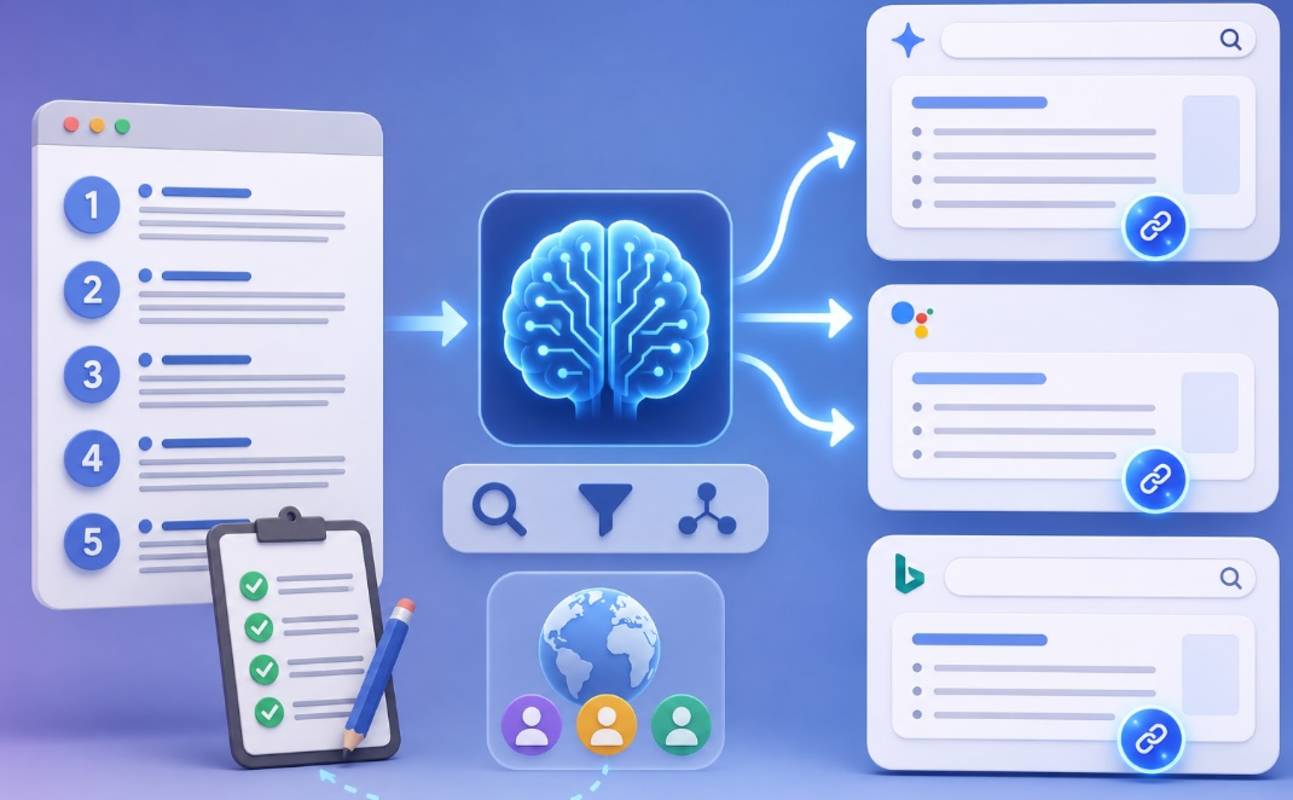
AI search is changing how people discover content online.
Instead of showing users a list of blue links, platforms like Google, OpenAI, Microsoft, and Perplexity AI now generate direct answers using information pulled from websites across the internet.
This means your content no longer needs to rank number one to gain visibility.
It needs to be easy for AI systems to understand, extract, summarise, and cite.
One of the most effective content formats for this new era is the simple, direct-answer listicle.
Here’s why it works — and how to structure content that AI search engines are more likely to reference.
What AI Search Engines Want From Content
AI search systems are designed to answer questions quickly and clearly.
That means they favour content that is:
- Easy to scan
- Clearly organised
- Directly relevant to the question
- Written in plain English
- Structured with headings and lists
- Focused on one topic
- Free from unnecessary filler
Traditional SEO often rewarded:
- lengthy introductions,
- keyword stuffing,
- and overly complicated writing.
AI search rewards clarity instead.
If an AI model can instantly identify:
- the question,
- the answer,
- the supporting points,
- and the structure,
your chances of being cited increase significantly.
Why Listicles Perform So Well in AI Search
Listicles naturally align with how AI systems process information.
A numbered structure creates predictable formatting that is easy for language models to parse and summarise.
Poor Structure
A long wall of text explaining multiple ideas at once.
Better Structure
7 Reasons Simple Content Gets Cited in AI Overviews
- Clear headings
- Short paragraphs
- Direct answers
- Keyword relevance
- Structured formatting
- Easy extraction
- Strong topical focus
AI systems can immediately understand:
- the topic,
- the hierarchy,
- and the key takeaways.
That makes listicles ideal for AI-generated summaries.
How AI Overviews Extract Information
AI Overviews generally work by:
- Understanding the search query
- Finding relevant web pages
- Extracting concise answer sections
- Combining multiple sources into a summary
- Linking to cited sources
If your article contains:
- a direct question,
- followed immediately by a clear answer,
- supported by bullet points,
your content becomes much easier to cite.
The Best Content Structure for AI Citations
Here is a structure that works well for both readers and AI systems.
1. Start With the Direct Answer
Many websites spend hundreds of words building up to the answer.
AI systems prefer pages that answer immediately.
Example
Question
How do listicles improve AI search visibility?
Direct Answer
Listicles improve AI search visibility because they organise information into clear sections that AI systems can easily extract, summarise, and cite in AI-generated answers.
This structure improves clarity and topical relevance.
2. Use Clear Heading Hierarchies
Use:
- H1 for the main topic
- H2 for major sections
- H3 for supporting points
Strong heading structures help AI models understand relationships between ideas.
Example
Main Topic
Why AI Search Prefers Structured Content
- Short Paragraphs Improve Readability
- Lists Improve Information Extraction
- Direct Answers Increase Citation Potential
This hierarchy improves machine readability.
3. Keep Paragraphs Short
Large text blocks are harder for both humans and AI systems to process.
Best practice includes:
- 1–3 sentence paragraphs
- Simple wording
- One idea per paragraph
Instead of This
“Content creators attempting to maximise visibility in emerging AI-powered search interfaces should strongly consider restructuring their informational architecture…”
Write This
“AI search engines prefer content that is easy to scan and summarise.”
Simple writing performs better.
4. Match Search Intent Exactly
AI search engines prioritise pages that closely answer the user’s query.
That means your headings should align directly with common searches.
Good Examples
- “How AI Overviews Choose Sources”
- “Why Listicles Perform Well in AI Search”
- “Best Content Structure for AI Citations”
- “How to Write AI-Friendly Articles”
These headings closely mirror real user searches.
5. Use Lists and Bullet Points Frequently
Lists are highly AI-friendly.
They:
- separate ideas clearly,
- improve extraction,
- reduce ambiguity,
- and create structured information.
Example
Key Elements of AI-Friendly Content
- Clear headings
- Short answers
- Bullet points
- Topical relevance
- Simple language
- FAQ sections
- Consistent formatting
This is much easier for AI systems to summarise than dense paragraphs.
6. Add FAQ Sections
FAQ sections are extremely valuable for AI search optimisation.
They mirror how people naturally search online.
Example FAQ
What type of content gets cited in AI Overviews?
Content that is:
- well-structured,
- highly relevant,
- easy to summarise,
- and written in plain English
is more likely to appear in AI-generated answers.
Do longer articles perform better?
Not necessarily.
Clear, useful, structured content often outperforms longer but less focused articles.
7. Focus on One Topic Per Article
AI systems reward topical clarity.
Trying to cover too many unrelated ideas weakens relevance.
Better Approach
Create:
- one article about AI Overviews,
- another about AI SEO,
- another about structured content,
- and another about answer-engine optimisation.
Strong topical focus improves extraction accuracy.
Why Simplicity Is Becoming a Competitive Advantage
Many websites still write for older SEO systems.
They:
- overcomplicate language,
- add unnecessary filler,
- bury the answer,
- and prioritise word count over usefulness.
AI search changes this.
The clearest answer often wins.
That means smaller publishers can now compete with larger websites if their content is:
- more direct,
- more organised,
- and easier for AI systems to process.
Example of an AI-Friendly Article Layout
Here is a simple structure that performs well.
Title
How to Optimise Content for AI Overviews
Introduction
Provide the direct answer in 2–3 sentences.
Main Sections
- What AI Overviews Are
- How AI Systems Extract Content
- Best Formatting Practices
- Why Listicles Work
- Common Mistakes to Avoid
FAQ Section
Answer common search queries directly.
Conclusion
Summarise the key takeaways simply and clearly.
This structure improves:
- readability,
- indexing,
- extraction,
- and citation potential.
Common Mistakes That Reduce AI Citations
1. Long Introductions
Answer the question immediately.
2. Keyword Stuffing
Use natural language instead.
3. Weak Structure
Use headings consistently.
4. Large Paragraphs
Keep content scannable.
5. Covering Too Many Topics
Stay tightly focused.
6. Vague Headlines
Match genuine search intent.
The Future of SEO Is AI Readability
SEO is evolving into something closer to:
- answer optimisation,
- information extraction,
- and machine readability.
The websites most likely to succeed will create content that is:
- useful,
- direct,
- structured,
- and easy to summarise.
Simple listicles achieve this exceptionally well.
That is why they are increasingly appearing inside AI-generated search experiences.
Final Thoughts
If you want your content cited in AI search results and AI Overviews:
- Answer questions directly
- Use strong headings
- Keep formatting simple
- Write short paragraphs
- Add bullet points
- Match search intent closely
- Stay highly topical
- Prioritise clarity over complexity
The easier your content is to understand, the easier it is for AI systems to cite.
And in the age of AI search, clarity is quickly becoming one of the most valuable SEO advantages available.