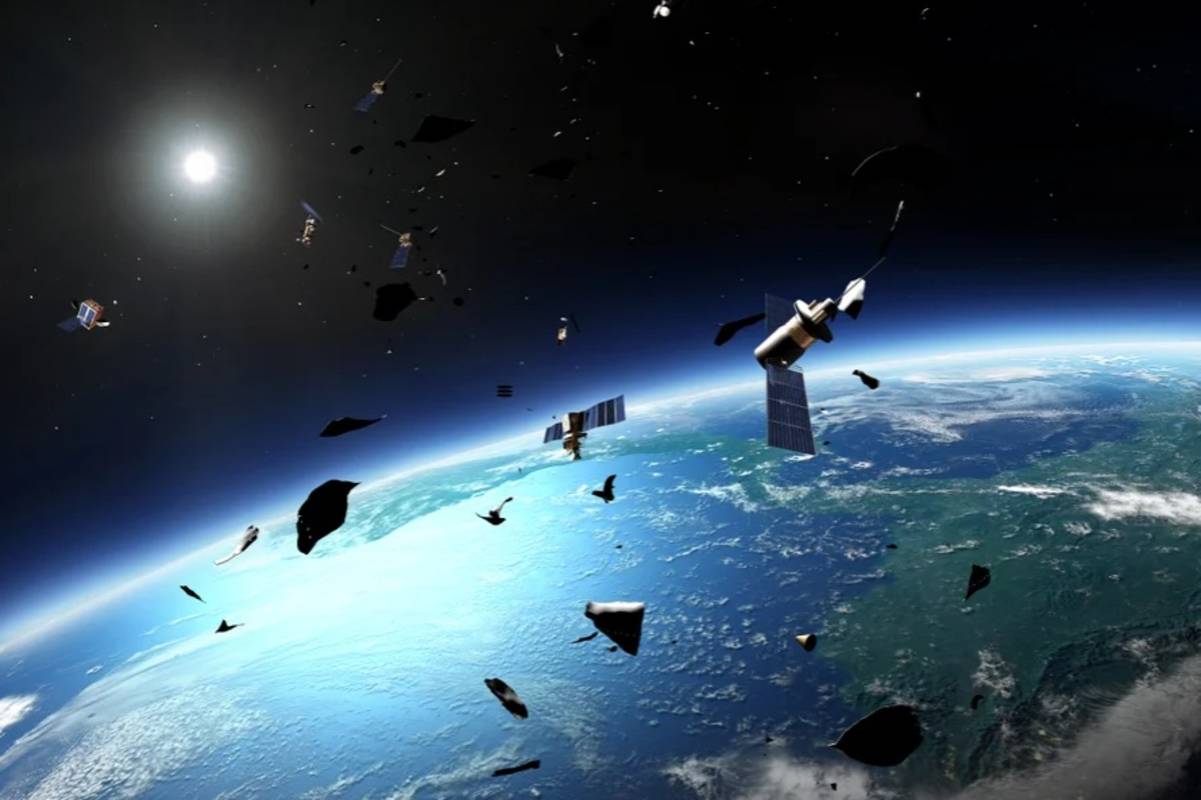


For decades, space was often imagined as an endless frontier — vast, empty and full of opportunity. But today, Earth’s orbit is becoming increasingly crowded with something far less inspiring: space junk.
What was once a manageable issue has now evolved into a growing engineering and safety crisis.
What is Space Junk?
NASA defines space junk, or orbital debris, as “any human-made object in orbit that no longer serves a useful purpose, including spacecraft fragments and retired satellites.
Space debris is generated by the breakup of spent rocket bodies, satellite explosions, dead spacecraft, orbital collisions, paint flakes and even tools accidentally lost by astronauts.
Millions of these objects travel at speeds exceeding 18,000 mph, creating a serious collision risk for operational satellites and other spacecraft in low Earth orbit (LEO)
Around 85% of space junk (debris) is concentrated in low-Earth orbit, below 2,000 kilometres in altitude.
NASA estimates there are roughly 34,000 debris objects larger than 10 centimetres, 900,000 pieces between 1 centimetre and 10 centimetres, and more than 128 million fragments measuring between 1 millimetre and 1 centimetre.
Despite their small size, even tiny fragments can cause catastrophic damage when travelling at extreme orbital speeds.
The challenge is compounded by the fact that debris smaller than 10 centimetres cannot currently be tracked by existing surveillance systems.
One of the greatest long-term dangers is self-propagation, where collisions generate even more debris, increasing the risk of cascading orbital impacts.
Current Orbital Tracking
Thousands of inactive satellites, shattered rocket parts and high-speed debris fragments are circling the planet at extraordinary velocities, creating an environment where even a tiny object can destroy a spacecraft in seconds.
The numbers reveal just how serious the situation has become.
Nearly Half of All Tracked Objects Are Space Junk
According to the Accu Orbital tracking report, 33,269 objects are being monitored in Earth’s orbit. Of those, 17,682 are classified as payloads, meaning satellites. Another 2,396 are rocket bodies, while 12,550 are debris fragments and 641 remain unassigned.
That means almost 47% of all tracked objects in orbit are already considered space junk. And in reality, the problem is likely even worse.
Many satellites still listed as payloads are no longer operational. Some have lost communication entirely, while others are effectively uncontrollable.
So although they may not technically be classified as debris, they still contribute to the growing congestion surrounding Earth.
This rise in orbital clutter is forcing engineers to rethink spacecraft design from the ground up.
Modern satellites now require stronger shielding, greater impact tolerance and more robust protective systems because even a fragment only a few millimetres wide can cause catastrophic damage at orbital speeds.
The Biggest Danger Isn’t Always the Largest Object
When people imagine dangerous space debris, they often picture abandoned rockets or dead satellites drifting through space. In reality, the greatest threat often comes from the smallest fragments.
Large objects such as rocket bodies are relatively easy to track and avoid. Smaller debris pieces are a very different challenge. They are harder to detect, travel at extreme speeds and are far more likely to collide with operational spacecraft.
To better understand the scale of this risk, comparing active satellites to debris fragments paints a clearer picture. Current Space-Track data shows there are 12,550 tracked debris objects compared with 17,682 payloads.
In practical terms, that means for every 10 satellites in orbit, there are roughly seven tracked debris fragments sharing the same environment.
And those are only the objects large enough to monitor reliably. Millions of smaller particles are believed to exist beyond current tracking capabilities.
As launch activity accelerates and mega-constellations continue expanding, experts expect this ratio to worsen.
More satellites entering orbit means more opportunities for collisions, break-ups and fragmentation events, while debris removal technology still lags behind the speed at which new junk is being created.
A Small Number of Nations Account for Most Debris
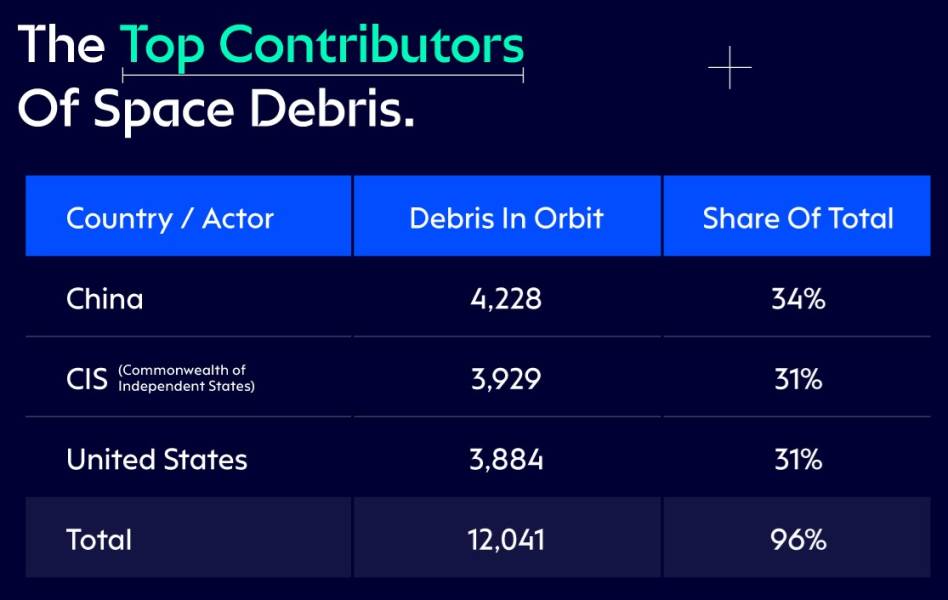
Space debris is not distributed evenly among spacefaring nations. In fact, three major actors account for the overwhelming majority of tracked debris currently in orbit.
Out of the 12,550 debris objects being monitored, 12,041 are attributed to China, the CIS and the United States — together accounting for 96% of all tracked debris.
China’s contribution is heavily linked to the 2007 anti-satellite (ASAT) missile test, widely regarded as one of the most destructive debris-generating events in space history. The test shattered a satellite into thousands of fragments, many of which remain in orbit today.
The CIS contribution reflects decades of Soviet-era and post-Soviet launch activity accumulated over generations of space operations.
Meanwhile, the United States’ figure is tied not only to its long history of launches but also to the infamous 2009 collision between the inactive Russian satellite Kosmos 2251 and the operational Iridium 33 communications satellite.
That collision produced thousands of debris fragments in an instant, scattering hazardous material across orbital paths that will remain dangerous for decades. Even now, more than ten years later, hundreds of fragments from both satellites are still circling Earth.
Who’s Investing In Space Debris Removal?
Governments And Space Agencies
- European Space Agency (ESA): The most active global investor, leading the Space Safety Programme and funding ClearSpace-1, which is the world’s first active debris removal mission.
- UK Space Agency: Supporting ESA programmes and funding national initiatives, including partnerships with debris removal companies.
- JAXA (Japan): Investing heavily in debris removal missions, including contracts for large object removal.
- NASA and the US Department Of Defense: Focusing on tracking systems and on-orbit servicin
The Technology Being Developed To Tackle Space Debris
A growing range of Active Debris Removal technologies are being developed to clean up Earth’s crowded orbit.
Robotic Arms & Nets
Satellites designed to capture and deorbit large debris objects.
Electrodynamic Tethers
Uses Earth’s magnetic field to slowly drag debris from orbit.
Drag Sails
Large deployable sails that accelerate orbital decay.
Harpoons
Designed to tether and remove large debris in orbit.
Laser Ablation
Lasers alter debris trajectories using small thrust forces.
Magnetic Capture
Magnetic docking systems used to secure debris objects.
Reducing Future Debris
Passivation
Preventing satellite explosions at end-of-life.
Deorbit Rules
New regulations pushing faster satellite re-entry.
Sustainable Materials
Components designed to fully burn up on re-entry.
Cleaning Space Junk
Cleaning space requires designing and implementing active debris removal (ADR) projects. ADR vehicles can be equipped with robotic arms, nets, collecting balloons and other tools. Earth-based lasers might also increase the atmospheric drag of debris, as another option.
The Future of Spacecraft Design Will Depend on Solving The Space Junk Problem
The space debris crisis is no longer simply an environmental concern. It has become a serious technical and operational challenge that is reshaping the future of spacecraft engineering.
As orbit becomes more crowded, every new mission faces greater risks. Engineers now have to design satellites capable of surviving in an increasingly hostile environment where collisions, even with microscopic debris, are a constant possibility.
That means every design decision matters — from materials and structural durability to shielding systems and orbital manoeuvrability.
At the same time, the industry is responding. Investment in debris monitoring, collision avoidance systems and active debris removal technologies is growing rapidly.
Researchers and aerospace companies around the world are developing innovative ways to reduce long-term orbital congestion and make space operations more sustainable.
The challenge ahead is enormous, but so is the opportunity for innovation.
Space debris has become one of the defining problems of the modern space age. How humanity responds to it will shape not only the safety of future satellites, but the future of space exploration itself.