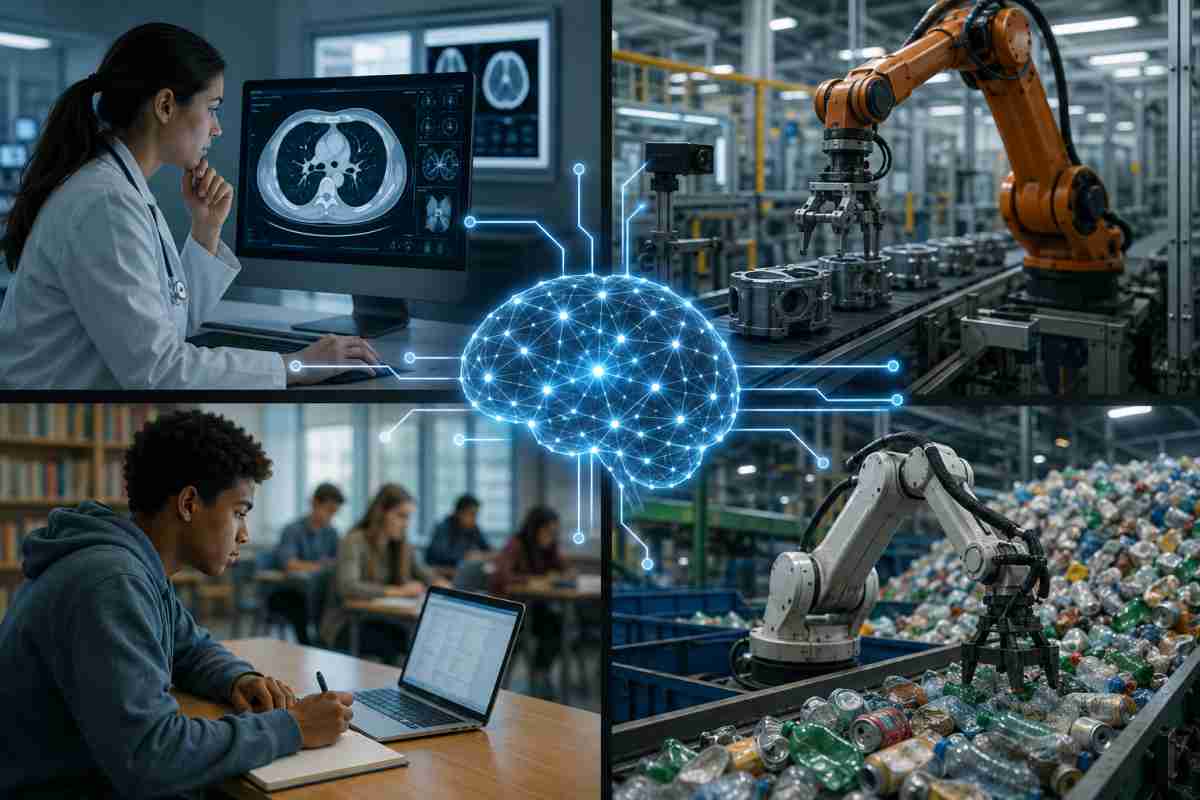
Artificial intelligence (AI) is no longer a future-facing technology sitting inside research labs. It is now being used in doctor’s offices, classrooms, factories, recycling plants, semiconductor research facilities and government departments.
The real shift is not just that AI can generate text, images or code. The bigger change is that AI systems are now being connected to daily decision-making, physical infrastructure and professional workflows.
That makes the technology more useful, but also more difficult to manage.
Across industries, AI is being used to detect disease, support teachers, predict machine failures, sort waste, discover new semiconductor materials, analyse risk, automate service desks and assist with policy planning.
At the same time, it is raising hard questions about bias, privacy, security, accountability and whether people can understand how an AI system reached its answer.
The promise is large. So are the risks.
What Are AI Applications Across Industries?
AI applications across industries refer to the practical use of artificial intelligence systems in different sectors, including healthcare, education, manufacturing, recycling, finance, government, transport, agriculture, cybersecurity and scientific research.
In simple terms, AI is used to help computers perform tasks that usually require human intelligence.
Tasks can include learning from data, recognising patterns, understanding language, interpreting images, making predictions, recommending actions and generating new content.
The most common AI technologies used across industries include:
- Machine learning, where systems learn patterns from data and improve performance over time.
- Generative AI, which can create text, images, audio, video, code and synthetic data.
- Computer vision, which allows systems to analyse images, video and visual environments.
- Natural language processing, which helps machines understand and generate human language.
- Robotics and AI, where intelligent software is combined with physical machines.
- Predictive analytics, which uses historical and real-time data to forecast outcomes.
- Interpretable and explainable AI, which aims to make AI decisions more understandable.
The strongest AI use cases are usually not the flashy ones. They are the applications that reduce repetitive work, find patterns humans miss, support better decisions and improve safety
AI Fundamentals: What Artificial Intelligence Actually Means
Artificial intelligence is often described as simulated human intelligence, but that phrase can be misleading. AI does not think, reason or understand the world in the same way a person does.
It processes data, identifies patterns and produces outputs based on mathematical models.
AI systems can appear intelligent because they perform tasks linked to human cognitive processes, such as language, perception, classification, prediction and decision-making.
However, they do not have human judgement, intent, experience or moral responsibility.
That distinction matters.
A generative AI tool may write a convincing explanation of a medical condition, a legal policy or a university assignment. But fluency is not the same as accuracy.
A machine learning system may identify cancer risk in medical imaging, but it still needs clinical validation, monitoring and human oversight.
For businesses, universities and public agencies, AI literacy is now becoming essential. Staff do not need to become data scientists, but they do need to understand what AI can do, what it cannot do and when its outputs need to be questioned.
AI in the Doctor’s Office
AI in the doctor’s office is one of the clearest examples of how artificial intelligence is moving from back-end analysis into daily professional work.
In healthcare, AI is being used for:
- Medical imaging analysis
- Clinical documentation
- Triage and risk scoring
- Patient communication
- Drug discovery
- Remote monitoring
- Hospital workflow optimisation
- Predictive modelling for disease risk
- Administrative automation
One of the most visible applications is ambient clinical documentation. These tools listen to the consultation, generate draft notes and help reduce the time doctors spend typing after an appointment.
In theory, that gives clinicians more time to focus on the patient. In practice, it also creates new questions about consent, accuracy, privacy and clinical liability.
AI-enabled medical devices are also expanding. Some tools help detect signs of disease in scans or test results. Others support surgical navigation, heart monitoring, eye screening and radiology workflows.
Those systems can be valuable, but they need strong evaluation because errors in healthcare can directly affect patient safety.
The most responsible use of AI in healthcare is not replacing doctors. It is supporting doctors with better information, faster analysis and less administrative burden.
Where AI Is Useful in Healthcare
AI works best in healthcare when it supports pattern recognition and routine workflow tasks. For example, an AI system can scan thousands of medical images for signs of abnormality, flag high-risk cases for review or help summarise patient records before a consultation.
It can also help with patient access. Chatbots and virtual assistants can answer basic questions, send appointment reminders and guide patients through pre-visit forms. Used properly, this reduces pressure on front-desk staff and gives patients faster information.
However, AI in healthcare must be held to a higher standard than AI used for general office productivity. A hallucinated answer in a chatbot is annoying. A false negative in a medical setting can be dangerous.
AI in Manufacturing
Manufacturing is one of the strongest areas for industrial AI because factories produce large volumes of machine, sensor, quality and supply-chain data.
AI in manufacturing is commonly used for:
- Predictive maintenance
- Quality control
- Demand forecasting
- Supply-chain planning
- Computer vision inspection
- Energy optimisation
- Warehouse automation
- AI-powered robotics
- Worker safety monitoring
- Production scheduling
Predictive maintenance is one of the most practical examples. Instead of waiting for a machine to fail, AI can analyse sensor data and detect early signs of wear, heat, vibration or performance drift. That allows maintenance teams to repair equipment before it causes downtime.
Quality control is another major use case. AI-powered computer vision systems can inspect products for defects at speeds that human inspectors cannot match.
AI-powered robotics is also changing the factory floor. Traditional automation follows fixed instructions. AI-enabled robots can adapt to changing environments, recognise objects, adjust movement and work more safely around people.
Robots and AI: Why Intelligent Automation Is Different
Robots and AI are often discussed as the same thing, but they are different technologies.
A robot is a physical machine that performs tasks. AI is the software that can help the machine interpret data, learn patterns or make decisions.
When the two are combined, robots become more flexible.
For example, an industrial robot without AI may repeat the same welding motion thousands of times. An AI-enabled robot can use computer vision to identify part variations, adjust its movement and detect when something is out of place.
In warehouses, AI-driven robots can navigate around people, shelves and moving objects. In agriculture, robots can identify weeds, monitor crops or support precision spraying. In healthcare, robotic systems can assist with surgery, logistics and rehabilitation.
The common thread is adaptability. AI gives robots more ability to respond to the real world instead of only following a fixed program.
AI-Driven Semiconductor Materials Discovery
AI-driven semiconductor materials discovery is becoming an important frontier as countries compete to build stronger chip supply chains.
Semiconductors depend on advanced materials with specific electrical, optical and thermal properties. Finding those materials has traditionally required slow laboratory testing, trial-and-error experimentation and expensive simulation.
AI can speed up that process by analysing chemical structures, predicting material properties and narrowing the list of candidates before physical testing begins.
This is particularly relevant for:
- New chipmaking chemicals
- Quantum materials
- Optoelectronic materials
- Gallium-based semiconductor materials
- Metal phosphide semiconductors
- Indium phosphide production
- Advanced packaging materials
- Battery and magnet materials
- Alternatives to restricted or environmentally problematic substances
Indium phosphide is one example of a material attracting attention because of its use in photonics, high-speed electronics, lasers and optical communications.
AI can’t magically solve production constraints, but it can help researchers explore alternative compounds, improve synthesis methods and identify materials with useful properties earlier.
The wider trend is clear: AI is becoming a research accelerator. It helps scientists search larger chemical spaces and test more possibilities before committing to expensive lab work.
AI in Recycling and Waste Sorting
Recycling is another industry where AI is moving from theory into physical operations.
Modern recycling facilities deal with mixed waste streams, contamination, inconsistent materials and labour shortages. AI can help by using computer vision, sensors and robotics to identify and sort materials more accurately.
AI in recycling can be used for:
- Identifying plastics, metals, paper, glass and textiles
- Detecting contamination in waste streams
- Improving robotic sorting
- Measuring material recovery rates
- Analysing municipal waste patterns
- Reducing recyclable material sent to landfill
- Supporting circular economy reporting
- Improving safety in sorting facilities
The challenge with recycling is that waste is messy. Items are crushed, dirty, torn, mixed or partly hidden. A plastic bottle in a recycling bin does not look like a clean product photo in a database.
That is why advanced systems often combine several technologies. Computer vision may identify the shape of an object, while infrared or multispectral imaging helps classify the material. A robot can then pick the item from a conveyor belt and place it into the correct stream.
AI will not fix recycling on its own. Poor product design, weak collection systems and public confusion still matter. But AI can improve sorting efficiency and help recover materials that would otherwise be lost.
AI Implementation in Education
AI implementation in education is moving quickly, particularly in higher education and campus environments.
Universities, schools and training providers are using AI for:
- Admissions process support
- Student services chatbots
- Campus infrastructure management
- Learning analytics
- Personalised learning
- Language translation
- Content and syllabus creation
- Grading support
- Virtual assistants
- Research support
- Accessibility tools
- Timetable and resource planning
Generative AI has made this shift more visible. Students use AI tools to brainstorm, summarise, translate, draft, code and study. Instructors use them to develop teaching materials, design quizzes, generate examples and reduce administrative work.
The strongest education use cases are those that support learning rather than replace it.
AI can help explain a concept in different ways, provide practice questions, translate course material or help students organise their notes. But it can also create shortcuts that weaken learning if students outsource the thinking entirely.
That is why education institutions need more than a list of approved tools. They need a clear AI policy framework covering assessment, privacy, academic integrity, accessibility, staff training and appropriate use.
AI Use and Policies in the Classroom
AI classroom use and policies are now central to teaching and learning.
A useful classroom policy should explain:
- When students may use AI tools
- Which AI tools are allowed
- Whether AI use must be disclosed
- How students should cite or describe AI assistance
- What counts as misconduct
- How privacy and personal data should be protected
- Whether AI can be used for brainstorming, editing, coding or translation
- Whether AI outputs can be submitted as final work
- How teachers will assess process, not just final answers
Blanket bans are becoming harder to enforce because AI is being built into search engines, writing tools, learning platforms, coding software and productivity suites.
The better approach is discipline-specific guidance. A journalism class, engineering subject, nursing course and computer science unit will not use AI in the same way. Each needs clear expectations linked to learning outcomes.
Teaching With Artificial Intelligence
Teaching with artificial intelligence should not mean handing the class over to a chatbot.
Used well, AI can support teachers by helping with lesson planning, examples, rubrics, translation, formative feedback and differentiated learning. It can also help students ask better questions and revise their work.
Used badly, it can flood classrooms with generic output, weaken writing skills and create a false sense of mastery.
The key is to keep the human learning goal at the centre. Students should still be asked to explain their reasoning, show their process, defend their conclusions and understand the material behind the answer.
AI Policy and Regulation
AI policy and regulation are developing unevenly around the world.
Some governments are focusing on innovation and competitiveness. Others are placing stronger emphasis on consumer protection, privacy, safety and anti-discrimination rules.
In the United States, federal AI policy has moved toward accelerating innovation, building AI infrastructure and supporting national security priorities, while several states have developed their own rules for high-risk AI, training data transparency and algorithmic discrimination.
This creates a difficult compliance environment for companies. An AI tool used in hiring, education, healthcare, insurance or lending may trigger different obligations depending on where it is deployed, what data it uses and whether it affects a consequential decision.
Common policy issues include:
- Bias in AI
- Algorithmic discrimination
- Data privacy
- Training data transparency
- Copyright
- Cybersecurity
- AI safety testing
- Human review
- Explainability
- Procurement rules
- Disclosure when people interact with AI
- Federal and state AI legislation
- Guardrails around AI in public services
The regulatory question is no longer whether AI should be governed. It is how to govern it without freezing useful innovation or allowing harmful systems to operate unchecked.
AI Research and Standards
AI research and standards are becoming essential as AI systems move into critical sectors.
Standards help organisations define what “good” AI looks like. They can support measurement, testing, governance, documentation, risk assessment and accountability.
Important areas include:
- AI measurements
- Technical standards
- Benchmarks and evaluations
- AI-related evaluations
- Risk-based AI governance
- Test beds
- AI ethical guidelines
- AI risk management frameworks
- Trustworthy AI technologies
- Interpretable and explainable AI
- Continuous monitoring and updating
A risk-based approach is important because not all AI systems carry the same level of risk. An AI tool that recommends email subject lines does not require the same oversight as an AI system used in medical diagnosis, loan approval, student assessment or criminal justice.
For high-risk systems, organisations need documentation, validation, testing, post-deployment monitoring and clear accountability. They also need a plan for what happens when the system changes over time.
Why Test Beds Matter
Test beds give researchers, regulators and companies a controlled environment to evaluate AI before it is deployed in the real world.
This matters because AI systems can perform well in a lab but fail when exposed to messy, live conditions. A recycling robot may work on clean training samples but struggle with damaged packaging.
A medical AI model may perform well on one patient population but worse on another. A learning analytics tool may appear accurate until it is used with different student groups.
Test beds help expose these problems earlier.
They are especially important for manufacturing, healthcare, robotics, cybersecurity, education technology and critical infrastructure.
Ethics and Trust in AI
Ethics and trust in AI are not optional extras. They are central to adoption.
People are more likely to accept AI systems when they believe the technology is safe, fair, understandable and accountable. Trustworthy AI technologies need to be designed with governance from the start, not patched after deployment.
Key ethical concerns include:
- Bias in AI systems
- Unfair outcomes
- Lack of transparency
- Weak consent
- Data misuse
- Poor explainability
- Over-reliance on automation
- Loss of human judgement
- Security vulnerabilities
- Unclear accountability when errors occur
Bias in AI is one of the most serious issues. AI systems learn from data, and data often reflects existing social, economic and institutional inequalities. If that data is used without proper testing, the system can reproduce or amplify unfair outcomes.
Explainable AI is one response to this problem. It aims to make AI decisions easier for humans to understand. In some cases, that may involve showing which factors influenced a decision.
In others, it may involve documentation, model cards, audit logs or clearer explanations to affected users.
However, explainability alone is not enough. A system can be explainable and still be unfair. AI governance also needs testing, oversight, human review and the ability to challenge decisions.
Continuous-Monitor-and-Update Security Model
AI security cannot be treated as a one-off project.
A continuous-monitor-and-update security model is becoming more important because AI systems can change, degrade, be attacked or produce unexpected behaviour after deployment.
This model involves:
- Monitoring system performance
- Tracking model drift
- Testing for bias over time
- Reviewing security vulnerabilities
- Updating models when conditions change
- Logging AI decisions
- Auditing outputs
- Detecting misuse
- Managing third-party AI tools
- Reviewing data access
- Maintaining incident response plans
AI systems are not static software. Models can be updated, prompts can be manipulated, data pipelines can shift and users can discover unexpected ways to misuse tools.
For enterprise AI, this should sit alongside cybersecurity, privacy, legal, compliance and operational risk teams.
The Business Value of AI Across Industries
AI can create business value in several ways.
It can reduce manual work, increase speed, improve accuracy, support decision-making, lower downtime, personalise services and help organisations make better use of existing data.
In healthcare, that may mean faster documentation and better triage. In manufacturing, it may mean fewer breakdowns and higher-quality output.
In recycling, it may mean better material recovery. In education, it may mean more personalised support and faster administrative service. In semiconductor research, it may mean faster materials discovery.
But the return on AI depends on implementation quality.
Many AI projects fail because organisations buy tools before defining the problem. Others fail because data is poor, staff are not trained or governance is treated as an afterthought.
The most successful AI projects usually start with a specific problem, a measurable outcome and a clear understanding of risk.
How Organisations Should Prepare for AI Adoption
Organisations planning AI adoption should begin with five practical steps.
1. Build AI Literacy
Staff need to understand the basics of AI, machine learning, generative AI, data privacy, bias and responsible use. AI literacy should not be limited to technical teams.
2. Identify High-Value Use Cases
AI should be applied where it solves a real problem. Good candidates include repetitive workflows, large-scale document review, predictive maintenance, customer support, quality inspection and data analysis.
3. Create an AI Policy Framework
A strong policy framework should define acceptable use, data controls, procurement rules, human oversight, risk levels, documentation and escalation procedures.
4. Test Before Deployment
AI tools should be evaluated before use, especially in high-risk settings. Testing should include accuracy, bias, security, privacy and operational impact.
5. Monitor After Launch
AI systems need ongoing monitoring. Organisations should track performance, failures, complaints, security issues and changes in output quality.
What Makes AI Trustworthy?
Trustworthy AI is not just AI that works. It is AI that works reliably, safely and fairly in the setting where it is used.
A trustworthy AI system should be:
- Validated for its intended purpose
- Tested across relevant user groups
- Transparent enough for users to understand its role
- Secure against misuse
- Governed by clear human accountability
- Monitored after deployment
- Documented properly
- Designed to reduce unfair bias
- Able to be challenged or reviewed when it affects people
Trustworthy AI also requires honesty about limitations. No organisation should imply that an AI tool is more accurate, independent or intelligent than it really is.
The Future of AI Applications Across Industries
The next stage of AI adoption will be less about novelty and more about integration.
AI will become embedded into enterprise systems, medical devices, classroom platforms, manufacturing equipment, recycling infrastructure, government services and research workflows.
Users may not always open a separate AI tool. Instead, AI will sit inside the software and machines they already use.
That creates a new challenge. When AI becomes invisible, governance becomes harder.
Businesses and institutions will need to know where AI is being used, what data it touches, what decisions it influences and who is responsible when it goes wrong.
AI applications across industries will continue to expand because the technology is useful. But the winners will not simply be the organisations that adopt AI fastest.
They will be the ones that adopt it with discipline, evidence and trust.
Frequently Asked Questions
What are the main applications of AI across industries?
The main applications of AI across industries include healthcare diagnostics, clinical documentation, predictive maintenance, quality control, recycling automation, semiconductor materials discovery, student support, personalised learning, chatbots, cybersecurity, supply-chain planning and business process automation.
How is AI used in healthcare?
AI is used in healthcare for medical imaging, patient triage, clinical documentation, hospital workflow management, drug discovery, remote monitoring and AI-enabled medical devices. In the doctor’s office, AI can help draft clinical notes, summarise patient information and reduce administrative workload.
How is AI used in manufacturing?
AI is used in manufacturing for predictive maintenance, quality control, demand forecasting, supply-chain optimisation, robotics, computer vision inspection and production scheduling. It helps factories reduce downtime, improve consistency and respond faster to operational problems.
How is AI used in recycling?
AI is used in recycling to identify and sort materials such as plastic, glass, paper, metal and textiles. AI-powered computer vision, sensors and robotic systems can improve sorting accuracy, reduce contamination and increase material recovery.
How is AI used in education?
AI is used in education for personalised learning, content creation, grading support, chatbots, virtual assistants, translation, learning analytics, accessibility and student services. In higher education, AI is also being used to support research, admissions and campus operations.
What is generative AI?
Generative AI is a type of artificial intelligence that can create new content, including text, images, audio, video, code and synthetic data. It uses machine learning models trained on large datasets to generate outputs in response to prompts.
What is bias in AI?
Bias in AI occurs when an AI system produces unfair or inaccurate outcomes because of the data it was trained on, the way it was designed or the context in which it is used. Bias can affect hiring, education, healthcare, finance, policing and other high-impact decisions.
What is explainable AI?
Explainable AI refers to methods that make AI decisions easier for humans to understand. It can include model documentation, decision explanations, audit logs, feature importance reports and other tools that help users see why a system produced a certain output.
What are trustworthy AI technologies?
Trustworthy AI technologies are systems designed, tested and governed to be safe, fair, reliable, secure and accountable. They should be monitored after deployment and used with appropriate human oversight.
Why do AI standards matter?
AI standards matter because they help organisations measure, test, document and govern AI systems. Standards support safer deployment, stronger trust and clearer accountability, especially in high-risk industries.
Organisations Move From AI Trials To Core Integration
Encouragingly, many organisations are now looking beyond isolated AI trials and beginning to focus on deeper integration.
Over the next 12 to 24 months, the leading priority is embedding AI into core systems and business processes, cited by 32% of organisations. That places full integration ahead of expanding current AI use cases at 19% and continued experimentation at 17%.
Conclusion
AI applications across industries are becoming part of ordinary business, public service, education and research. The technology is already helping doctors, teachers, engineers, manufacturers, recyclers and scientists work faster and make better use of data.
But AI is not just another software upgrade. It changes how decisions are made, how work is organised and how responsibility is assigned.
The organisations that benefit most from AI will be those that treat it as both a technical system and a governance challenge.
They will invest in AI literacy, practical use cases, policy frameworks, standards, testing, explainability and continuous monitoring.
Artificial intelligence will keep spreading across industries. The real question is whether it is deployed in a way that improves human judgement or quietly replaces it with systems people do not understand.