Respona and Link Publishers both operate within the paid link-building industry, connecting businesses that want online placements with publishers willing to provide them.
While most of the marketing around these services is aimed at SEO agencies and website owners buying backlinks, the experience of the publishers supplying the websites is rarely given the same attention.
After listing several of my privately owned websites and completing orders through both services, Respona came out as the clear winner.
The difference was not based on the number of websites available or the sales pitch presented to buyers, but on support, communication and how quickly publishers were paid after completing the work.
What Respona and Link Publishers actually do
Although the two companies approach link building differently, both depend on relationships with publishers that can provide guest posts, niche edits, brand mentions or other forms of content placement.
Link Publishers operates as a self-service marketplace where advertisers can browse websites, compare SEO metrics and order placements.
The company says its platform connects businesses and agencies with more than 114,000 websites offering guest posts, niche edits, brand mentions and digital PR placements. Link Publishers describes its marketplace
Respona now presents itself as a managed, pay-per-result link-building service.
Buyers provide their landing pages, anchor text and preferred publisher requirements, while Respona handles the research, content and placement process through its network of website owners
For publishers, the underlying transaction is still similar. A website owner agrees to provide a placement at a nominated price, the platform finds the customer, collects the buyer’s payment and sends the order to the publisher for completion.
These platforms act as middlemen, advertising services and payment processors, although describing them as formal escrow providers would go further than their published terms support.
They hold the buyer’s money while the work is completed, then release an agreed amount to the publisher after the placement has been checked or approved.
Link building has grown into a major global business
The commercial stakes surrounding these platforms are becoming much larger as businesses continue pouring money into search visibility.
Mordor Intelligence estimates the worldwide SEO services market grew from US$74.9 billion in 2025 to US$83.98 billion in 2026, with the sector forecast to reach US$148.86 billion by 2031.
The market researcher says outcome-based SEO contracts are among the fastest-growing service models, with forecast annual growth of 18.4 per cent through to 2031.
That change helps explain why Respona moved away from relying mainly on software subscriptions and began charging customers for completed placements.
A separate State of Link Building survey conducted by Reporter Outreach questioned 500 SEO professionals during the first quarter of 2026.
It found 58 per cent had increased their link-building budgets compared with 2025, while only 14 per cent had reduced spending. 2
The same survey found 64% of respondents were spending at least US$3,000 a month on link building, while 38 per cent were spending US$6,000 or more.
Around 76% said they would pay at least US$300 for a high-quality link, including 31 per cent prepared to pay between US$500 and US$1,000.
Self funded guest posts were being used by 42.4% of the SEO professionals surveyed, while 42% used niche edits or link insertions.
Digital PR was rated as the best-performing approach by 34%, compared with 18% for guest posting and 14% for link insertions.
The figures come from an industry survey distributed partly through Reporter Outreach’s own client and partner network, so they should not be treated as a complete measurement of the global market.
They do, however, show why platforms connecting link buyers with publishers have become valuable businesses rather than small directories operating at the edge of the SEO industry.
The price of guest posts increased during 2026
Research published by competing content marketplace Adsy provides another view of the money moving through this industry.
After examining 52,671 websites in February 2026, Adsy calculated that the average advertised guest-post price had increased from US$427 in 2025 to US$459 in 2026, representing annual growth of 7.5%
The average niche edit or link insertion cost US$225, which was about 56% less than the average guest post.
Prices increased sharply among websites with a Domain Rating above 60, including a reported 46 per cent increase for websites in the DR 81 to 90 range.
Australian websites also attracted a sizeable premium. The study placed the average Australian guest-post price at US$632, around 38 per cent above the worldwide average, although the figures came from Adsy’s own marketplace inventory and should be read in that context.
One of the most revealing findings concerned the difference between what publishers asked and what buyers actually paid.
The average listed backlink price was US$929, while the typical completed transaction was closer to US$207 because buyers generally selected cheaper available websites.
That gap helps explain the pressure placed on publishers to reduce their prices, even when the platform or reseller may later sell the same placement at a higher amount.
It also shows why payment timing matters because these are no longer insignificant transactions, particularly for independent publications providing several placements each month.
How the marketplace pricing model works
Publishers generally nominate the amount they are prepared to accept for a guest post, niche edit or another placement.
The platform then earns money through a commission, processing charge, buyer-side margin or a broader price that may also include content, administration and support.
As a simple example, a publisher might agree to provide a placement for $100, while the buyer sees a final price of $120.
The platform keeps the difference for finding the customer, processing the order and managing the transaction, although that is only an example and should not be treated as the exact margin charged by either service.
Link Publishers currently advertises “No subscription · No markups ·
Pay only for what you order” to buyers. However, its terms also state that the company’s commission percentage may be changed at its discretion, which means publishers should check the amount displayed in their accounts rather than assume the buyer and seller always see the same price.
There is nothing unreasonable about a platform earning money from a transaction it helped create.
The problem begins when the publisher provides the website, accepts the commercial and SEO risk, completes the work and then has to wait an unnecessarily long time for money the platform has already collected.
Respona changed its business model as demand grew
Respona has gone through a significant change since it was known mainly as a self-service outreach tool.
In an August 2026 interview, co-founder Farzad Rashidi said the company had reached approximately US$2.5 million in annual recurring revenue after moving towards a managed, pay-per-placement model. Farzad Rashidi’s 2026 Respona interview
The figures were reported by Rashidi and have not been independently audited, but they provide some idea of how quickly the market is growing.
He said Respona had increased revenue by 400 per cent over the previous 12 to 18 months, was operating with a 20 per cent EBITDA margin and employed 15 full-time staff alongside contractors.
The change reportedly began in early 2025 when an agency customer questioned the cost of an US$800 monthly software licence but was willing to pay much more for completed results.
Respona then moved the software behind a managed service, built a publisher network and began charging according to the number and authority of completed placements.
Rashidi said one customer that initially spent between US$7,000 and US$8,000 a month later increased its spending substantially.
“That same customer still with us today and their spend has ramped up to about 65, 70k a month,” he said during an appearance on the SaaS Club podcast.
Respona’s change also explains why comparing the company directly with Link Publishers is not completely straightforward from a buyer’s perspective.
Linkpublishers.com remains heavily focused on self-service selection, while Respona increasingly sells the finished result and manages the work behind the scenes.
For publishers, however, both companies still need access to websites willing to host the content. The quality and reliability of those publisher relationships directly affect whether either business can deliver what it has sold.
Link Publishers is pushing deeper into AI-assisted link selection
Link Publishers has also expanded its services during 2025 and 2026, with the company promoting artificial intelligence as a way to reduce the time spent finding suitable pages for link insertions.
In July 2025, the company announced ReleVink AI, a tool that searches existing articles and recommends pages where a backlink could be inserted.
The system includes filters for country, authority score and whether the requested link will be DoFollow or NoFollow.
“Imagine getting highly relevant articles, keyword-based, for natural link placements in just a few seconds. That’s the power of ReleVink AI,” Link Publishers co-founder Het Balar said in a syndicated company announcement.
Balar said the tool could reduce a 40 to 45-minute manual search to several seconds, while the company claimed an overall research-time reduction of 95 per cent.
Those figures were supplied by Link Publishers as part of its product promotion rather than an independent assessment.
The company has also promoted internal research suggesting brands with strong backlinks appear more often in AI-generated answers.
That reflects a wider shift across the SEO industry, where services once marketed around Google rankings are now being sold as a route into ChatGPT
Google has urged website owners to be cautious about that argument.
Its current guidance says there is no special method required to appear in generative search and specifically warns that pursuing inauthentic mentions across websites may not provide the benefit marketers expect.
Respona provided better communication and support
In my experience, Respona offered much faster and more responsive support throughout the order process.
When a question or problem came up, there was a clear way to contact the Respona representative handling the request, which made it possible to discuss the job before a small issue turned into a dispute.
That direct communication matters because content placements are not always as simple as copying an article into WordPress and pressing publish.
A publisher may need clarification about the anchor text, destination URL, formatting, disclosure, content quality or whether the requested link fits the publication’s editorial rules.
The experience with Link Publishers was much more frustrating. Responses were slower, and messages submitted through its internal support system did not appear to produce a reply during the matters covered by this review.
If a buyer left a note saying there was a problem with a completed order, I could not contact that buyer directly to explain the issue or ask a question.
Communication had to go through the platform, yet attempts to reach the platform through its dashboard went unanswered, leaving manual email as the only practical way to seek guidance.
Link Publishers has a legitimate reason for preventing buyers and publishers from exchanging direct contact details because the restriction stops both sides from moving future transactions outside the platform.
Its terms expressly prohibit publishers and advertisers from sharing contact information, but that restriction makes reliable internal support even more important.
The company’s public FAQ says people with an unresolved concern should receive a response within 48 hours. That promise did not match my experience with the internal dashboard, which is why I found its support poor overall.
Other reviewers have also questioned Link Publishers support
My experience is not universal, and it would be unfair to suggest that everyone using Link Publishers has encountered the same problems.
The company held a Trustpilot score of 4.5 out of five from 109 reviews in August 2026, with 87 per cent awarding five stars and seven per cent awarding one star. Link Publishers reviews on Trustpilot
Many positive reviewers praised the size of the website inventory, the filtering system and the help they received from account managers.
That feedback sits in clear contrast with my experience and suggests the quality of support may depend on the account, contact method or staff member handling the request.
There has still been some published criticism.
A verified Trustpilot reviewer who gave the platform three stars said prices became less predictable after websites were added to favourites or placed in a shopping cart, eventually concluding that “pricing consistency became a major downside for me over time.”
Another one-star reviewer complained about rising prices and poor service, although the review contained little supporting detail.
Individual customer reviews cannot establish how a company operates across every account, but they are still relevant when similar concerns appear in a hands-on publisher review.
A February 2026 assessment published by SEO research website Xamsor was considerably more critical. It gave Link Publishers an overall score of 4.5 out of 10, ranked it 16th among 18 guest-post marketplaces and scored its support quality at two out of 10.
The reviewer praised the platform’s filters and interface but criticised masked website names, limited traffic data and what it described as non-responsive support.
Xamsor disclosed that its article may contain affiliate links, which readers should consider when weighing the review, but its support findings closely reflect what I experienced through the publisher dashboard.
The mixed feedback does not mean Link Publishers is fraudulent or that buyers will necessarily have a poor experience. It does show that a strong overall rating does not erase legitimate complaints about communication, price consistency or the way individual orders are handled.
Payment speed was the deciding issue
When someone requests a service or purchases a product at a clearly advertised price, the money should already be available to pay for it.
Unless delayed payment terms were agreed in advance, it is unprofessional and disrespectful to accept completed work and then announce that payment may arrive several days later or sometime the following week.
That principle becomes even harder to ignore when a platform has already taken payment from the customer.
Link Publishers’ terms say payment is deducted from the buyer when an order is placed and held by the platform until the seller successfully completes the work. Link Publishers terms and conditions
Once the publisher has supplied the live URL and the platform can confirm that the article or link meets the order requirements, the money should be released promptly.
The publisher has already provided the service, used its time and placed a commercial link on an online property that may have taken years of investment to build.
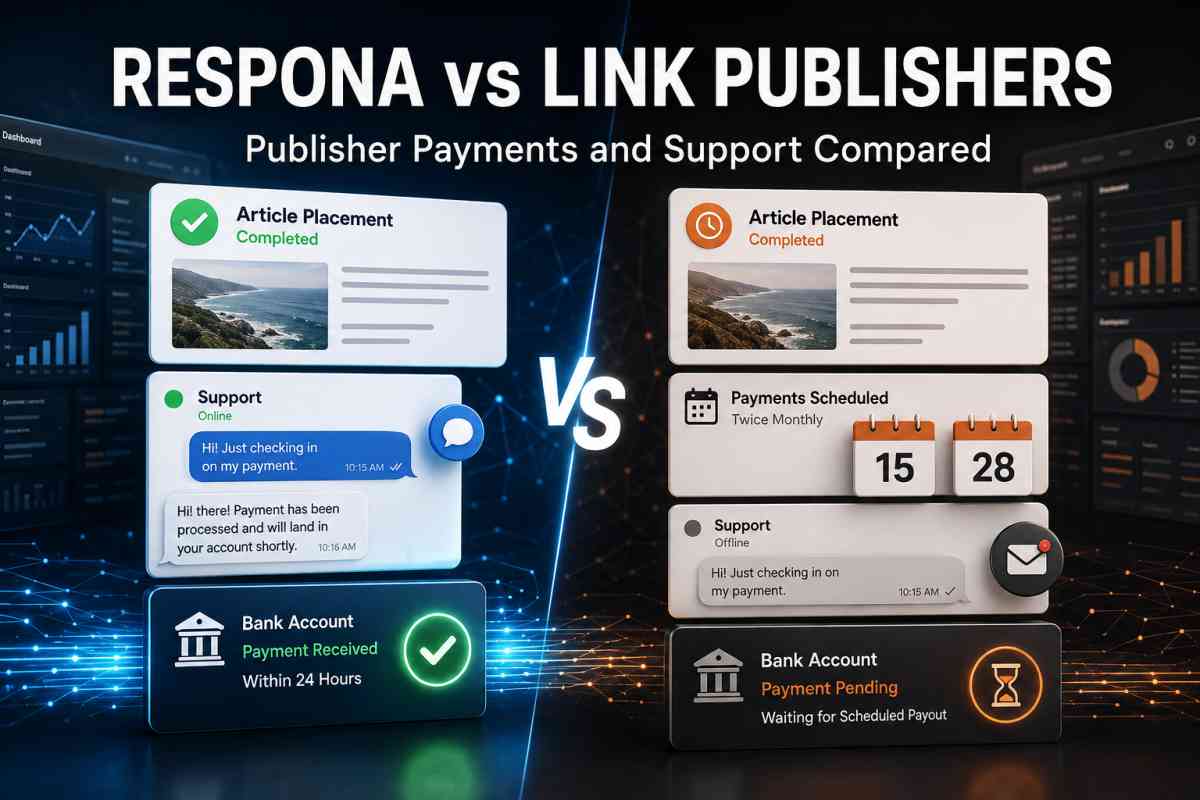
This is where Respona was far better for me as a publisher. After I completed an order and supplied the live placement, Respona checked the work promptly and sent the full publisher payment to my bank account within 24 hours, often on the same day.
That was my own experience rather than a publicly advertised payment guarantee from Respona.
Even so, the process felt like a normal business transaction because the service was requested, the placement was delivered, the work was checked and the payment followed without an unnecessary holding period.
Link Publishers pays on two scheduled dates
Link Publishers follows a much more restrictive publisher payment schedule. Its help centre says payments are released on the 15th and 28th of each month after a publisher submits a withdrawal request, with payments moved to the next business day when either date falls on a weekend.
The scheduled payment dates create delays that have little connection to when the publisher actually performed the work.
A publisher can accept an order, prepare or review the content, publish it on the same day and still be forced to wait for the next payment run.
The terms are publicly disclosed, meaning publishers technically accept the schedule when they use the service. My criticism is not that the schedule is hidden, but that it is an unnecessarily poor business model for the people supplying the websites and completing the work.
The delay can become longer when the buyer does not approve the completed placement promptly.
During my use of the platform, the seller workflow indicated that an order could remain pending for several days before being automatically completed if the buyer took no action.
Link Publishers’ current public FAQ says a submitted live link will be automatically approved if the buyer does not respond within 48 hours.
That differs from the five-day period presented during the experience behind this review, but either period can still cause a publisher to miss one of the two payment dates.
For example, a publisher could deliver an order shortly before the 15th, only for buyer approval or automatic completion to occur after that date.
The publisher would then need to wait until the 28th, assuming the withdrawal was processed in time and no further support issue delayed the order.
Where approval problems, revisions or unanswered support requests are involved, the wait can stretch across several weeks and move closer to a month. During that time, the paid placement remains live on the publisher’s website even though the publisher has not received the money held for the completed service.
Buyer approval should not prevent prompt payment
Giving a buyer time to inspect a placement is reasonable because the platform must protect customers from incorrect links, missing content or work that does not match the original order.
That protection does not explain why an undisputed and easily verified placement should then wait for one of only two monthly payment runs.
A platform dealing with online publications can check whether a page is live, whether the correct destination URL has been used and whether the requested anchor text appears in the article.
Those checks do not require weeks of processing, particularly when Respona showed that the same general task could be reviewed and paid on the day it was completed.
Link Publishers’ terms say money collected from the buyer will be provided to the seller upon completion of the order. In practice, its fixed withdrawal dates mean that “upon completion” does not necessarily mean the publisher will receive the money promptly.
That gap between completing the work and receiving payment is the main reason I consider Link Publishers’ publisher model unfair.
A platform should not promote fast delivery to buyers while making the publishers responsible for that speed wait weeks to be paid.
The business model conflicts with search engine rules when links pass ranking credit
There is an uncomfortable issue sitting underneath the entire paid link-building industry.
Respona and Link Publishers are legitimate businesses offering real services, and operating a marketplace or arranging online content does not automatically mean either company is directly breaching Google or Bing policies.
The problem arises when money, goods or services are exchanged for a link that passes ranking credit.
Google classifies that arrangement as link spam when the purpose is to influence search rankings, regardless of whether the website is genuine, the article is well written or the placement is described as outreach rather than a purchased backlink.
Google’s spam policy specifically includes exchanging money for links or posts containing links, exchanging goods or services for links and paying for advertorials or guest posts that pass ranking credit.
Paid links remain permitted when they are marked with rel="sponsored" or rel="nofollow", which prevents them from being treated as ordinary editorial endorsements. Google Search spam policies
This distinction matters because the commercial value of services such as guest posts and niche edits is often tied to obtaining a DoFollow link.
A standard followed link does not carry a special “DoFollow” attribute, but it can pass ranking signals when it has not been qualified as sponsored or nofollow.
Link Publishers openly allows buyers to filter opportunities according to whether a publisher provides DoFollow or NoFollow links.
Respona says its placements differ from buying links because it uses real websites with genuine traffic, rankings and topical relevance, but Google’s policy is based on the payment and the passing of ranking credit rather than the apparent quality of the website.
A paid placement on a respected publication can still fall within Google’s definition of link spam if the link is followed and was purchased for ranking purposes.
Calling the service digital PR, blogger outreach, a brand mention or a contextual placement does not change the nature of the transaction.
Bing takes a similar position. Microsoft says its systems can identify and discount unnatural links, while websites clearly using link schemes, paid links or link spam may be removed from the Bing index.
Neither platform controls every publisher’s HTML or every reason a buyer orders a placement. However, when a service promotes paid DoFollow links specifically because they may improve rankings, it is facilitating a practice that sits outside the published rules of major search engines.
Why links attract so much money
Links remain commercially valuable because search engines use them to understand relationships between pages, assess relevance and discover content.
Google says its link-analysis systems include PageRank, which has changed considerably since the company launched but remains part of its core ranking systems. Google ranking systems guide
Links are sometimes described as votes because an editorial link can indicate that one website considers another page useful or trustworthy.
That description is simplified because Google uses many ranking systems and does not treat every link equally, but it explains why a link from a respected publication can influence where a page appears for a particular keyword search.
Ahrefs’ 2026 collection of SEO statistics found a positive correlation between the number of websites linking to a page and its search traffic.
It also reported that higher-ranking pages tend to acquire followed links from new referring domains more quickly, although correlation alone does not prove that buying additional links will produce higher rankings.
The same Ahrefs data found only 0.01 per cent of referring domains among the top 110,000 websites used the rel="sponsored" attribute.
That low figure helps explain why the paid link economy remains attractive, but it also suggests that clear disclosure and technical qualification of sponsored relationships remain far less common than Google’s policies expect.
A naturally earned link exists because an editor, journalist, researcher or website owner independently decided the destination was useful to readers.
Once payment determines whether that followed link appears, the trust signal has been commercially manufactured, which is precisely what search engine rules are designed to prevent.
Publishers carry more risk than the dashboard shows
A guest post or niche edit may look like a quick transaction, but the publisher takes on risks that are easy to overlook. The placement can affect the credibility of the website, the trust of its readers and its standing with search engines if the article is poor, irrelevant or obviously written only to carry a backlink.
Publishers also remain responsible for hosting the content, maintaining the page and dealing with complaints or correction requests after the platform has completed the transaction.
For a genuine publication, the value being sold is tied to years of content production, technical maintenance, audience development and editorial work.
That makes it important for publishers to refuse articles that exist only to wrap low-value content around a commercial hyperlink.
A payment does not make an irrelevant article suitable, and a strong Domain Rating does not remove the risk created by repeatedly publishing followed links intended to manipulate rankings.
Publishers that accept paid content should clearly disclose the commercial relationship and qualify paid links with rel="sponsored" or rel="nofollow".
Doing so may reduce the SEO value sought by the buyer, but it protects the publication and brings the placement closer to the rules established by search engines.
What publishers should check before joining
Before listing a website, publishers should read the seller terms and find out exactly when an order becomes payable. The important date is not when the buyer pays the platform, but when the publisher can withdraw and actually receive the money.
Publishers should also check whether approval depends entirely on the buyer, how long automatic approval takes and whether the platform can manually confirm a completed placement.
If support is the only route for resolving a disputed order, it should be tested before a valuable website is added to the marketplace.
The final amount received also matters because platform margins, PayPal fees, currency conversion and withdrawal charges can reduce the advertised publisher price. A $100 listing does not necessarily mean $100 will arrive in an Australian bank account.
Communication controls deserve the same scrutiny. Preventing direct contact may protect the platform’s commission, but it leaves the publisher completely dependent on the platform when content, payment or approval problems arise.
Publishers should also decide in advance whether they will permit paid followed links, nofollow links or only properly labelled sponsored content. Allowing an advertiser or marketplace to make that decision can expose the entire website to a risk that is far greater than the value of one placement.
Respona is the better choice for publishers
Based on my experience using both services across several privately owned websites, Respona was the clear winner for publishers. Its support was more responsive, communication around individual jobs was easier and completed work was checked and paid quickly.
Link Publishers may offer buyers a larger self-service marketplace, extensive filtering and a straightforward way to order guest posts and niche edits.
Its generally positive public review score also shows that many customers and publishers have had a better experience than I did.
Those buyer-facing advantages do not make up for the problems I encountered with support or a payment system that can leave a publisher waiting weeks after providing the service. The two scheduled monthly payout dates remain the biggest problem.
When Link Publishers has already collected the buyer’s money and can confirm that a live placement satisfies the order, there is no convincing operational reason to keep the publisher waiting until the 15th or 28th.
Respona demonstrated that completed work could be checked and paid within 24 hours, often on the same day. A fair marketplace should value the website owners supplying the inventory as much as the advertisers purchasing it.
Respona did that more convincingly in my dealings with the company, while Link Publishers made a completed and paid-for transaction feel unnecessarily slow, difficult and one-sided.