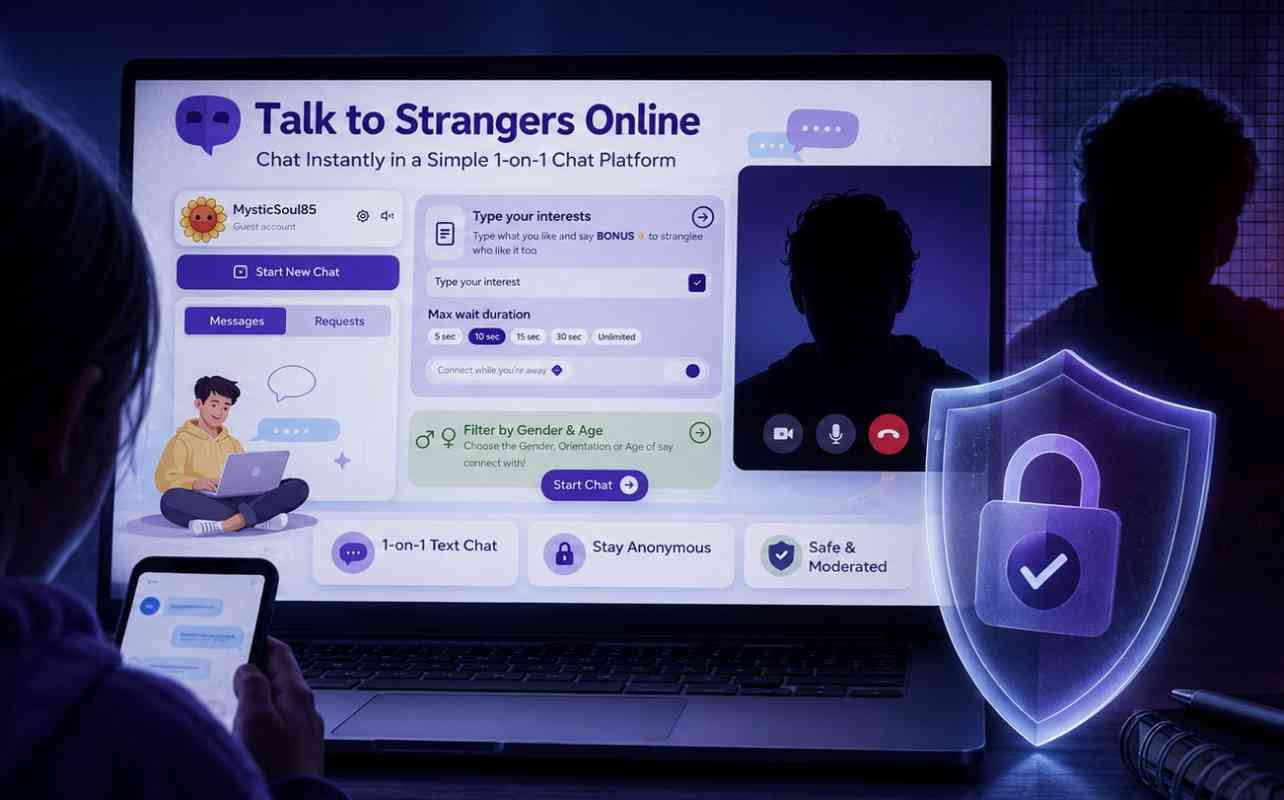


The website requires users to declare they are 18, yet its no-sign-up text, voice and video model raises familiar questions about how easily children can enter adult online spaces.
A website promoting free and anonymous conversations with strangers has brought renewed attention to the child safety risks that followed Omegle for years before it closed.
StrangerLine.io offers instant text, voice and video chats with people around the world, without requiring an account, email address or phone number before a conversation begins.
The anonymous online chat platform describes itself as an adults-only service and its rules make clear that anyone under 18 is prohibited from using it.
However, the age process described in its published policies consists of ticking an “I’m at least 18 years old” checkbox, with the platform recording the declaration for 90 days.
Based on the public documents reviewed for this report, StrangerLine does not describe any independent age check involving identification, facial age estimation or another age-assurance method before guest access is granted.
That distinction matters because children do not always obey an adults-only warning, particularly when a site is free, browser-based and requires no registration.
A declaration may set a rule, but it does not establish that the person behind the screen is an adult, nor does it confirm that the stranger they are matched with is who they claim to be.
StrangerLine promotes “100% anonymous” access, matches users in under three seconds and allows conversations to move from text to voice or live video.
It also allows images and voice messages to be exchanged, while registered users can save chats, send friend requests and contact people again after a conversation has ended.
Those functions may be intended for adults seeking casual conversation, but they also recreate several of the conditions child safety authorities have repeatedly identified as high risk.
Anonymity can conceal identity, random matching can bring a child into contact with an adult immediately, and live video can expose a young user to sexual or disturbing material before a report is made or a moderator can intervene.
There is no suggestion in this report that StrangerLine has been linked to a specific offence or that Australia’s eSafety Commissioner has taken enforcement action against the service.
The concern is the wider design of anonymous random-chat platforms and whether published safety controls can prevent children from entering an adult environment in the first place.
StrangerLine says it has moderation and safety controls
StrangerLine says it uses AI filtering, round-the-clock human moderation, one-tap blocking and reporting, and images that are blurred by default.
Its community guidelines ban child sexual abuse material, grooming, non-consensual intimate content, harassment and recording another user without consent, while reports are said to be reviewed within 48 hours.
The company also says it uses Cloudflare technology to detect known child sexual abuse material and that a detected transfer is blocked, the session is suspended and a report is made to the US National Center for Missing and Exploited Children.
Its rules state that adults who contact, solicit or groom a person who is or appears to be under 18 will be permanently banned and reported to law enforcement.
These measures are relevant and show that the platform has at least acknowledged the risks attached to anonymous chat.
Even so, moderation generally responds to detected material, automated signals or user reports, while grooming can begin as an ordinary conversation and inappropriate live content can appear before the user has time to disconnect.
The platform’s own safety advice recognises some of this difficulty. It warns users that recipients may capture or save media, advises them not to reveal identifying information and says they should be cautious when asked to move a conversation elsewhere.
For a child, however, recognising manipulation is rarely that simple.
Grooming often relies on patience, secrecy and trust, with an offender gradually moving the conversation to another service, asking for personal details or sexual images, and then using those images to apply pressure or make threats.
Are Omegle and sites similar to Omegle safe for kids?
The short answer is no.
Omegle-style random chat services are not considered safe environments for children, even when a platform states that it is restricted to adults, because the basic product places users into private conversations with unknown people and may offer text, media, voice or live video contact.
Australia’s eSafety Commissioner has warned that anonymous random-chat platforms can become gateways to inappropriate content, manipulation and sexual exploitation.
Its August 2025 advisory identified weak age checking, random pairing, live video, anonymity and the risk of conversations being recorded without consent as the main dangers for children.
Omegle remains the clearest warning of what can happen when a stranger-chat service grows faster than its safeguards.
The platform shut down in November 2023 after years of safety concerns and mounting legal action, with eSafety reporting that Omegle had flagged more than 500,000 instances of child sexual abuse material during 2022 alone.
In one major US case, the family of an 11-year-old girl alleged she was coerced into creating explicit material after being connected with an adult through Omegle.
The case settled for US$22 million before the service closed, while Omegle founder Leif K-Brooks acknowledged that the site had been misused for “unspeakably heinous crimes.”
The closure of Omegle diden’t end the model, and a long list of alternatives moved into the audience it left behind.
StrangerLine openly markets itself as a modern Omegle replacement and says it has “the moderation, safety tools, and features Omegle never built,” but the wider risk remains wherever anonymous strangers can be paired instantly and age controls depend heavily on what users say about themselves.
Australian regulators have already acted against another service using a similar format.
In October 2025, Apple and Google removed OmeTV from their Australian app stores after eSafety said adults were using the roulette-style video service to groom and sexually exploit children, following an earlier formal warning to its operator over alleged breaches of Australian online safety requirements.
The action was directed at OmeTV, not StrangerLine, but it shows how seriously regulators view random adult-to-child contact.
At the time, eSafety Commissioner Julie Inman Grant said: “We know that this service is popular with children and for this reason it’s also popular with adults seeking to sexually prey on them.”
Australian children are already encountering harm online
The concern is backed by fresh Australian data rather than worst-case speculation. An eSafety report published in June 2026 drew on a nationally representative survey of 3,454 children aged 10 to 17, including detailed findings from 2,629 children aged between 10 and 15.
Among children aged 10 to 15, 94 per cent had used a communication platform to chat, message, call or video call other people.
The study found 24% cent had experienced online sexual harassment, 14% had encountered grooming-type behaviour and 8 per cent had experienced image-based abuse.
Separate eSafety guidance says children can first experience online sexual grooming in late primary school and often do not recognise what is happening.
It also reports that 86.7 per cent of adult-perpetrated online sexual grooming identified through the Australian Child Maltreatment Study involved an adult the child did not know offline.
Australia’s online safety codes require services to take steps against the most serious illegal material, including child sexual exploitation and abuse, while newer age-restricted material codes came into effect for relevant electronic and designated internet services in March 2026.
Whether particular obligations apply depends on how a service is classified and operates, but eSafety’s guidance is clear that effective age assurance, properly resourced moderation and safety-by-design controls are expected where the risk warrants them.
What parents should do if a child has used a random chat site
Parents and carers should treat StrangerLine and other Omegle-style services as adults-only and block access on devices used by children.
Apple Screen Time, Google Family Link, router-level filtering and dedicated parental-control software can help, although none replaces a calm conversation about why anonymous chat carries risks.
Children should be told never to reveal their full name, school, address, phone number or live location to a stranger, and never to move to another app or meet an online contact without involving a trusted adult.
They should also know that a person seen on video may still be lying about their age, identity or intentions, and that any image sent privately can be recorded and redistributed.
If something has already happened, anger or punishment can make a child less likely to explain the full situation.
Parents should reassure them that they are not to blame, preserve usernames, messages, URLs and screenshots where it is safe to do so, then block the contact and report suspected grooming or sexual exploitation to the Australian Centre to Counter Child Exploitation.
Illegal or harmful online content can also be reported through the eSafety Commissioner, while immediate danger should be reported to Triple Zero.
Children and young people who need confidential support can contact Kids Helpline on 1800 55 1800 at any time.
The difficult lesson from Omegle is that an adults-only label and a report button do not make anonymous random chat suitable for children.
StrangerLine publishes more safety rules than some earlier services did, but for parents the safest position remains straightforward: children should not be using it or any other platform built around private, instant contact with unknown adults.