The global freelance boom is feeding a much larger market for SEO, publishing and digital marketing services, but it is also making it harder for businesses to tell the difference between people who actually understand search and those simply reselling somebody else’s work.
That distinction matters more in 2026 because the freelance workforce itself is expanding quickly.
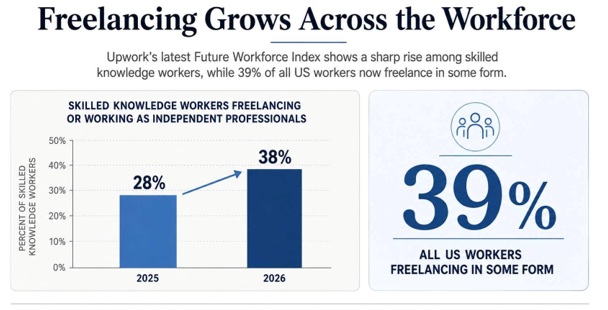
Upwork’s latest Future Workforce Index found 38% of skilled knowledge workers now operate as freelancers or independent professionals, compared with 28% in its 2025 research, while 39% of all US workers are now freelancing in some form.
The numbers help explain why LinkedIn, Facebook groups, freelance marketplaces and direct email have become crowded with people offering SEO, guest posts, backlinks, website authority and publishing packages.
Many are legitimate specialists with years of practical experience, but the same market also makes it remarkably easy for someone with little technical background to present themselves as an SEO consultant, publisher or digital strategist.
In many cases, the service being sold is not actually produced by the person selling it.
A reseller may take a website placement offered elsewhere for $30, package it as part of an “authority link” service for $100 or more, then move on to the next buyer.
That model has become easier to scale because online gig work is now deeply embedded in the global labour market.
World Bank research estimates online gig work represents between 4.4% and 12.5% of the global labour force, with as many as 435 million people potentially participating in online gig work when secondary employment is included.
India, Bangladesh, Pakistan and the Philippines are among the countries with large and established online freelance workforces, although that says nothing about the quality of individual workers.
The point is scale.
The supply of people offering web, marketing, programming, design and publishing services is enormous, and buyers are increasingly dealing with sellers across borders who may be several steps removed from the actual service being delivered.
Social media has become part of that sales infrastructure.
Payoneer’s global freelancer research found 74% of freelancers used social media to promote their services, while separate research into the Philippines found Facebook was the biggest source of freelance work, ahead of Instagram and other employment or gig platforms.
For SEO buyers, that’s created a strange marketplace where a polished profile, a spreadsheet of websites and a collection of third-party metrics can sometimes carry more weight than actual evidence of technical ability.
Domain Rating, Domain Authority and similar scores are often central to the pitch. They can be useful comparative indicators when used properly, but they are created by commercial SEO platforms and are not Google ranking metrics.
Ahrefs itself says there is no evidence that search engines use Domain Rating or similar third-party authority scores as ranking factors.
That is where the sales language can begin drifting away from what search engines actually care about.
A reseller may advertise a “DR 70 website” as though the number alone proves the site is valuable, while ignoring whether Google indexes its recent pages, whether it receives meaningful search traffic, whether the content is thin, whether the site publishes hundreds of unrelated sponsored articles or whether the placement sits inside a part of the website search engines barely trust..
Google’s own documentation is considerably less glamorous. Its SEO guidance focuses on helping search engines understand content, making websites accessible and useful to users, and maintaining technical structures that allow pages to be crawled and indexed properly.
The company is also explicit about paid links. Google classifies buying or selling links for ranking purposes as link spam, including exchanging money for posts containing links, although paid advertising and sponsorship are permitted where links are appropriately marked with nofollow or sponsored.
That creates an awkward gap between the way many SEO placements are marketed and the way Google says they should actually be handled.
A seller promising a permanent “dofollow guest post” for cash may describe the transaction as white-hat outreach, but Google’s published spam policy treats paid links that pass ranking credit very differently.
The same problem appears with publishing. Genuine editorial placement requires far more than inserting an anchor into 600 words of generic copy.
A real publisher has to consider whether the story belongs on the site, whether it is accurate, whether the headline works, whether the article has a reason to exist and whether readers are likely to care about it once the link is stripped away.
Resellers rarely need to confront those questions because their product is often the placement itself. The article is simply the vehicle used to deliver it.
That becomes obvious when the same sales pitch includes hundreds or thousands of websites across unrelated categories, sometimes stretching from technology and finance to health, travel, gaming and home improvement.
The seller may describe the list as an editorial network, although in practical terms it can operate more like inventory.
Technical SEO is harder to fake once the conversation moves beyond metrics and placements. Crawling, rendering, canonicalisation, internal linking, structured data, JavaScript, server responses, redirects, sitemap handling, indexing and log analysis require some understanding of how websites actually behave.
Google’s Search documentation reflects that complexity, covering crawling and indexing, structured data, JavaScript SEO, site architecture and Search Console rather than reducing optimisation to a single authority score.
There is also a growing risk around the type of content being produced.
Google’s current spam policies specifically target scaled content created primarily to manipulate rankings and site reputation abuse, where third-party content is published on an established domain mainly to take advantage of the host site’s existing ranking signals.
That matters to publishers because a website can look commercially successful while gradually becoming weaker as an editorial product.
If every page exists because somebody paid for a backlink, the publication eventually stops behaving like a publication and begins behaving like a catalogue of sponsored placements.
The irony is that the freelance market itself is not the problem.
Some of the strongest developers, writers, technical SEO specialists and digital consultants work independently, and Upwork’s own 2026 figures show freelancing has become a mainstream part of the skilled workforce rather than a fringe employment model.
The problem is the absence of friction. It takes minutes to create a profile, call yourself an SEO expert and begin selling access to websites you do not own, content you did not write and metrics you did not create.
For businesses buying those services, the harder question in 2026 is no longer whether somebody can produce a spreadsheet full of links.
It is whether the person selling the strategy has ever built a website, fixed one, ranked one, recovered one after a search decline or published something people actually wanted to read.
The digital marketing industry continues to grow in 2026, with global advertising spend forecast to exceed US$1 trillion for the first time, up about 5% year-on-year, while digital channels capture an increasingly dominant share of budgets.