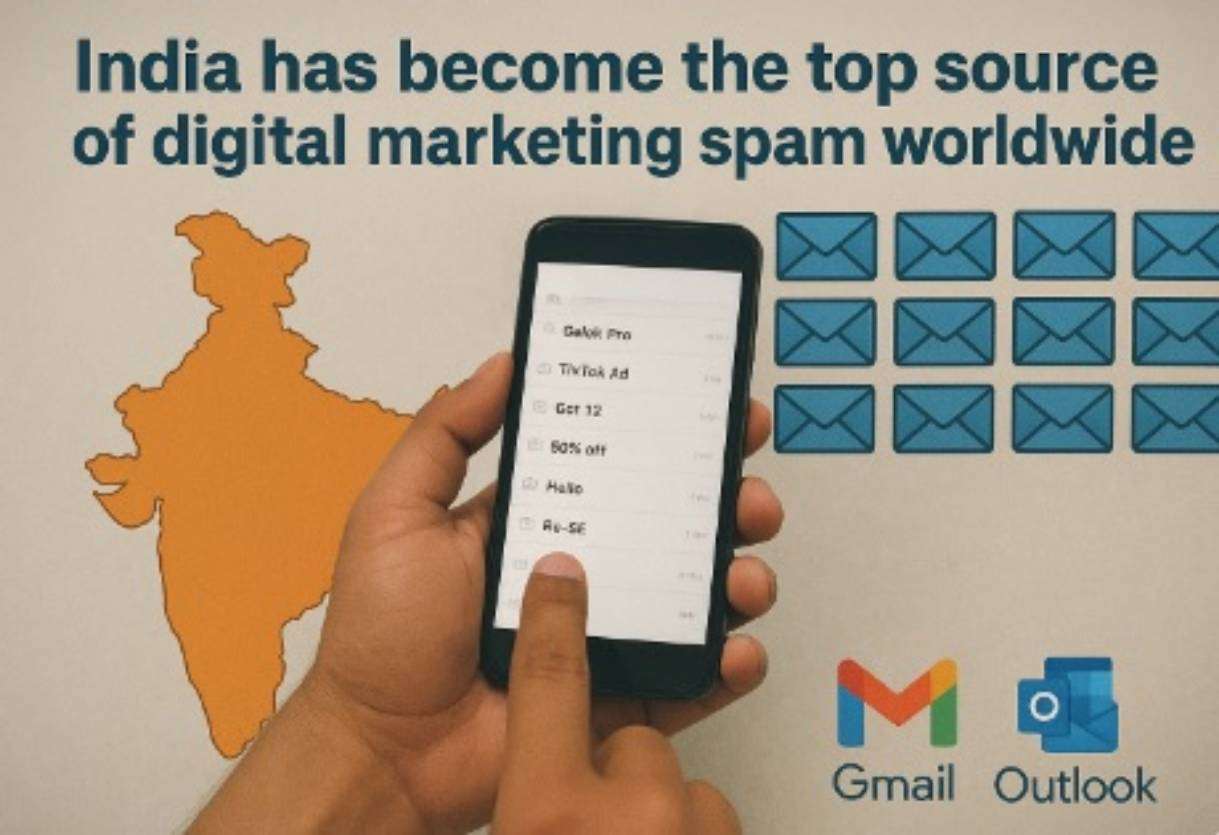


From Gmail and Outlook accounts, an unprecedented flood of unfounded SEO promises has crowned India as the global champion of inbox marketing terrorism
Picture this: It’s 9:47 AM on a Tuesday. Your inbox pings. Again. And again. And again.
“Hi, I was checking your website and see you have a good design and it looks great, but it’s not ranking on Google and other major search engines. We can place your website on Google’s 1st page.”
The sender? Names like, “David Johnson” from a Gmail account. Or maybe it’s “Sarah Williams” from Outlook. Tomorrow it’ll be “Michael Anderson” from Hotmail.
The names change. The free email accounts rotate. The message stays identical. And 98% of them all originate from one place: India.
Welcome to the new reality of digital business communication, where legitimate website owners worldwide are drowning in what has become the most pervasive, relentless, and industrialised spam operation the internet has ever witnessed.
India hasn’t just become a major player in global spam—it has architected, perfected, and deployed the most sophisticated system of email harassment ever devised, all promising the same impossible dream: guaranteed #1 rankings on Google.
The Anatomy of the Daily Assault
Some website owners report receiving these emails over 20 times per day from different Gmail accounts. Not 20 per week. Not 20 per month.
Twenty separate spam messages every single day, each one claiming to have personally reviewed your website, each one offering miraculous SEO results, each one sent from a free email provider.
The emails are being sent through free email providers such as Gmail, Hotmail, and Outlook, purportedly coming from individuals using fake Western English names.
India now ranks third globally in daily spam email volume, pumping out approximately 7.6 billion spam messages every single day.
To contextualise this staggering figure: that’s roughly five spam emails for every person on the planet—emanating from a single country—daily.
The sheer mathematical improbability of this scale becomes comprehensible only when you understand the industrial infrastructure undergirding it.
But raw volume tells only part of this cautionary tale. What distinguishes India’s spam ecosystem isn’t merely quantity—it’s the cynical precision with which these operations exploit trust, mimic legitimacy, and systematically contaminate every digital communication channel in existence.
The Template of Deception
The formula is so consistent it borders on comical—if it weren’t so infuriating. Here’s the standard template that arrives in millions of inboxes daily:
“Hello,
I was examining your website and it is really well developed, but doesn’t rank on the first page of Google and other major search engines. You’re likely losing a lot of traffic and leads to your business.
I’m an SEO Expert and I helped hundreds of businesses rank on the first page of Google. My rates are very affordable. We can fairly quickly promote your website to the top of search rankings with no long term contracts!
Let me know if you are interested. I will be happy to send you some references, company info, as well as cost for our services.
Best regards,
[Generic Western Fake Name]
[Gmail/Outlook/Hotmail address]“
These emails showcase several typical characteristics: vague references to the recipient’s website, overly broad claims about ranking improvements, combined with a lack of specific details about the sender or their company.
Notice what’s conspicuously absent: No company name. No website. No business email address. No phone number. No physical address. No demonstrable portfolio.
No specific analysis of what’s actually wrong with your site. Just empty promises wrapped in the digital equivalent of a trench coat.
The psychological manipulation is deliberate. These emails are usually well-written and sound knowledgeable, but the person writing the email hasn’t looked at your website specifically.
They’re crafted to sound personal while being completely generic—personalised enough to bypass spam filters, vague enough to apply to literally any business website on the internet.
6 Noted Indian Companies Sending Spam Via Disposable Email Accounts.
- Webxploretechnologies.com
- Brainfoster.com
- Triveniinfosoft.com
- Webpristine.com
- QorvaTech.com
- Quantum IT Innovation
The Red Flag Parade
The biggest red flag: emails originate from generic email accounts like Gmail or Outlook, rather than established business domains.
Legitimate businesses use their own domain for emails. If someone contacts you from a free email service, it’s a clear sign they might not be as professional as they claim.
Spammers use generic Gmail or Yahoo accounts because it adds a layer of anonymity that makes it hard for any spam complaints to actually come back and harm their domain.
A real SEO company offering valuable services would never spam you like this, and if for some reason they did send an unsolicited email, it certainly wouldn’t come from a Gmail account.
But the Gmail addresses are merely the most visible symptom of a deeper pathology. These spammers never provide a full name, phone number, company name, address, or website.
When they do occasionally include a website, it’s invariably a hastily constructed WordPress template populated with stock photos of nonexistent “teams” and fabricated testimonials.
The absurdity reaches its apex when you consider documented cases of these spammers contacting actual SEO professionals.
A colleague at Google received a message offering to make changes to help Google rank higher on Google—evidence of the completely automated, thoughtless nature of these campaigns.
SEO agencies that publicly identify themselves as experts and rank well for SEO-related keywords continue receiving these pitches, further proof that no actual human review occurs before these emails are sent.
The Impossible Promise
Here’s the fundamental lie at the heart of every single one of these emails: “No one can guarantee a #1 ranking on Google.” Google itself is adamant about that in their official documentation.
If these services are truly capable of achieving first-page rankings on Google, why do they resort to spamming tactics instead of relying on organic website traffic and legitimate marketing strategies to promote their own services?
The logic is inescapable: If you possessed legitimate SEO expertise capable of delivering guaranteed #1 rankings, you wouldn’t need to send 10,000 spam emails per day from free Gmail accounts using fake names.
You’d have more client work than you could handle, arriving through organic search and referrals. The spam itself is proof of incompetence.
Any SEO consultant who quotes you a blanket rate in an unsolicited email without any knowledge of your business, industry, competitors, geographical reach, website, or content is suspect.
SEO services are not universal across all websites, and you cannot optimise all websites within the same amount of time.
Yet the emails persist, promising “$99 per month could land you at the top of Google results page in less than a week!” The mathematical impossibility doesn’t matter. The ethical bankruptcy doesn’t matter. The complete absence of legitimacy doesn’t matter.
What matters is volume—send enough spam, and eventually someone, somewhere, desperate enough or uninformed enough, will respond.
The Middleman Economy
Further investigation into the identities behind these spam emails unveils a complex web of deceit. Many of the purported digital marketing services are merely middlemen, reselling SEO services offered by other providers for a commission.
SEO spam emails are often generated by dubious lead generation companies hired to send out these messages on behalf of Indian SEO agencies. The agencies, despite their grandiose promises, can’t even rank their own websites effectively.
These emails come from what industry experts regard as “SEO Reseller Spam Beggars”—they are not SEO agencies but Indian reseller spammers who know nothing about SEO and are just trying to make commission money from an SEO agency offering a private label reseller program.
The ecosystem operates like a pyramid scheme: At the top sit a handful of actual (though often incompetent) SEO service providers.
Below them, an army of resellers with zero expertise spam the world on commission. Below them, freelance “lead generators” scrape email addresses and blast out messages. Nobody in this chain possesses genuine expertise.
Nobody provides actual value. The entire structure exists solely to extract money from businesses desperate for online visibility.
The Guest Post Plague
The spam extends beyond simple ranking promises. Spam emails also inundate modern inboxes with guest post offers—random emails offering lists of guest posts for purchase.
These spam emails are frequently dispatched by freelance resellers, commonly from regions like India or Pakistan, with lists often compiled from various online services, including the black hat link buying and selling platform iCopify.com.
A recent study revealed that out of 1,000 “Guest Post Reseller Spam Emails,” the overwhelming majority originated from Indian sources, promoting toxic backlink schemes that violate Google’s webmaster guidelines and can actively harm website rankings.
Yet the emails promise “DA90+ backlinks” and “high-authority placements”—technical-sounding jargon designed to impress uninformed business owners while delivering digital poison.
The Global Contamination
The consequences extend far beyond annoyed inboxes. The proliferation of junk content and toxic backlinks has made it harder for legitimate websites to rank, contributing to Google’s increasingly aggressive algorithm updates that punish everyone—including ethical practitioners—as collateral damage.
The digital ecosystem is being poisoned by an unending torrent of low-quality links, plagiarized content, and manipulative SEO tactics.
Google’s spam-fighting systems caught over 40 billion spammy pages daily in 2024—a staggering figure that speaks to both the scale of the problem and the futility of purely technological solutions.
Every spam email, every fake backlink, every AI-generated blog post contributes to what cybersecurity experts now describe as “internet pollution”—digital waste that degrades the quality and utility of online spaces for everyone.
Spam emails comprise approximately 56.5% of all email traffic, with India’s contribution representing a disproportionate share relative to its global internet user percentage.
In 2012, India topped Sophos’ ranking of the world’s largest spam-relaying countries with a global share of 11.4%, and while the metrics have evolved, the nation’s position atop the spam hierarchy has remained remarkably consistent.
The Systematic Exploitation
What makes India’s spam operation particularly insidious is its systematic nature. These aren’t random acts of digital misbehavior—they’re the output of an industrialized system with clear economic incentives, established methodologies, and complete absence of regulatory deterrence.
The infrastructure operates openly. Training courses advertise “How to Make Money with SEO Reselling.” WhatsApp groups coordinate spam campaigns.
Fiverr gigs promise “10,000 targeted email blasts for $5.” Upwork profiles offer “SEO services” from accounts with fabricated portfolios. The entire ecosystem functions in plain sight because there’s no meaningful consequence for participation.
India’s internet user base is forecasted to exceed 800 million by 2025, up from approximately 600 million users recorded in 2024, with approximately 70% accessing the internet primarily through smartphones.
The massive digital adoption, combined with an educational system churning out tech-literate graduates at unprecedented rates, has created a perfect storm: millions seeking online income opportunities colliding with minimal barriers to entry in the digital marketing space and zero enforcement of professional standards.
The desperation economics are real. With rural internet users growing at an annual rate of about 30%, millions are coming online for the first time, seeking income opportunities in an economy where traditional employment remains scarce.
Digital marketing’s low barriers to entry make it an obvious target—but the lack of professional standards or ethical guardrails has created a race to the bottom.
The Platform Failure
Gmail, Outlook, and other email providers bear significant responsibility for enabling this epidemic. Despite advanced spam filtering technology, these free email services continue allowing unlimited creation of accounts used exclusively for spam.
Despite advanced AI capabilities, Gmail and Outlook still let spammy SEO and web development pitches flood inboxes, leaving users battling digital junk daily.
The solution is straightforward: Implement meaningful verification requirements for bulk email sending. Rate-limit outbound messages from free accounts. Create reputation systems that identify and block serial spam accounts. The technology exists. The will apparently does not.
When a single individual can create dozens of Gmail accounts in minutes and immediately begin blasting thousands of spam messages with zero verification, zero accountability, and zero consequences, the platform has become complicit in the harassment.
The Regulatory Vacuum
Perhaps most damning is the apparent absence of governmental or industry self-regulation within India itself. In countries where anti-spam laws are non-existent or inadequate, they undermine global attempts to combat spam.
India’s regulatory environment has failed to keep pace with the spam explosion, creating a de facto free-for-all where bad actors operate with impunity.
The contrast with other jurisdictions is stark. In the United States, the CAN-SPAM Act establishes clear penalties for violations.
Europe’s GDPR imposes stringent requirements on data collection and communication consent. India has no comparable enforcement mechanism, no systematic penalties, no meaningful deterrent. The result is predictable: spam operators flourish because there’s no cost to doing so.
Multiple documented cases show Indian marketing companies continuing to send spam even after recipients explicitly request removal, demonstrating complete disregard for basic business ethics and anti-spam regulations.
The pattern is consistent: initial contact from a free email address with an English-sounding name, followed by increasingly aggressive follow-ups, with no honor given to unsubscribe requests.
The Credibility Crisis
The reputation damage extends beyond the spam operators themselves. Legitimate concerns have emerged about marketing firms outsourcing work to India where contractors have no understanding of the client’s business or proper marketing practices, resulting in worthless deliverables and potential legal violations.
The irony is acute: India’s legitimate IT services industry built a global reputation for technical excellence over decades. The digital marketing spam epidemic threatens to unravel that goodwill in a fraction of the time.
When “Made in India” becomes synonymous with Gmail spam and fake SEO promises rather than innovation, everyone loses—including the genuine professionals whose reputations are destroyed by association.
India’s SEO market is projected to reach $8.1 billion—a massive industry that includes both legitimate practitioners and the spam operations that have parasitised the ecosystem.
The tragedy is that India possesses genuine digital marketing talent; the digital economy of India is estimated to reach a valuation of $1 trillion by 2025, fueled by increasing internet penetration, mobile usage, and the growth of e-commerce and digital services. Yet the spam epidemic threatens to poison the entire well.
The Daily Reality
For business owners worldwide, the morning routine now includes a ritual of deletion. Scroll through inbox. Delete spam from “John Peterson” ([email protected]).
Delete spam from “Emily Thompson” ([email protected]). Delete spam from “David Miller” ([email protected]). Block sender. Report spam. Watch three more arrive within the hour.
The psychological toll is real. Legitimate business development becomes harder when every unsolicited email triggers instant suspicion.
Actual opportunities from real professionals get lost in the flood of garbage. The digital communication channels that should facilitate business growth instead become sources of frustration and wasted time.
And tomorrow morning, the cycle begins again. Different names. Different email addresses. Same promises. Same lies. Same country of origin.
A Path Forward?
Solutions exist, but they require will. Email providers must implement meaningful verification and rate limiting for free accounts. Industry associations could establish and enforce professional standards.
Educational institutions could emphasise ethics alongside technique. The Indian government could enact and actually enforce anti-spam legislation.
International platforms could implement more aggressive verification and penalty systems for spam originating from specific regions.
But these solutions require acknowledging the problem’s existence—something that has proven politically and economically uncomfortable.
It’s easier to celebrate India’s digital economy growth statistics than to confront the reality that a substantial portion of that “growth” consists of parasitic activity that destroys value rather than creating it.
The Inbox Never Sleeps
The digital revolution promised connection, opportunity, democratisation of information. Instead, for millions of professionals worldwide, it has delivered an unending barrage of unwanted solicitations from fake names using free email accounts, promising impossible results they can never deliver.
Every “Hi, I was checking your website” message, every “guaranteed #1 ranking” offer, every Gmail address pretending to be a legitimate business represents more than mere annoyance.
They represent the degradation of professional communication channels, the erosion of trust in digital business relationships, and the systematic contamination of online spaces that once held promise for authentic connection.
India didn’t set out to become the world’s spam superpower. But through a combination of economic desperation, regulatory neglect, educational shortcuts, platform negligence, and the complete absence of professional shame, it has achieved exactly that distinction.
Until systemic reforms address the root causes rather than symptoms, the deluge will continue—seven billion messages at a time, one Gmail account at a time, one fake name at a time.
Your inbox already knows this. The question is: when will anyone in a position of authority care enough to actually do something about it?