


It’s 2025, and if you thought Facebook (now Meta) had made any real progress in tackling scams, think again. The platform is currently drowning in deepfake scam ads, and despite countless users reporting them, Meta is refusing to take them down.
The scams aren’t subtle. We’re talking about highly manipulated videos and images of well-known Australians like David Koch, Gina Rinehart, Robert Irwin, and even Prime Minister Anthony Albanese, falsely promoting shady investment schemes.
According to the Australian Broadcasting Corporation’s (ABC) last year, parent company Meta said it took down 8,000 of these so-called celebrity-bait ads from Facebook and Instagram.
Apparently., Meta has taken action to try to close the door on scammers by announcing plans to tighten requirements for ads promoting financial services.
The ads usually link to a fake media article that includes quotes attributed to Australian public figures endorsing a cryptocurrency or other money-making scheme.
Facebook users are then invited to sign up for the scheme and are then contacted by scammers to convince them to deposit funds.
Last year, Assistant Treasurer Stephen Jones wrote on X that “Meta needs to step up and do more to stop the proliferation of scammers on its platforms”.
In a previous address to the National Press Club, he said social media giants were “dragging their heels” in the fight against the multi-billion-dollar scourge of scams.
The ads appear daily in users’ feeds, and my own personal feed often as paid, sponsored ads published by legitimiate looking fake Facebook user accounts, meaning in the end Facebook is actively profiting from them.
So what happens when myself and other users on the platform report these scam ads? They’re met with the same response:
We didn’t remove the ad.
Thanks again for your report. This information helps us improve the integrity and relevance of advertising on Facebook.
We understand this might be frustrating, so we recommend influencing the ads you see by hiding ads and changing your ad preferences
Improve the integrity of advertising? That’s laughable!
Recommend changing my ad preferences? Where’s the option to turn off scams?
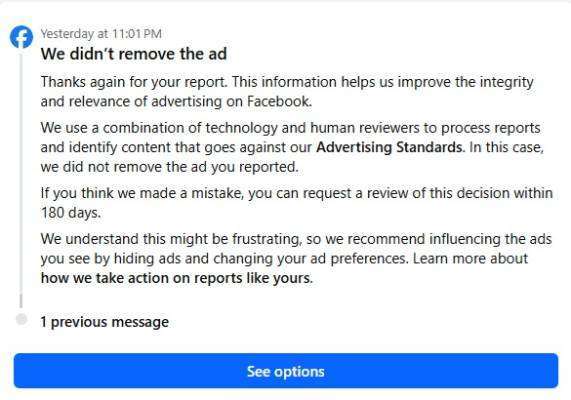
Facebook’s Reporting System Becomes A Boat Anchor
For months, I’ve been personally reporting these scam ads—close to 30 deepfake scams so far—and not one single scam was removed. Instead, I get told that Facebook’s “combination of technology and human reviewers” has decided the ad does not violate their Advertising Standards.
Meanwhile, the somewhat convincing ads continue flooding users’ feeds, promoted under seemingly normal sponsored Facebook accounts.
But here’s the catch—when I try to contact the user acounts running the ads, none of them respond. Because they don’t seem to be real people. To me, they look like fake accounts created purely to run these scams.
So why is Meta refusing to act? In my personal opinion it’s painfully obvious: Advertising Revenue
Meta Profits While Users Get Scammed
If I’m seeing hundreds of these deepfake scam ads, just imagine how many thousands—maybe millions—are being pushed across the platform. Each of these ads is a paid advertisement, meaning scammers are handing Meta piles of cash to run them.
At this scale, it’s hard not to conclude that Meta simply doesn’t care about stopping these scams because they make too much money from them. After all, why crack down on fraudulent advertisers when they’re bringing in revenue?
The irony? Meta has no problem banning legitimate advertisers for the smallest infractions—but when it comes to scammers running deepfake fraud campaigns, their “Advertising Standards” suddenly don’t apply.
- Deepfake Scams On The Rise – Stealing Millions
Deepfake videos and AI-generated audio are spreading faster than ever. In 2024, a deepfake attack happened every five minutes, making up a staggering 40% of all biometric fraud cases. And it’s only getting worse.
According to Gartner, by 2026, nearly a third of businesses won’t trust traditional identity verification methods on their own—AI-generated deepfakes are just too convincing.
A survey by iProov found that 43% of people weren’t confident they could tell the difference between a real video and a deepfake. Even more alarming, nearly a third had never even heard of deepfakes—leaving a huge number of people vulnerable to deception.
In 2023, a Hong Kong employee joined a video call with his company’s CFO—except it wasn’t really his boss. Scammers had used AI to create a deepfake video of the executive, tricking the employee into transferring $25 million to a fraudulent account.
This wasn’t a scene from a sci-fi movie—it was a real heist. Deepfake technology has advanced to the point where criminals can convincingly fake voices and faces with alarming accuracy.
From scammers cloning a loved one’s voice for fake kidnapping calls to AI-generated bosses authorising bogus payments, deepfakes are definantly becoming a powerful tool for cybercriminals.
Deepfakes exploit trust. When a victim sees a familiar face or hears a voice they recognise, they don’t question it. The scams also thrive on urgency and secrecy—think, “I need to transfer some money immediately, and don’t tell anyone.”
At the end of the day, it’s the combination of emotional manipulation and hyper-realistic visuals or audio that makes it easy to fool even seasoned professionals.
Take the case Hong Kong. The employee did notice something was off—the call ended abruptly, and he never directly interacted with his colleagues—but by the time the red flags raised, the money was already gone.
Facebook’s Scam Problem Is Worse Than Ever
Back in 2024, the issue of scam ads on Facebook was already making headlines. But now, in 2025, the problem has exploded. Meta has not only failed to fix it, but they’ve allowed it to get worse.
So here’s the real question: At what point does Meta become complicit in these scams? If they knowingly approve fraudulent ads, refuse to remove them when reported, and continue pocketing the revenue—how is that any different from enabling the scammers themselves?
It’s time for real accountability. Facebook users deserve better than to be treated as easy targets for fraud, while Meta sits back and counts its ad dollars. The only question now is whether anyone will force them to take action.
Between January and September 2024, Scamwatch recorded 5,738 investment scams, resulting in over $135 million in losses. Around 25% of these scams were facilitated through social media platforms.
The National Anti-Scam Centre reported receiving over 400 complaints about these types of scams in 2023, including one case where an Australian man lost $80,000 in cryptocurrency.