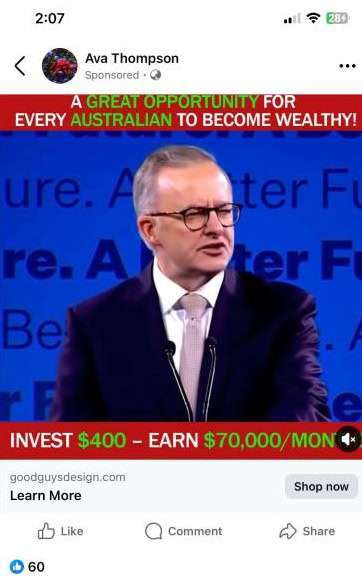
A screenshot shared with us shows Anthony Albanese in what appears to be a professionally made video ad, promoting a supposed “lucrative investment opportunity.”
The sponsored ad, still circulating on Facebook in 2025 (current day) is linked to the domain goodguydesign.com, which upon investigation, has no legitimate ties to financial services or the Australian Prime Minister.
The blatant misuse of the PM’s likeness is achieved through advanced deepfake technology, making the scam particularly convincing with one user stating in the ad comments he was outright scammed.
The deepfake video portrays Albanese enthusiastically endorsing an investment program that promises significant returns with minimal effort—a classic hallmark of fraudulent schemes.
The scammers behind the ad are banking on the credibility and trust associated with the Prime Minister’s image to fool unsuspecting users to engage with the dodgy investment scheme.
(META) Facebook’s Role in the Fraud
Despite repeated criticisms of its content moderation practices, Facebook continues to allow these types of scams to proliferate across it’s platform.
In a bold statement, a Facebook user from Melbourne who requested to remain un-named has called for major sanctions on Facebook ads in Australia, drawing parallels to the growing global scrutiny of tech giants.
The comment comes in light of the proposed bans on TikTok in the United States, where lawmakers are actively pushing for restrictions on the Chinese-owned social media platform over national security concerns.
“Now is the time for Australia to take decisive action against Facebook and other social media giants that contribute to the spread of misinformation, scams, and unethical practices,” the Melbourne user stated.
“If the US is considering drastic moves to control TikTok, why is Australia not holding Meta’s Facebook and other social media platforms accountable here as well?
The platform’s ad review system has once again failed to flag and remove harmful content. Critics argue that Facebook’s reluctance to employ robust fact-checking measures is tied to its profit-driven business model, which prioritises ad revenue over user safety.
While the platform claims to combat misinformation, these scam ads demonstrate that fraudulent domains being linked to like goodguydesign.com from the social media platform can easily slip through the cracks, exposing users to significant financial and personal risk.
Between January and September 2024, Scamwatch reported 5,738 investment scams, resulting in losses exceeding $135 million. Approximately 25% of these scams were facilitated through social media platforms.
The National Anti-Scam Centre revealed that in 2023, it had received over 400 reports of such scams, including one case where an Australian man lost $80,000 in cryptocurrency.
Despite META’s pledge to combat these scams, their prevalence continues unchecked on Facebook. In October, the company claimed to have removed 8,000 of these so-called celebrity-bait ads from Facebook and Instagram.
Meta loves to talk big about tightening requirements for ads promoting financial services, but let’s be real: actions speak louder than press releases.
Their so-called “crackdown” is just smoke and mirrors. If they were serious about this, they’d overhaul their ad approval process, invest in proper monitoring, and, dare I say it, actually prioritise user safety over ad revenue.
The truth is, Meta benefits from these scams. Every click, every ad impression, and every dollar lost by users is another dollar in their pocket. Why would they stop it? The financial incentives are stacked against accountability..
Facebook (META) Turns A Blind Eye To The Scam
Four of these deepfake scams operating on the platform via various alias sponsored advertisers were reported through its reporting tool, despite the alarming nature of these fraudulent activities META chose not to take action, declining to remove the offending content.
This decision has raised concerns about the platform’s prioritisation of ad revenue over user safety, with the reports being met with the shocking response that the scams would remain.

Meta Scraps Fact-Checking
Meta recently announced on that it will discontinue its third-party fact-checking program in favor of a new “Community Notes” model, aimed at “restoring free expression.”
The new approach, similar to the system used by Elon Musk’s platform X, will allow users to write and rate notes that provide additional context to posts across Meta’s platforms.
The feature is expected to roll out in the U.S. over the coming months. This move is seen as part of Meta’s ongoing efforts to improve its relationship with Republican President-elect Donald Trump.
Gina Rinehart Also Targeted In Deepfake Scams: A Growing Problem – Fake Nine News
Australian mining magnate Gina Rinehart is also the face of deepfake scams circulating across Facebook. A fake Nine.com.au page currently connected to the domain ausxtech.com is being used to display ad fraud to Facebook users.

The billionaire, whose reputation as one of the wealthiest individuals in Australia precedes her, has become the latest high-profile figure to be manipulated in these dangerous, digitally forged schemes.
These deepfake scams exploit Rinehart’s likeness, using artificial intelligence to create convincing video and audio clips that mimic her voice and image.
Meanwhile, scammers are laughing their way to the bank—literally. Meta’s platforms have become a paradise for fraudsters, and the company’s response has been, at best, a lazy shrug.
META also announced plans to tighten advertising requirements for financial services, aiming to curb fraudulent activity. However, the effectiveness of these measures remains to be seen.
With the rise in online investing, the NSW Government is urging the public to be vigilant against celebrity deepfake scams that are increasingly targeting potential investors.
Deepfake investment scams are rampant across multiple online platforms, including social media, email, news websites, and messaging services