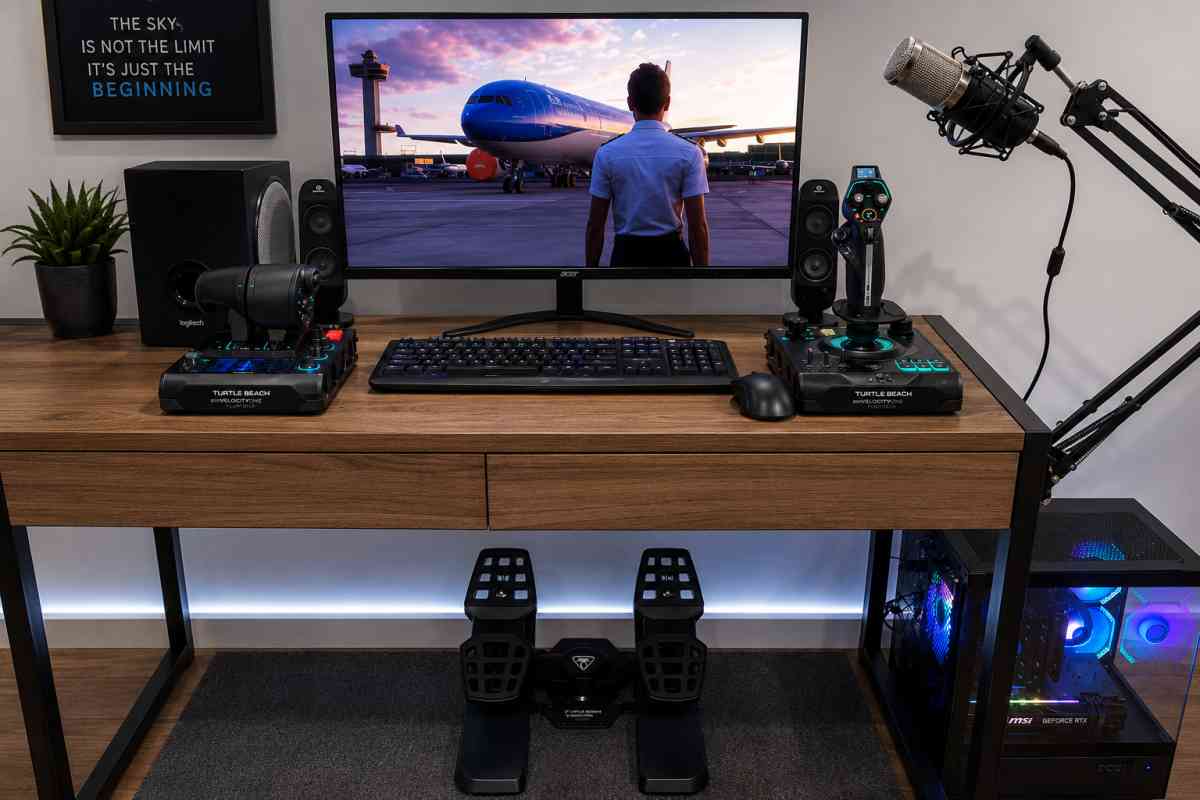
I’ve spent hundreds of hours in Microsoft Flight Simulator over the years. Like most serious simmers, I’ve gradually built my setup piece by piece, always chasing that elusive feeling of actually being in the cockpit rather than sitting behind a desk.
The latest additions to my virtual flight deck have been the Turtle Beach VelocityOne Flightdeck HOTAS system and the VelocityOne Rudder Pedals.
After extensive flying in Microsoft Flight Simulator 2024, ranging from general aviation aircraft and bush trips through to larger airliners, I can comfortably say these products have transformed the experience.
The biggest surprise wasn’t the Flightdeck. It was the rudder pedals.
First Impressions
Turtle Beach has clearly aimed the VelocityOne Flightdeck at enthusiasts who want something more substantial than an entry-level joystick but don’t necessarily want to spend thousands assembling a specialist cockpit.
The Flightdeck is a premium HOTAS system featuring Hall-effect sensors for precision and longevity, a fighter-inspired throttle design, an OLED display, and an impressive number of programmable controls.
With 15 axes and up to 139 programmable functions available, there is more than enough flexibility for even the most demanding aircraft setups.
What struck me immediately was the build quality. The stick feels solid and precise, while the throttle has a satisfying weight and resistance that makes engine management feel deliberate rather than mechanical.
After a few flights, muscle memory starts to take over. Instead of hunting for keyboard shortcuts, almost everything you need is within reach.
Flying MSFS 2024 with the Flightdeck
Microsoft Flight Simulator 2024 rewards precision more than ever, particularly during approaches, crosswind landings and hand-flown departures.
This is where the Flightdeck shines.
The Hall-effect sensors provide smooth, highly accurate inputs that eliminate the small inconsistencies often found in cheaper flight controls.
Whether I was hand-flying a Cessna through turbulent weather or managing a larger aircraft on final approach, the controls felt predictable and responsive.
The throttle unit deserves special mention. Having dedicated controls, physical detents and extensive customisation options creates a far more authentic experience than using keyboard commands or generic gaming controllers.
For combat and military aircraft, the Flightdeck’s fighter-inspired design feels particularly at home. But I was pleasantly surprised by how adaptable it proved across virtually every type of aircraft I flew.
The Real Game Changer: VelocityOne Rudder Pedals
As much as I enjoy the Flightdeck, the VelocityOne Rudder Pedals ended up being the standout product in my setup.
Before using dedicated rudder pedals, I relied on twist controls and occasional keyboard inputs. They worked, but they never felt natural.
The moment I installed the VelocityOne Rudder Pedals, taxiing alone became a completely different experience.
That may sound like a small thing, but experienced simmers will understand exactly what I mean.
For the first time, I wasn’t steering an aircraft using compromises. I was steering it the way real pilots do.
The pedals feature a smooth rudder axis along with differential toe brakes, allowing precise ground handling, tighter turns and far greater control during take-off and landing rolls. The adjustable pedal positions and swappable springs also allow you to tailor the feel to different aircraft types.
Crosswind landings immediately became more engaging.
Holding centreline during take-off felt more realistic.
Taxiing through busy airports suddenly required proper footwork instead of a quick twist of the wrist.
The difference in immersion is difficult to overstate.
Why Rudder Pedals Matter More Than Most Simmers Realise
Many simmers spend significant money upgrading yokes, throttles and graphics cards while overlooking rudder pedals.
After spending time with the VelocityOne Rudder, I think that is a mistake.
The feet are constantly involved in real-world flying. Removing that element from a simulator creates a disconnect, even if you don’t consciously notice it.
Adding dedicated rudder pedals closes that gap.
- You’re coordinating turns.
- You’re managing yaw.
- You’re working the brakes independently.
- You’re actively flying the aircraft with your entire body rather than just your hands.
That’s where immersion moves beyond graphics and starts becoming muscle memory.
The VelocityOne Rudder Pedals finally brought that missing dimension into my simulator.
Build Quality and Comfort
One area where Turtle Beach deserves credit is adjustability.
The rudder pedals offer different spring tensions and adjustable pedal configurations, making them suitable whether you’re flying a light trainer, a business jet or a military aircraft.
The pedals remain stable during use and never felt flimsy, even during aggressive braking and crosswind corrections.
Likewise, the Flightdeck’s stick and throttle have enough weight and resistance to feel purposeful without becoming tiring during longer flights.
Final Verdict
The Turtle Beach VelocityOne Flightdeck is an impressive HOTAS system that delivers precision, customisation and a genuinely premium feel. For Microsoft Flight Simulator 2024 pilots looking for a versatile flight control solution, it is one of the strongest packages currently available.
But if I had to identify the single upgrade that most transformed my experience, it would be the VelocityOne Rudder Pedals.
- They changed the way I interact with the simulator.
- Landings became more rewarding.
- Taxiing became more realistic.
- Crosswind operations became more challenging in all the right ways.
Most importantly, they introduced a level of immersion that simply cannot be replicated with a twist stick or keyboard controls.
Together, the Flightdeck and Rudder Pedals create a setup that feels less like playing a flight simulator and more like operating an aircraft.
For serious Microsoft Flight Simulator 2024 pilots, that’s about as high a compliment as I can give.