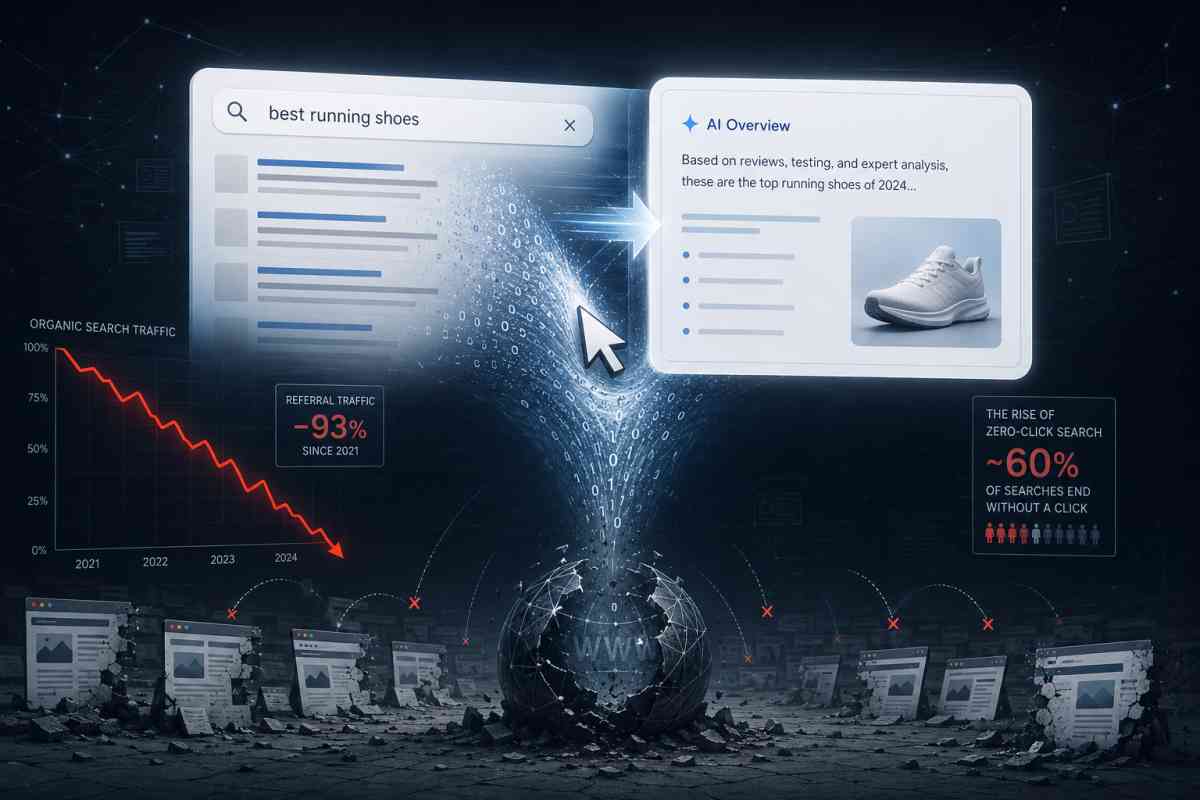


Google is not dying. The old search bargain is.
For more than two decades, search worked on a simple exchange.
Users typed a query. Google organised the web. Publishers, businesses and creators received traffic. Advertisers paid to appear near intent.
The system was imperfect, often brutal, and increasingly tilted toward the platform. But the bargain held because search still sent people outward.
That bargain is now breaking.
Not because people have stopped searching. They have not. Google still controls about 90% of the global search engine market.
Search advertising remains one of the largest money machines in the digital economy. Alphabet’s search revenue is still growing. By the old financial measures, search looks healthy.
But by the web’s measures, it is deteriorating.
The collapse is not a collapse in search demand. It is a collapse in search as a referral system. The search box is becoming an answer box.
The results page is becoming a destination. The blue link is becoming optional. For publishers, affiliates, small businesses and independent site owners, that distinction is existential.
The new search economy is not built around sending users to the best page. It is built around extracting the answer, displaying it inside the platform, monetising the session, and letting the source fight for whatever scraps of attribution remain.
That is the collapse of search as we know it.
The market share says stability. The click data says rupture.
On the surface, Google remains overwhelmingly dominant. StatCounter put Google’s worldwide search engine share at 90.39% in May 2026, with Bing at 5.03%, Yahoo at 1.4%, Yandex at 0.99%, DuckDuckGo at 0.71% and Baidu at 0.53%.
That is not what disruption usually looks like. There is no clean platform migration, no obvious MySpace-to-Facebook moment, no single rival eating Google’s lunch.
Instead, the product is mutating from the inside.
Google’s AI Overviews now reach more than 2.5 billion monthly active users, while AI Mode has passed 1 billion monthly users. In other words, the biggest AI search engine is not Perplexity, ChatGPT Search or Bing Copilot.
It is Google itself, grafted onto the default behaviour of billions of users.
That matters because it changes the unit economics of search. The old question was: “Who owns search market share?” The new question is: “How much of each search still leaks out to the open web?”
That answer is getting worse.
SparkToro’s 2024 zero-click study found that 58.5% of US Google searches and 59.7% of EU Google searches ended without a click. For every 1,000 US Google searches, only 360 clicks went to the open web.
That is the baseline before the full force of AI search has been priced in.
Then AI Overviews arrived as a second compression layer. Ahrefs, analysing 300,000 keywords using aggregated Google Search Console data, found that the presence of an AI Overview was associated with a 58% lower average click-through rate for the top-ranking result as of December 2025.
The numbers are stark. In Ahrefs’ dataset, the average position-one CTR for AI Overview keywords fell from 7.3% in December 2023 to 1.6% in December 2025. That is not a minor SERP layout change. It is a structural reduction in the value of ranking first.
Search has not disappeared. The click has.
The old SEO equation is broken.
The traditional SEO model rested on three assumptions:
- Ranking higher produces more traffic.
- More traffic produces more revenue.
- Publishing useful content increases the odds of both.
AI search weakens all three.
A publisher can rank first and still lose the click. A source can be cited and still receive no meaningful visit. A page can be used to generate an answer without receiving enough traffic to pay for the reporting, testing, expertise or maintenance behind it.
This is the central statistical shift: ranking position is becoming a less reliable predictor of traffic.
In the old search economy, a high ranking was an asset. In the AI search economy, a high ranking may simply make a page more extractable.
The result is a new form of content arbitrage. Publishers bear the cost of producing the answer. The platform captures the user session.
Advertisers continue buying attention where the user remains. The website receives visibility, perhaps a citation, but often not the visit.
That is why the phrase “zero-click search” understates the problem. The issue is not merely that users are satisfied faster. It is that the economic value of the answer is being transferred away from the party that created it.
The publisher traffic cliff is already measurable.
The clearest evidence is in referral data.
Chartbeat data reported by Axios found that over the past two years, traditional search referral traffic declined by 60% for small publishers, 47% for medium-sized publishers and 22% for large publishers.
That distribution matters. The collapse is not evenly felt. Large media brands have direct audiences, apps, newsletters, subscriptions, licensing teams, video operations and brand recognition. Smaller publishers often have search.
When search drops, they do not lose a channel. They lose the channel.
The same Chartbeat dataset found that page views from Google Search fell 34% from December 2024 to December 2025, while Google Discover fell 15%.
ChatGPT referrals grew by more than 200% over the same period, but still accounted for less than 1% of publisher referral page views.
That is the replacement problem in one sentence: AI referrals are growing quickly from a tiny base, while search referrals are shrinking from a massive base.
The Reuters Institute’s 2026 media trends work, reported by The Guardian, found that media leaders expect search engine referrals to fall 43% over three years.
It also reported that search traffic to news sites had already fallen by about a third globally across more than 2,500 news sites sourced by Chartbeat.
This is not a theoretical panic inside SEO circles. It is showing up in publisher dashboards.
The most worrying evidence is causal.
Much of the AI search debate is noisy because correlation is easy to overclaim. Traffic can fall for many reasons: algorithm updates, weak news cycles, platform changes, seasonality, competition, social decline, subscription walls, and audience fatigue.
But the evidence is becoming stronger.
A 2026 study of Google AI Overviews and Wikipedia used a difference-in-differences design across 161,382 matched article-language pairs.
The researchers compared English Wikipedia articles exposed to AI Overviews against the same underlying articles in language editions that were not exposed during the observation period.
The result: AI Overview exposure reduced daily traffic to English Wikipedia articles by about 15%.
That is important because Wikipedia is not a weak content farm. It is one of the web’s canonical reference sources.
If AI summaries can materially reduce traffic to Wikipedia, the effect on commercial informational publishers, niche sites and ad-supported explainers could be harsher.
The study also found larger relative declines for culture articles than for STEM topics, suggesting that AI answers are especially substitutionary when a short summary satisfies the user’s intent.
That finding points to a hard truth: not all content is equally defensible.
Commodity explanations, basic definitions, simple how-to answers, celebrity facts, travel summaries, product comparisons and evergreen service journalism are all exposed. If the user only needs a paragraph, the machine can intercept the visit.
Search revenue is still growing, which makes the collapse more dangerous.
The paradox is that the search business remains financially strong.
IAB/PwC reported that US search revenue, including AI search, reached $114.2 billion in 2025, representing 38.8% of total digital ad revenue.
Search still held the largest share of revenue dollars. But growth slowed to 11% year on year, down from 15.9% in 2024.
Alphabet’s own results show the same resilience. In Q4 2025, Google Services revenue rose 14% to $95.9 billion, led by 17% growth in Google Search & other. Alphabet also said annual revenue exceeded $400 billion for the first time.
This is why the collapse is so difficult to see from Wall Street. Search can become worse for the open web while remaining excellent for Alphabet.
In fact, AI search may strengthen the platform in the short term. If users stay longer, ask more follow-ups, view more AI-generated answers and encounter ads inside AI surfaces, Google can preserve or even expand monetisation while sending fewer visits away.
Google has already moved ads into AI Overviews and AI Mode. That is the commercial logic of the new search page: keep the answer, keep the user, keep the ad opportunity.
The web gets attribution. The platform gets the money.
AI search changes who gets seen.
The collapse is not only about clicks. It is also about selection.
Traditional search was never neutral, but at least its basic structure was visible: ten blue links, snippets, ads, local packs, video modules, shopping boxes, featured snippets. Publishers could study rankings, query classes and competitors. They could test, adapt and measure.
AI search makes visibility harder to audit.
A 2026 arXiv study of 55,393 trending queries found that Google AI Overviews activated on 13.7% of queries overall, rising to 64.7% for question-form queries. It also found that nearly 30% of AI Overview-cited domains did not appear in the co-displayed first-page results.
That means AI citation is not simply “ranking, but with a summary.” It is a different selection layer.
Another 2026 study comparing traditional Google Search, AI Overviews and Gemini Flash 2.5 across 11,500 user queries found that AI Overviews appeared for 51.5% of representative real-user queries and were displayed above organic results.
It also found low overlap between retrieved sources across systems, with average Jaccard similarity below 0.2.
For publishers, this creates a new visibility problem. You can optimise for search rankings and still be absent from the AI answer.
You can be present in the AI answer and still receive little traffic. You can block AI crawlers and reduce the odds of being cited. You can allow crawling and risk being summarised instead of visited.
Every option carries a cost.
The answer layer introduces an accuracy problem.
The old search results page asked users to choose sources. The AI results page often chooses for them.
That raises the stakes of errors.
The same 2026 longitudinal study of AI Overviews decomposed responses into 98,020 atomic claims and found that 11% were unsupported by the cited pages. [11]
That is a serious number at search scale. A small error rate becomes large when multiplied across billions of monthly users.
More importantly, AI Overviews can flatten uncertainty. A search result list shows disagreement. An AI answer tends to synthesise, compress and resolve.
That compression may be convenient, but it is also editorial.
Search used to rank the web. AI search interprets it.
That is a different kind of power.
Regulation is arriving because the bargain is visibly breaking.
The UK Competition and Markets Authority moved in June 2026 to give publishers more control over whether their content is used to power AI features in Google Search, including AI Overviews.
The CMA described the requirement as a “world first” and said publishers should be able to opt out of AI use while maintaining stronger bargaining power.
The regulator also required Google to ensure publisher content is properly attributed with clear links in AI-generated search results.
This is a major policy signal. Regulators are beginning to separate two things Google has historically bundled together: visibility in search and permission to use content in AI search.
That distinction may shape the next phase of the web. Publishers do not merely want to be indexed. They want terms.
They want data. They want meaningful referral reporting. They want the right to refuse extraction without disappearing from conventional search.
The old robots.txt model was not built for this world. The web needs new rights around summarisation, citation, licensing, measurement and compensation.
The statistical model publishers should now use.
The most important metric is no longer ranking. It is click yield.
A simplified model looks like this:
Search value = query volume × visibility × click-through rate × revenue per visit
AI search attacks the third variable.
If a keyword once generated 100,000 monthly impressions and a top result earned a 7.3% CTR, that meant 7,300 visits. If an AI Overview reduces CTR to 1.6%, the same ranking produces 1,600 visits.
The publisher has not lost visibility. It has lost 5,700 visits.
That is a 78% raw decline in clicks in the example drawn from Ahrefs’ observed AI Overview keyword CTR movement between December 2023 and December 2025.
Even if revenue per visit improves, most publishers cannot make up that gap indefinitely. The fixed cost of quality content remains.
Reporting still takes time. Reviews still require testing. Expert editing still costs money. Databases need maintenance. Tools need development. Journalists, editors, developers and commercial teams still need salaries.
The machine lowers the marginal value of each ranking while leaving the production cost mostly intact.
That is the economic squeeze.
What survives?
The content most exposed to AI search has three traits: it is informational, summarised easily and weakly branded.
The content most likely to survive has the opposite traits.
It is original, experiential, data-rich, community-driven, transactional, visual, local, opinionated, entertaining, tool-based or strongly branded. It gives the user something an answer box cannot fully reproduce.
That does not mean every publisher should abandon SEO. Search will remain a major discovery channel. Google will remain huge.
Millions of users will still click. Commercial queries will still matter. Local intent will still matter. Product-led searches will still matter.
But SEO can no longer be the centre of the audience strategy.
The strategic shift is from ranking dependence to demand ownership.
That means:
- building direct audiences through newsletters, apps, memberships, podcasts, communities and repeat-use products
- investing in brand search, not just non-brand search.
- creating proprietary data, calculators, tools, databases and reporting that cannot be cheaply summarised.
- treating video, social and creator distribution as core infrastructure, not side channels.
- using AI visibility monitoring, but not mistaking citations for traffic.
- negotiating licensing where leverage exists.
- reducing dependence on low-margin evergreen explainers that AI can answer instantly.
- measuring revenue by audience relationship, not just page view volume.
The publishers that survive will not be the ones that “do SEO harder.” They will be the ones that make themselves worth seeking out by name.
The end of search is really the end of borrowed traffic.
Search is not disappearing. It is becoming ambient, conversational and embedded across browsers, operating systems, apps, assistants and agents.
The search bar will still exist. But the old behaviour — type query, scan links, click source, read page — is no longer the default path for many informational needs.
The web built a huge economy around that path.
That economy is now being repriced.
The collapse of search as we know it is not a single event. It is a statistical erosion: a few percentage points fewer clicks here, a lower CTR there, an AI answer above the fold, a chatbot referral that does not replace the lost Google visit, a publisher deciding the next evergreen article is no longer worth commissioning.
Eventually, the numbers become a business model.
Google will survive this transition. So will the largest platforms. Some publishers will adapt. Some will build stronger direct relationships than they ever had in the good old SEO days
But the open web will not look the same.
For years, the web’s operating assumption was that good information could earn attention through search.
That assumption is now broken.
That is the real collapse.
Not the death of searching.
The death of the click as the web’s basic unit of reward.