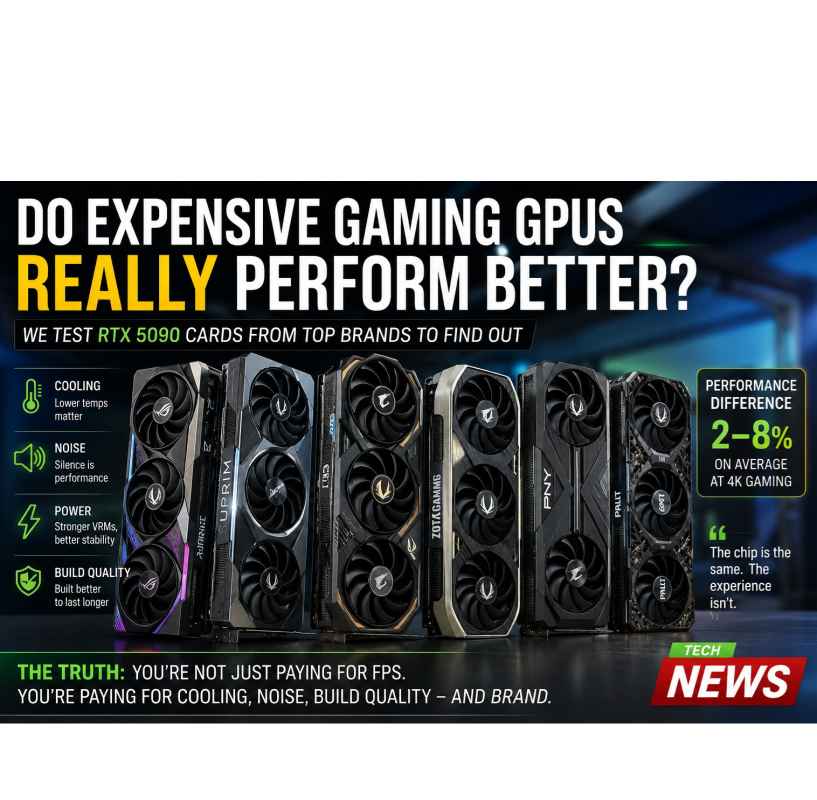
An RTX 5090 is still an RTX 5090.
Whether it’s made by ASUS, MSI, Gigabyte, ZOTAC, PNY, or Palit, the underlying NVIDIA chip is fundamentally the same.
In most modern gaming benchmarks:
- Entry-level and premium variants are often separated by only 2–8% performance
- At 4K resolution, the gap can shrink further because games become GPU-limited
- Many factory overclocks amount to little more than a few extra frames per second
A $3,500 “extreme OC edition” won’t magically turn a 120 FPS game into 200 FPS.
That’s the reality many buyers discover after spending hundreds extra.
Where the Expensive Models Do Matter
The difference shows up less in raw FPS — and more in how the card behaves.
1. Cooling Performance
This is the biggest real-world differentiator.
Premium cards typically include:
- Larger heatsinks
- Vapor chamber cooling
- Better thermal pads
- Triple or quad-fan designs
- Higher airflow
- Improved VRM cooling
Result:
- Lower temperatures
- Less thermal throttling
- Better sustained boost clocks
A cheap RTX 5090 may hit the same peak speed briefly, but a premium one can maintain it longer under heavy loads.
That matters for:
- Long gaming sessions
- AI workloads
- 3D rendering
- Video production
- Overclocking
2. Noise Levels
This is where expensive GPUs often earn their reputation.
Budget cards can sound like:
- small vacuums,
- server fans,
- or jet engines under load.
Higher-end models often use:
- larger fans spinning slower,
- quieter bearings,
- better fan curves,
- semi-passive cooling.
The FPS may be identical — but the experience is very different.
A silent GPU becomes surprisingly valuable once you’ve lived with one.
3. Power Delivery & Stability
Premium models usually include:
- stronger VRMs,
- better capacitors,
- cleaner power phases,
- higher power limits.
This matters mostly for:
- overclockers,
- enthusiasts,
- workstation users,
- heavy AI compute,
- long-term durability.
For average gaming? The gains are modest.
But cheaper cards sometimes run closer to thermal or electrical limits.
4. Build Quality
This is harder to benchmark, but easy to feel.
More expensive cards often include:
- metal backplates,
- reinforced frames,
- anti-sag structures,
- better PCB layouts,
- higher-quality fans.
Cheaper cards can flex more, vibrate more, and age less gracefully.
Given how enormous modern flagship GPUs have become, physical durability matters more than it used to.
What You’re Often Paying Mostly For
RGB and Branding
A large chunk of premium pricing is aesthetic.
You’ll often pay extra for:
- LCD displays,
- RGB lighting,
- “gaming” styling,
- anime editions,
- white editions,
- limited editions.
These do nothing for performance.
Factory Overclocks
Factory overclocks used to matter more.
Modern NVIDIA boost algorithms already push cards aggressively near their limits.
That means:
- manual overclocking headroom is smaller,
- factory OC gains are often tiny,
- many cheaper cards can be tuned close to premium models.
In many cases, buyers are paying hundreds for:
“3–5% more performance.”
The Hidden Truth: Silicon Lottery Still Exists
Even among identical models, some chips are naturally better.
A cheaper card can occasionally outperform an expensive one simply because:
- its silicon quality is better,
- temperatures are favorable,
- or NVIDIA’s boost behavior scales well.
That frustrates buyers who assume higher price guarantees superior performance.
It doesn’t.
Which Brands Tend to Focus on What
Premium / Quiet / Enthusiast
- ASUS ROG Strix Series
- MSI Suprim Series
- Gigabyte AORUS Series
Usually:
- best cooling,
- quieter operation,
- highest power limits,
- highest prices.
Mid-Range Sweet Spot
- MSI Gaming Trio
- ASUS TUF Gaming
- Gigabyte Gaming OC
Often the best balance:
- strong thermals,
- reasonable acoustics,
- near-premium performance,
- lower prices.
This is where many experienced builders buy.
Budget-Oriented
- ZOTAC Gaming
- Palit GamingPro
- PNY GeForce Series
Usually:
- cheaper coolers,
- less aggressive tuning,
- louder operation,
- fewer extras.
But still fundamentally capable.
So Should You Buy the Cheapest RTX 5090?
Usually:
- avoid the absolute cheapest,
- but also avoid overspending on halo models unless you specifically value silence, aesthetics, or overclocking.
The smartest buys are often:
- mid-tier cooling designs,
- reputable warranty support,
- solid thermals,
- reasonable noise.
That’s where price-to-performance tends to peak.
The Premium Model Illusion Conclusion
The GPU market sells the illusion that every premium model is dramatically faster.
In reality:
- the chip matters most,
- the cooler matters second,
- branding matters far less than many buyers think.
A high-end RTX 5090 from one manufacturer may feel more refined, quieter, and cooler than another — but it rarely transforms gaming performance in proportion to its price.
For most players, the jump from:
- RTX 5080 → RTX 5090
is far more meaningful than:
- cheap RTX 5090 → luxury RTX 5090.
Ultra-Expensive RTX 5090 Editions
Premium RTX 5090 variants can cost thousands more than standard models due to liquid cooling, factory overclocks, limited-edition designs, and enthusiast-focused features.
| GPU Model | Average Price | Highlights |
|---|---|---|
| ASUS ROG Astral RTX 5090 OC / BTF | $6,499–$6,899 AUD | High-end air-cooled flagship with premium build quality and aggressive factory overclocks. |
| Gigabyte AORUS RTX 5090 Xtreme Waterforce | $6,299–$7,300 AUD | Premium liquid-cooled model with 240mm and 360mm radiator configurations. |
| ASUS ROG Matrix Platinum 30th Anniversary Edition | Up to $9,760 AUD | Limited-edition extreme overclocking card with liquid metal cooling and quad-fan thermal design. |