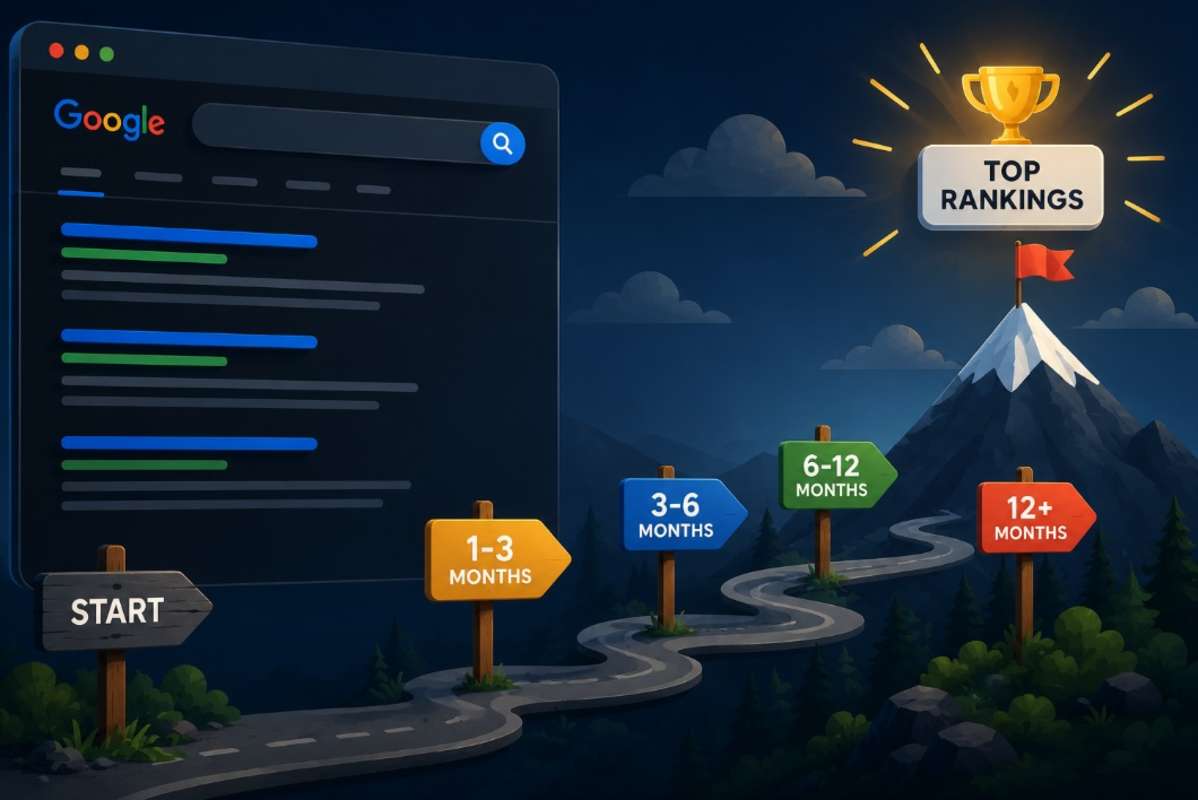


If you’ve just launched a website or started investing in SEO, you’re probably asking the same question every business owner eventually asks:
“How long does it take to rank on Google?”
Why does it take so long to rank on Google? The honest answer?
For most websites, meaningful SEO results take 3–6 months.
In more competitive industries, it can take 6–18 months to consistently rank on page one of Google.
That’s not because SEO is broken.
It’s because Google is designed to reward websites that prove they’re trustworthy over time.
Understanding how Google rankings actually work helps set realistic expectations — and realistic expectations are where successful SEO starts.
Why SEO Takes Time
Google’s entire business depends on delivering trustworthy search results.
If new websites could rank instantly, search results would be flooded with:
- Spam websites
- AI-generated junk content
- Fake businesses
- Scam affiliate pages
- Low-quality copied articles
So Google intentionally slows the process down.
Before Google gives your website strong visibility, it wants evidence that:
- Your business is legitimate
- Your content genuinely helps users
- Visitors engage with your website
- Your site is technically reliable
- Other websites trust and reference you
- You consistently publish quality information
That trust is built gradually.
SEO is not like paid advertising where you turn on ads and immediately appear at the top of search results.
SEO works more like reputation.
And reputation compounds over time.
The 5 Stages of Ranking on Google
Most websites go through the same progression before they start ranking consistently.
Understanding these stages helps you avoid unrealistic expectations and common SEO mistakes.
Stage 1: Google Discovers Your Website
Before your website can rank, Google first needs to find your pages.
This usually happens through:
- Google Search Console
- Internal links
- XML sitemaps
- Backlinks from other websites
- Social media mentions
Established websites may get discovered within hours.
Brand-new websites can take days or weeks because Google crawls unknown websites less frequently.
How to Speed Up Website Discovery
- Set up Google Search Console immediately
- Submit your sitemap
- Create strong internal links
- Share content on social media
- Publish consistently
Stage 2: Google Indexes Your Content
Once Google discovers your pages, it decides whether they deserve to enter Google’s index.
This is where many websites quietly fail.
Google may choose not to index pages that are:
- Thin or low quality
- Duplicated
- Poorly structured
- Technically broken
- AI-generated without original value
Just because you publish content does not mean Google accepts it.
Common Reasons Google Won’t Index Your Website
Your robots.txt blocks Google
A single line can prevent your entire website from appearing in search results.
Your WordPress privacy settings are enabled
This is extremely common after website launches.
Your pages have weak internal linking
If Google cannot naturally navigate your website, pages often stay undiscovered.
Your content offers no original value
Google is becoming much better at identifying rewritten or generic content.
Stage 3: Google Tests Your Content in Search Results
After indexing, Google may begin testing your pages for smaller keywords and lower-competition searches.
At this stage, rankings often fluctuate heavily.
Google watches how users interact with your content, including:
- Click-through rates
- Time on page
- Bounce rates
- Engagement signals
This phase is essentially Google deciding whether users actually find your content useful.
Stage 4: Google Builds Trust in Your Website
As your website gains backlinks, publishes consistently, and earns engagement, Google slowly builds confidence in your site.
Some of the strongest SEO trust signals include:
- High-quality helpful content
- Backlinks from reputable websites
- Consistent publishing activity
- Strong user experience and site speed
- Secure HTTPS websites
- Positive user engagement
- Clear internal linking
- Author expertise and credibility
- Brand mentions across the web
- Genuine reviews and testimonials
Google rankings take time because trust takes time.
Google builds trust through quality content, backlinks, consistency, and user experience. There’s no real shortcut — and understanding that timeline is where good SEO starts.
Stage 5: Rankings Grow Through Authority & Momentum
Once Google sees your website as trustworthy and authoritative, SEO growth becomes much faster.
New pages index quicker.
Rankings improve more consistently.
Internal links become stronger.
Your entire website gains momentum.
This is where SEO starts compounding — and why consistent websites usually outperform inconsistent competitors long term.
The Biggest SEO Myth: More Content = Faster Rankings
Publishing content helps.
But publishing massive amounts of mediocre content rarely works anymore.
Google does not reward volume.
Google rewards:
- Original insights
- Expertise
- Real experience
- Helpful information
- Strong user engagement
- Topical authority
One exceptional article can outperform 50 shallow blog posts.
This is especially true after Google’s Helpful Content updates.
What Actually Speeds Up Google Rankings?
Several factors dramatically influence how fast a website ranks on Google.
1. Domain Age and Website Trust
Older domains often rank faster because Google already understands and trusts them.
A 10-year-old domain with consistent activity has accumulated authority over time.
A brand-new domain starts from zero.
That doesn’t mean new websites cannot rank.
It means they need stronger trust signals.
Domain age alone does not automatically give a website authority. An older domain can still have very little trust if it lacks quality content, backlinks, user engagement, or consistent activity over time
2. Search Intent Match
Most websites fail because they target the wrong keywords.
They create content they want to publish instead of content users are actively searching for.
Google’s job is matching search intent.
If someone searches:
“best accounting software for small business”
Google expects:
- Comparisons
- Reviews
- Pricing
- Pros and cons
- Feature breakdowns
If your page only talks generally about accounting software, it probably won’t rank.
Intent alignment matters more than keyword stuffing.
3. Competition Level
Some industries are relatively easy to rank in.
Others are brutally competitive.
Easier SEO Niches
- Local trades in smaller cities
- Specialty services
- Unique B2B industries
- Emerging markets
Harder SEO Niches
- Finance
- Legal
- Health
- Real estate
- Marketing
- Software
If competitors have been building backlinks and authority for years, overtaking them takes time.
4. Backlinks and Brand Signals
Backlinks still matter.
A lot.
But modern SEO goes beyond traditional backlinks.
Google also looks for:
- Brand searches
- Direct traffic
- Mentions across the web
- Social proof
- Returning visitors
- User engagement
If people actively search your business name, that’s a powerful trust signal.
Google sees real-world demand.
5. Website Quality and User Experience
Google increasingly evaluates:
- Website speed
- Mobile usability
- Navigation clarity
- Accessibility
- Content structure
- Bounce rates
- Engagement metrics
If users quickly leave your website, rankings usually suffer.
Because Google interprets that behaviour as dissatisfaction.
Realistic SEO Timelines for Different Websites
Brand-New Website
Typical Timeline:
- Indexing: 1–4 weeks
- Initial rankings: 2–4 months
- Meaningful traffic: 6–12 months
New websites face the biggest trust barrier.
Local Service Business SEO
Typical Timeline:
- Low competition markets: 1–3 months
- Moderate competition: 3–6 months
- Major cities: 6–12 months
Local SEO can move surprisingly fast if competitors are weak.
Established Website Publishing New Content
Typical Timeline:
- Indexing: Hours to days
- Rankings: Days to weeks
Trusted domains rank new content dramatically faster.
E-commerce SEO
Typical Timeline:
- Category pages: 4–12 months
- Product pages: Variable
- Competitive keywords: Often 12+ months
E-commerce SEO is usually a long-term investment.
Why Most Businesses Fail at SEO
The biggest reason businesses fail at SEO is simple:
They stop too early.
SEO often feels invisible at first.
You publish content.
Nothing happens.
You improve pages.
Still nothing.
Then suddenly rankings begin climbing.
That’s because SEO compounds over time.
Every article, backlink, internal link, and user interaction builds momentum.
The businesses that win are rarely the ones doing something magical.
They are usually the ones who stayed consistent longer than everyone else.
The SEO Compound Effect
A single blog post might not rank.
But 50 interconnected, high-quality articles create topical authority.
Topical authority tells Google:
“This website deeply understands this subject.”
Once that happens:
- Indexing speeds up
- Rankings improve faster
- New pages gain traction quicker
- Internal links become more powerful
- Backlinks have greater impact
SEO momentum is real.
And it becomes easier over time.
How to Rank Faster on Google (Without Gaming the System)
Focus on Easier Keywords First
Trying to rank immediately for ultra-competitive keywords is usually a mistake.
Instead:
- Target long-tail keywords
- Answer niche customer questions
- Build authority gradually
For example:
Instead of targeting:
“personal injury lawyer”
Target:
“what to do after a motorcycle accident in Melbourne”
Smaller wins build trust.
Trust unlocks bigger rankings later.
Publish Consistently
Consistency matters more than intensity.
One excellent article every week is far more effective than publishing 20 rushed articles and disappearing.
Google rewards active websites.
Consistency also trains Google’s crawlers to visit your website more frequently.
Build Content Around Real Expertise
Google increasingly favours experience-driven content.
The best-performing articles usually include:
- Original examples
- Personal insights
- Case studies
- Real opinions
- Practical experience
This is exactly why generic AI content often struggles.
AI can summarise.
But it cannot replace lived experience.
Improve Internal Linking
Internal links are massively underrated.
Strong internal linking helps:
- Google discover pages
- Pass authority through your website
- Improve user navigation
- Increase time on site
Every important page should connect logically to related pages.
Build Branded Searches
One overlooked SEO ranking signal is branded search demand.
When people search specifically for your business name, Google notices.
You can increase branded searches through:
- YouTube
- Social media
- Email marketing
- Podcasts
- PR
- Offline marketing
- Community engagement
The strongest SEO strategies combine branding and SEO together.
What to Do If Your Website Still Isn’t Ranking
If nothing improves after 60–90 days, investigate deeper.
Check Google Search Console
Look for:
- Indexed pages
- Crawl errors
- Manual penalties
- Mobile usability problems
- Core Web Vitals issues
Analyse Your Competitors
Ask:
- How old are their websites?
- How many backlinks do they have?
- How comprehensive is their content?
- How strong is their brand presence?
Sometimes the issue isn’t your SEO.
It’s underestimating the competition.
Audit Content Quality
Ask honestly:
- Is this genuinely useful?
- Is it better than existing results?
- Does it add original value?
- Would someone bookmark or share it?
Google’s quality standards are much higher today than they were a few years ago.
The Truth About Hiring an SEO Agency
Hiring an SEO agency does not magically bypass Google’s trust-building process.
What a good SEO agency can do is:
- Prevent technical mistakes
- Improve keyword targeting
- Create better content strategy
- Build quality backlinks
- Optimise site structure
- Maintain consistency
But even the best SEO team cannot force instant rankings.
Google still needs time.
Final Thoughts: SEO Rewards Patience More Than Hacks
Why does ranking on google take so long?
There’s no magic shortcut to achieving sustainable Google rankings in a short amount of time.
The websites that win usually do the fundamentals better and longer than everyone else.
They:
- Publish consistently
- Build real expertise
- Earn trust gradually
- Improve user experience
- Stay active for years
Eventually, the compounding effect becomes difficult for competitors to catch.
That’s the real SEO advantage.
Not tricks.
Not loopholes.
Consistency.
That combination compounds over time and produces the strongest long-term results.
Frequently Asked Questions
- The keyword is too competitive
- The content lacks depth
- Search intent doesn’t match
- Competitors have stronger authority
- Target easier keywords
- Publish consistently
- Improve content quality
- Build strong internal links
- Earn backlinks naturally
- Focus on user experience
Ranking on Google takes time because search engines prioritise trust, relevance, and consistency over quick wins. Google needs to evaluate your website’s content quality, authority, user experience, and credibility before rewarding it with strong rankings.
Since thousands of websites compete for the same keywords, building long-term SEO success requires ongoing optimisation, valuable content, and patience. While there are ways to accelerate growth, sustainable rankings are earned over time — not achieved overnight.