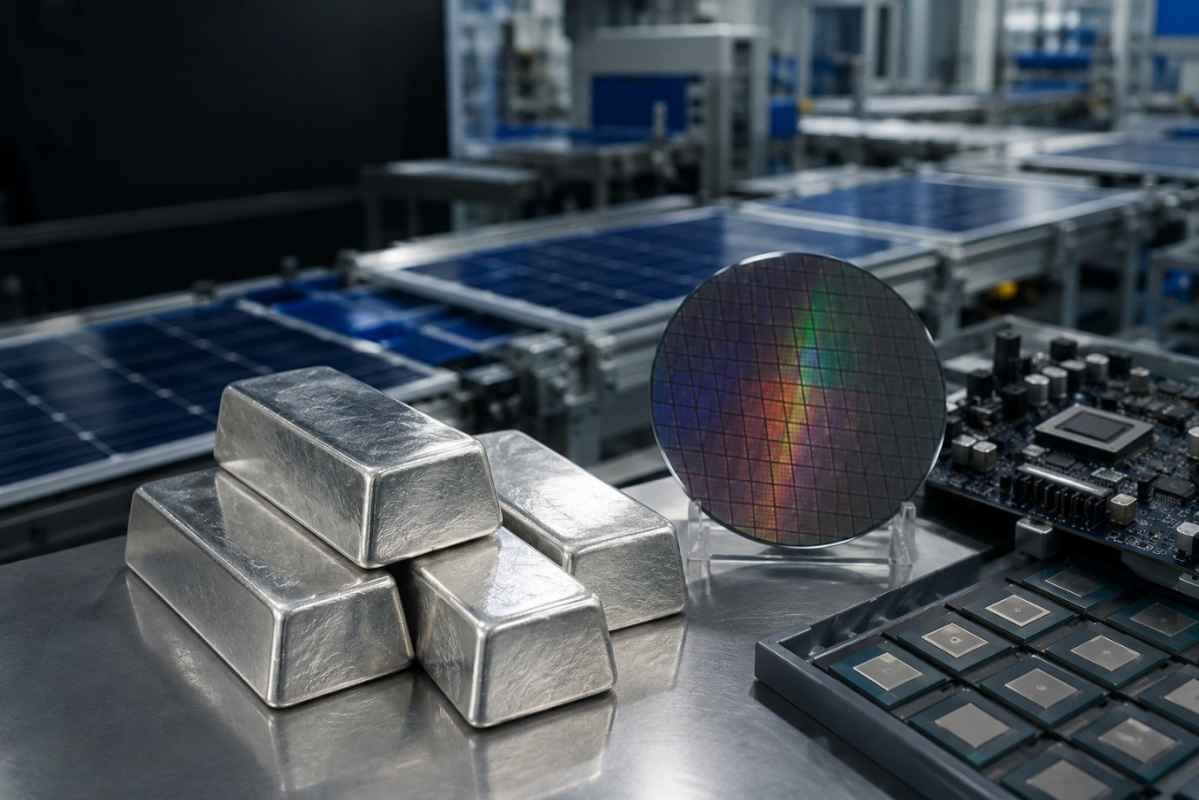


For years, silver has been viewed mainly as the cheaper and more volatile alternative to gold, bought by investors worried about inflation, interest rates or the next market shock.
That view is now too narrow, because the same metal sitting in a bullion dealer’s safe is also moving through solar factories, electric vehicles, advanced electronics, medical equipment and power infrastructure.
That puts silver in an unusual position in the global economy. Shares can tell investors how companies are performing, bonds can reveal where markets think interest rates are heading, and currencies can reflect confidence in governments and central banks.
Silver reacts to many of those pressures, while also carrying a direct link to the physical technology economy that is being reshaped by artificial intelligence, renewable energy investment and the race to build more advanced hardware.
Price climbed sharply early in 2026 before easing
The chart shows a rise from about 40 in October 2025 to a February 2026 peak near 115, followed by a volatile decline and partial recovery towards September.
Figures underline why the silver is attracting attention outside traditional precious metals circles.
Global industrial silver demand reached 657.4 million ounces in 2025, despite falling 3% from the previous year, while the Silver Institute forecasts industrial fabrication will ease another 2% in 2026 to about 650 million ounces.
The expected decline is largely tied to solar manufacturers using less silver per panel and, in some cases, substituting other materials, rather than a collapse in the importance of technology manufacturing.
A metal linked to the technology supply chain
Silver is one of the best electrical conductors available, which gives it a place in products that are increasingly central to everyday life.
It is used in photovoltaic cells, circuit boards, switches, connectors, automotive electronics and specialist medical applications, meaning demand can shift with changes in factory output and global technology spending.
That matters at a time when the semiconductor industry is expanding at extraordinary speed.
The Semiconductor Industry Association reported global chip sales of US$403.3 billion during the second quarter of 2026, up 35.1 per cent on the first quarter, while sales in June reached US$134.5 billion, a 123.6 per cent increase on the same month a year earlier.
The organisation has said the industry could reach US$1.5 trillion in annual sales during 2026, driven by AI infrastructure and accelerated computing platforms
Silver does not rise and fall in a neat line with chip sales, and it would be a mistake to treat it as a single measure of the technology market.
According to SDBullion.com when investors watch the price of silver alongside semiconductor orders, manufacturing data and solar installation numbers, it can provide an early indication of whether activity is strengthening or slowing across parts of the industrial economy.
Solar’s expansion is changing the silver market
The solar sector has been one of the biggest forces behind silver demand in recent years, particularly as governments and businesses have pushed to add renewable generation while electricity use rises.
Data centres and AI systems are adding another layer of pressure, with the International Energy Agency warning that AI is set to drive a sharp increase in data-centre electricity demand over the coming years
The relationship is becoming more complicated, however. Solar capacity is still growing, but manufacturers are working to reduce the amount of silver used in each panel because higher silver prices create a cost problem at scale.
That is why silver demand from photovoltaics can fall even as more panels are installed worldwide, creating a tension between rapid clean-energy deployment and the industry’s push to use less of an expensive material.
For investors and technology businesses, that distinction is important:
A softer silver market does not necessarily mean demand for solar technology or electrification has collapsed, as it may instead show that manufacturers are finding ways to reduce their exposure to a critical commodity.
It also means silver pricing can reveal the pressure being felt inside supply chains long before it becomes obvious in company earnings reports.
The market still reacts to inflation and central bank policy
Silver remains a monetary asset as well as an industrial material, which is why it can move sharply when investors begin worrying about inflation, falling real interest rates or weakening confidence in major currencies.
It is not held by central banks in the same way as gold, yet it is often bought by investors looking for a lower-cost way to gain exposure to precious metals when financial markets become unsettled.
The comparison between gold and silver can be useful in those periods.
When silver begins to outperform gold by a wide margin, it can indicate that buying has spread beyond institutions and into the retail market, where smaller investors are more likely to buy coins, bars and exchange-traded products.
When gold rises while silver fails to keep pace, concern may be concentrated among larger investors who prefer the deeper and more liquid gold market.
That does not make the gold-silver ratio a crystal ball, but it can show how widely financial anxiety is spreading.
It also highlights why silver can be far more volatile than gold, with the metal caught between competing forces such as factory demand, investor speculation, currency fears and geopolitical risk.
Supply shocks can quickly become a technology issue
Geopolitical events can have a particularly sharp effect on silver because supply chain disruption affects both its investment appeal and its industrial use.
A conflict, trade dispute, shipping disruption or sudden rise in energy costs can trigger immediate buying from investors while raising concern among manufacturers that depend on a reliable flow of metals and components.
The length of the reaction is often more useful than the first price spike. If silver settles back within days, traders may have concluded that the event is unlikely to cause lasting damage.
If it stays elevated for weeks, the market may be pricing in more serious concerns around mine supply, logistics, manufacturing costs or the availability of materials needed for electronics and renewable energy equipment.
This has become more relevant as technology companies and governments look harder at supply-chain security.
The International Energy Agency has reported that prices for key base metals, including copper, aluminium and tin, rose by roughly one-third between January 2025 and April 2026 amid tighter supply conditions, showing how quickly material costs can become a strategic issue.
Key base-metal prices rose about 33%
Copper, aluminium and tin prices increased by roughly one-third between January 2025 and April 2026 as supply conditions tightened.
Retail buying can tell a different story to the spot price
One of the more visible parts of the silver market is the physical premium charged on coins, rounds and smaller bars.
When those premiums rise sharply above the spot price, it can suggest that retail buyers are moving in with greater urgency, often because of concerns around inflation, currency stability or broader economic uncertainty.
When premiums soften, it may show that retail interest has cooled, even if the spot price remains high.
That helps separate a rally powered mainly by financial traders from one supported by people buying and holding physical metal, which can matter because strong physical demand reduces dealer inventories rather than simply shifting contracts between investors.
The Silver Institute said coin and bar demand jumped 14 per cent in 2025, even as total silver demand slipped 2 per cent to 1.13 billion ounces. That suggests retail interest remained strong while industrial buyers adjusted to changing conditions in solar and electronics manufacturing
Silver’s price now carries a wider message
Silver will never provide a perfect reading of the economy, and investors should be wary of treating any one commodity as a prediction machine.
Its value is in the fact that it reflects several overlapping pressures at once, including investor confidence, industrial activity, renewable energy spending, electronics demand and the health of global supply chains.
For the technology sector, silver is no longer simply a commodity tucked away in the background of manufacturing.
Its price can offer a glimpse into the pressure points facing the industries building AI infrastructure, solar capacity, electric transport and the next generation of consumer electronics, while also showing how nervous investors are becoming about the wider economy.
The metals sharp run has put the metal back on investors’ radar, but the price movement is also becoming a concern for technology manufacturers that depend on it for electronics, solar panels, electric vehicles and specialised hardware.
It traded between about US$66.20 and US$67.63 an ounce in early September, still roughly 61% higher than the same point last year after retreating from a dramatic January peak.