


Over the past year, more businesses and startups have begun using AI to build websites faster, reduce development costs and launch new ideas without the need to hire a full web development team.
Many of the sites look impressive at first glance, although developers and people familiar with AI builders can often spot the same layouts, gradients, oversized headings, rounded feature boxes and generic marketing copy appearing across completely unrelated businesses.
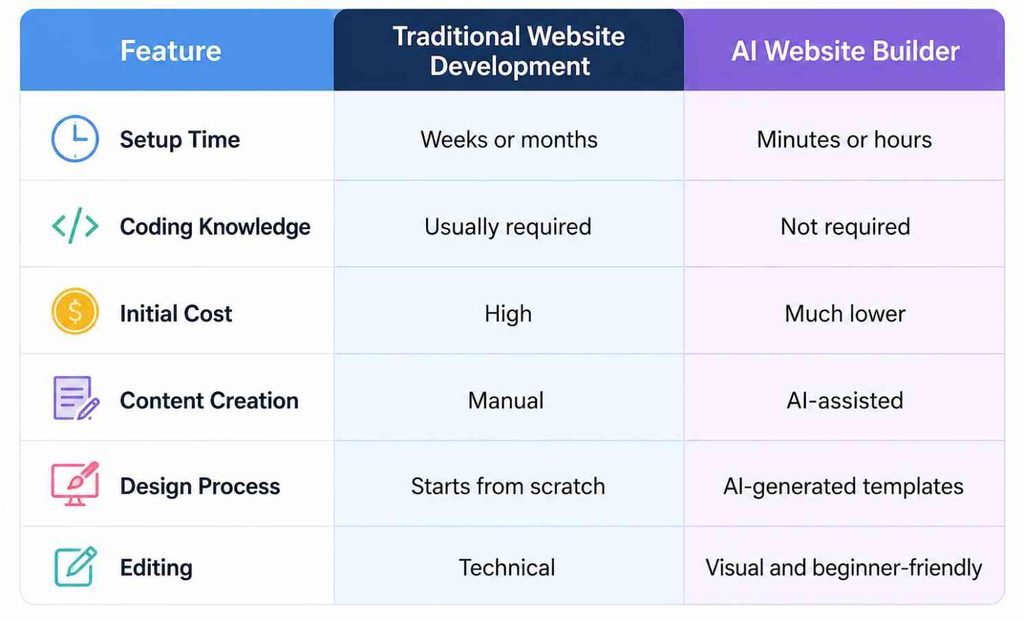
The appeal is obvious. Building a website once meant hiring a developer or agency, preparing a design brief and waiting weeks before the finished product was ready.
An AI website builder can now produce a homepage, service pages, images, contact forms and an early version of the written content from a short prompt.
How AI Is Changing Web Development
Artificial intelligence is changing web development by speeding up coding, automating design processes and moving developers from manually writing code towards directing, testing and reviewing AI-generated solutions.
Faster Coding and Automation
- Code Generation: AI assistants such as GitHub Copilot can quickly produce repetitive code, functions and reusable components.
- Code-Aware Editors: Tools such as Cursor can analyse entire codebases and generate code suited to a project’s existing structure and requirements.
- Testing and Debugging: Automated tools can identify bugs, expose vulnerabilities and suggest fixes in real time. Developers discussing the shift on Reddit say automating routine work gives them more time to concentrate on architecture
Smarter Design and User Experience
- Rapid Prototyping: Designers can use AI to create wireframes, page layouts and early design systems within minutes.
- Personalised Experiences: Machine learning can analyse visitor behaviour and deliver more relevant content, recommendations and website experiences in real time.
- Improved Security: AI systems can monitor live traffic, identify unusual behaviour and automatically respond to potential attacks.
Changing Skills and Workflows
- From Coding to Direction: Developers increasingly need strong technical fundamentals, clear prompting skills and the ability to check AI-generated work for errors.
- More Independent Development: Individuals can now create and launch functional websites and applications without relying entirely on traditional development teams.
Lovable, Replit, Base44 & Bolt Squeeze Web Developer Revenue
AI platforms such as Lovable, Replit, Base44, Bolt and v0 are beginning to squeeze revenue from basic web-development work, particularly brochure sites, landing pages and early prototypes that businesses can now generate themselves.
Lovable reached US$500 million in annualised revenue by June 2026 and now hosts 60 million projects, while Jobs and Skills Australia records a 600-person annual decline in Australia’s multimedia and web-development workforce, despite median weekly earnings of A$2,476.
Australian Businesses Are Adopting AI Quickly
The use of AI website builders is part of a wider increase in business adoption of artificial intelligence.
Figures released by the Australian Bureau of Statistics in June 2026 found 12 per cent of Australian businesses used AI in the workplace during 2024–25, compared with 1 per cent in 2021–22.
Tom Lay, head of business statistics at the Australian Bureau of Statistics, says the organisation’s latest Business Characteristics Survey showed adoption had risen sharply since generative AI tools became widely available.
“Around 12% of Australian businesses reported the use of AI in their workplace in 2024–25,” Lay said.
The survey found AI was being used by 35 per cent of large Australian businesses and 22 per cent of medium-sized organisations.
Uptake among small and micro businesses was lower at around 11 per cent, although the rate reached 19 per cent among innovation-active small businesses.
AI use was highest in information, media and telecommunications, where 38 per cent of businesses reported using the technology.
Professional, scientific and technical services, along with financial and insurance services, recorded adoption rates of 24%
There is no reliable figure showing exactly how many Australian business websites have been created using AI. Technology detection services can identify whether a site uses WordPress, Wix, React or another platform, but they cannot always determine whether its design, code or content began with an AI prompt.
Traditional Website Platforms Still Dominate
AI website builders are growing, although established content management systems remain responsible for a large share of the web.
W3Techs figures updated on 25 August 2026 show WordPress is used by 40.7 per cent of all websites and holds 58.9 per cent of the known content management system market.
Wix is used by 4.2 per cent of all websites, while Squarespace accounts for 2.4 per cent and Webflow 0.8 per cent. Those figures describe the underlying platforms and do not reveal how much AI was used during the design or development process.
Traditional platforms are also adding AI directly into their existing products. In January 2026, Wix launched Wix Harmony, an AI website builder that combines natural-language prompts with its existing visual editing and business tools.
“Now anyone can create a beautiful website, design easily with prompts and natural language,” said Avishai Abrahami, co-founder and chief executive of Wix, when the company announced Wix Harmony.
Abrahami said the platform was designed to retain the scalability, security, reliability and performance expected from a production website.
Wix also acknowledged that some prompt-based tools were better suited to demonstrations and early prototypes because generated output could contain bugs, security gaps or code that did not scale.
From a prompt to a functioning website
An AI Website Builder allows a user to describe a business, its customers and the type of website required in ordinary language.
The platform can then generate the page structure, design, written content and visual elements, with the user making changes through additional prompts or a visual editor.
This process is sometimes called Prompt to Website, where written instructions are turned into a functioning website instead of a design mock-up.
A No-Code Website Builder can also remove much of the technical barrier that previously made professional website development expensive or intimidating for smaller operators.
According to Creative AI its platform has generated more than 500,000 websites across more than 120 countries.
These are company-reported figures and have not been independently verified, although they give some indication of the scale at which prompt-based development platforms now claim to be operating.
For a small business, the practical benefit is speed. A fitness coach could enter information about services, pricing and target customers, then receive a website containing a homepage, service pages, contact form and early search content within the same day.
The first generated version would still need to be checked and rewritten. Business details can be wrong, calls to action may lead nowhere and AI-generated copy often says very little once the polished wording is stripped away.
The recognisable AI website look
The growing number of AI-built websites is creating a familiar design pattern. Many use a large headline, a short block of promotional text, a bright call-to-action button and several rows of rounded cards explaining features, benefits and testimonials.
These elements also appear in traditional templates, so appearance alone cannot prove that a website was created with AI.
However, the repeated combination of similar layouts, stock-style imagery and vague claims about helping customers innovate, transform or grow has made some AI-generated websites easier to suspect.
Developers may notice other clues in the code and behaviour of a site.
These can include repetitive component structures, inconsistent naming, unnecessary scripts and sections that look finished but do not behave properly when a form fails, a screen size changes or a user tries to complete an unexpected action.
For businesses, the bigger concern is that a website can look professional while saying almost nothing distinctive.
When the first generated version is published without original photography, real customer information or a recognisable brand voice, it can feel interchangeable with dozens of other startups.
Working Code Is Not Always Secure Code
Security becomes more important when an AI-generated website includes customer accounts, payment processing, booking systems or custom application functions.
The website may work as expected while still containing weaknesses that are difficult for a business owner without development experience to recognise.
Application security company Veracode tested more than 150 large language models for its Spring 2026 GenAI Code Security Update.
The research found 95% of generated code was syntactically correct, but only 55 per cent of generation tasks produced secure code when no specific security guidance was provided.
In the remaining 45% of tests, the model introduced a known security weakness. Veracode tested 80 coding tasks across Java, JavaScript, C# and Python, covering vulnerabilities including SQL injection, cross-site scripting, log injection and insecure cryptography.
“AI is transforming software faster than security teams can adapt,” Veracode chief executive Brian Roche said in an April 2026 company analysis.
The research was not an audit of commercial AI website builders, so the findings should not be applied directly to every generated website. They do show why custom code produced by AI still needs security testing before it is placed into a live business environment.
Accessibility Can Be Missed
A polished design can also hide accessibility problems. The WebAIM Million 2026 report analysed the homepages of one million widely visited websites and detected more than 56.1 million accessibility errors, averaging 56.1 errors per page.
Detected WCAG failures appeared on 95.9 per cent of the homepages examined. Low-contrast text was found on 83.9 per cent, while 53.1 per cent had images missing alternative text and 51 per cent had form inputs without proper labels.
WebAIM did not separate AI-built websites from traditionally developed sites, so the results cannot be attributed to AI website builders.
The findings still show why generated pages need accessibility testing instead of being published simply because they look complete on a laptop or mobile phone.
Ownership And Vendor Lock-In
Businesses also need to understand what they own after pressing publish. Some AI website platforms allow users to download the full source code and host the site elsewhere, while others keep the website inside a closed system that may be difficult to leave.
Creative AI says users can download the complete source code for websites and applications, host it independently and continue modifying it outside the platform.
Ownership of the domain name, customer data, analytics account and payment system should also be confirmed. A business can own its branding and content while remaining dependent on a platform for important functions that cannot be transferred easily.
Privacy Remains Part Of The Decision
AI-built websites are also beginning to include chatbots, customer portals and automated decision tools. These functions can collect personal information, which brings privacy obligations that do not disappear because the website was created without a developer.
The Office of the Australian Information Commissioner’s 2026 Australian Community Attitudes to Privacy Survey found 96 per cent of Australians believed conditions should be placed on AI use when it could affect them.
The survey found 79 per cent wanted to be told when AI was being used, while 81 per cent wanted the right to have an AI decision reviewed by a person.
Businesses using public-facing AI tools should clearly explain what information is collected, where it goes and whether a third-party provider can access it. Forms, chatbots and account systems should also be tested before launch rather than treated as finished because the AI builder generated them successfully.
Websites Are Becoming The Starting Point
The next stage of AI website building is already extending into software development.
Platforms are combining website generation with AI App Builder, AI Web App Builder and Prompt to App features that can create customer portals, booking systems, marketplaces, dashboards and early versions of digital products.
This will allow more startups to test ideas before investing in a full development team. It will also increase the need for experienced developers, security specialists and designers once those projects begin handling real customers, payments and personal information.
AI website builders have removed much of the cost and delay that once stopped small businesses from getting online.
The strongest results will come from businesses that treat the generated website as a first draft, then add real information, original branding and proper technical review.
AI creates the foundation, while people create trust.