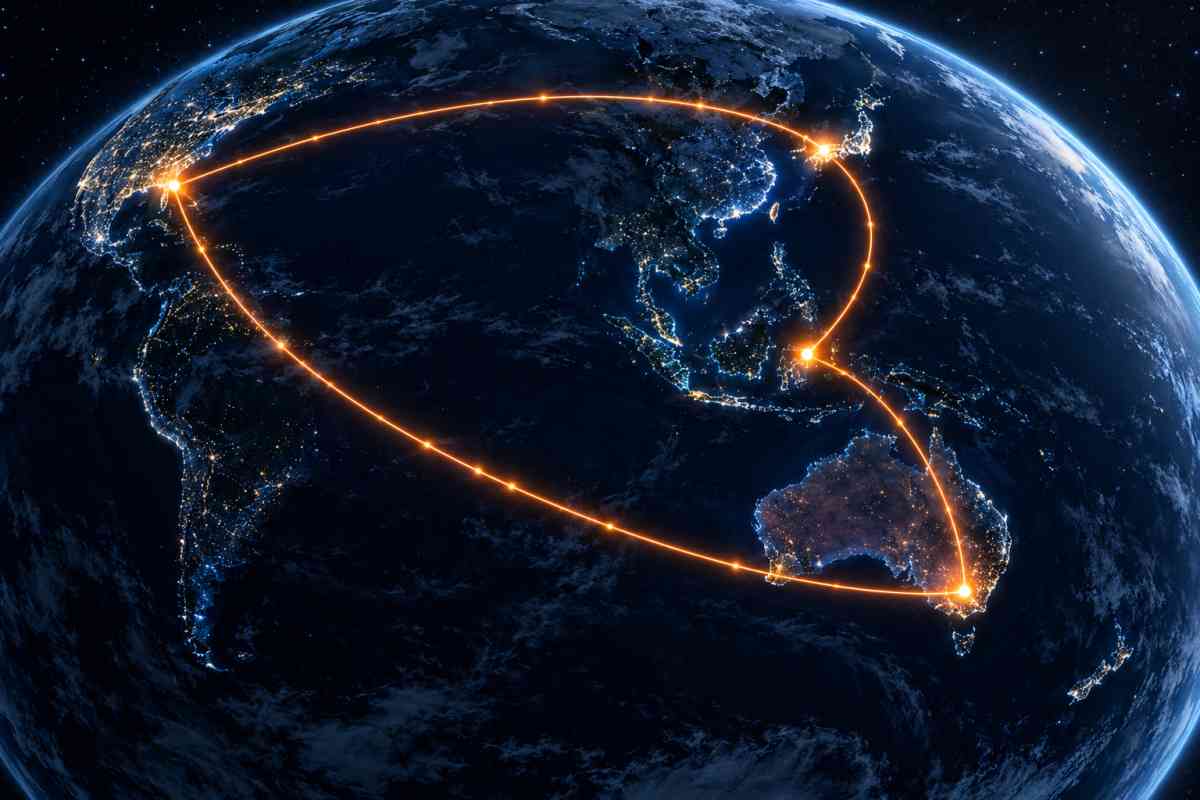
A confirmed fault on Vocus’s Australia-Singapore Cable (ASC) has disrupted international internet and transmission services between Australia and Singapore, forcing affected traffic onto alternate routes while a marine repair operation is planned.
Officially put into service in September 2018, the ASC was designed, built, and is solely operated by Vocus.
It stretches 4,600km between Perth and Singapore, with connections to Christmas Island and Indonesia, and provides an alternate and direct high-capacity route to Asia Pacific, as well as alternate connections to Europe and the United States.
The incident remains active as of 6 September, with Vocus confirming that the break is in Indonesian waters between Anyer and Singapore.
The company has completed testing from its Perth Cable Landing Station and says it has now established the precise location of the fault.
Vocus first disclosed the incident on 4 September, reported wavelength and Ethernet services on the cable were unavailable and that internet traffic had been rerouted through other paths.
It described the issue as a subsea cable fault and said a marine repair team had been engaged.
The fault is significant because the Australia-Singapore Cable is one of Vocus’s key international routes, carrying traffic between Western Australia and Singapore before onward connections into Asia, Europe and North America.
Vocus markets the cable as part of its wider international network, which includes infrastructure and capacity across Asia-Pacific, the United States and Europe.
The outage may also provide important context for troubling routing observations recorded from Melbourne in recent days.
Testing via an Australian ISP that uses the Vocus network demonstrated traffic bound for Singapore travelling from Melbourne through Sydney and San Jose, California, before continuing through Tokyo, Hong Kong and Singapore.
The route recorded sustained round-trip latency between 258ms and 350ms, with peaks above 400ms.
Melbourne → Sydney → San Jose, California → Tokyo, Japan → Hong Kong → Singapore
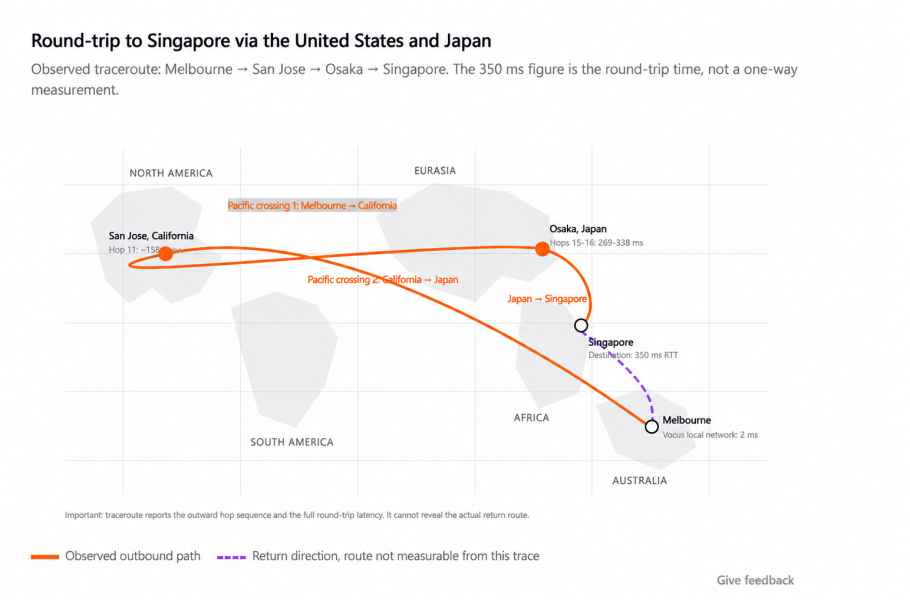
The route recorded sustained round-trip latency between 258ms and 350ms, with peaks above 400ms during repeated testing of Melbourne-to-Singapore traffic.
At 400ms, a connection to nearby Singapore can feel slower than infrastructure located in North America or Europe, despite Singapore often being selected by Australian businesses as a low-latency regional and global data hosting location.
Traceroute data showed traffic entering the Vocus network in Melbourne before moving through Sydney and into a possible Vocus border router in San Jose.
It then passed through Lumen and NTT infrastructure in the United States, Japan and Hong Kong before reaching Singapore.
Vocus’s cable fault does not conclusively establish that every poor Melbourne-to-Singapore route was caused by the outage, particularly if the routing problem was observed before 4 September.
It does, however, provide a credible explanation for why traffic may be taking long contingency paths through North America and Japan rather than using a direct Australia-to-Singapore connection.
On 5 September, Vocus said remote analysis had produced a more precise estimate of the cable break location and that its marine repair team was working through repair logistics.
It later conducted emergency cable testing from Perth, temporarily affecting services in Christmas Island during the testing window.
In its latest update, issued on 6 September, Vocus said it had completed COTDR testing from the Perth Cable Landing Station and was working with its marine repair partner on restoration planning.
The company has not provided an estimated restoration time.
Vocus supplies international and wholesale connectivity to carriers, resellers and service providers, meaning traffic from multiple networks may be affected where routes rely on the Australia-Singapore Cable or related transit arrangements.
For web hosting customers, the consequences can be immediate. High latency affects website administration, database-driven page generation, API requests, file uploads, remote desktop sessions, VPNs and real-time business applications.
A web hosting server in Singapore that would normally provide responsive access from Melbourne can become impractical for latency-sensitive workloads when each exchange with the origin takes several hundred milliseconds.
The incident has put Vocus’s contingency routing arrangements under scrutiny, particularly for businesses that rely on Singapore as a nearby regional hub for Australian customers and Asia-Pacific operations.
Rerouting is necessary after a subsea cable break. However, sending Melbourne-to-Singapore traffic across the Pacific twice, via California and Japan, is an extremely inefficient and long route.
For Australian customers that selected Singapore for its proximity, globally central location and low latency, the detour removes much of the speed and performance advantage they have been paying for.
Dual cable outages strip Australia of up to 100Tbps
Indigo West, one of the main Perth-to-Singapore subsea routes, has also been out of service since 8 August after a shunt fault disrupted the cable system.
The fault is an electrical failure rather than a confirmed cable break, with initial testing placing it about 48 kilometres from the Perth cable landing station. SubCo’s repair vessel is scheduled to carry out work on the Perth-end fault between 2 and 11 September.
A separate shunt fault at the Singapore end has further complicated the restoration effort, with repairs delayed until 2 October. That means Indigo West is unlikely to return to full service immediately, even if the Perth-side work is completed as planned.
Bevan Slattery, co-chief and founder of SUBCO, which owns the two Indigo cable systems, confirmed that the company reported the incidents to the AFP. He says both faults occurred near each other and at a similar time.
Slattery first raised the alarm about the incidents in a post on LinkedIn on the weekend, shortly after SUBCO detected “shunt faults” on its Indigo West and Indigo Central cable systems, which together connect Singapore and Sydney with a landing at Perth in-between.
According to an AFP spokesperson the agency was looking into the incident but stopped short of saying it is actively investigating it as a crime.
“The AFP has received a report of crime in relation to this matter. This report is currently being assessed based on the information provided. Further comment will be made at an appropriate time,”
The prolonged Indigo West outage has left Australia with fewer direct paths into Singapore, magnifying the impact of Vocus’s Australia-Singapore Cable failure on 4 September.
With both routes impaired, some ISPs have been forced to send traffic through Japan and, in some cases, the United States, adding hundreds of milliseconds of latency to connections that would ordinarily use a direct Asia-Pacific path.
The failures of the Indigo West and Vocus Australia-Singapore Cable systems have impaired up to 100Tbps of direct Perth-to-Singapore capacity
Indigo West is designed to carry about 40Tbps between Perth and Singapore, while Vocus’s Australia-Singapore Cable has a reliable capacity of up to 60Tbps.
Carriers don’t generally publish the amount of active capacity they operate or sell on each system, meaning the precise share of Australian traffic affected can’t be calculated publicly.
An Aussie Broadband representative recently confirmed its traffic had been moved onto longer routes after the Vocus cable failure removed the provider’s remaining direct Perth-to-Singapore capacity.
Either cable failing independently would ordinarily leave carriers with another direct Perth-to-Singapore path.
With Indigo West already impaired and Vocus’s cable now damaged in Indonesian waters, Australia has lost two of its main low-latency links into Southeast Asia at the same time.
The result is unlikely to cause a nationwide internet outage, as domestic traffic and Australian CDN-delivered services don’t depend on either cable.
However, it removes a significant portion of direct Asian connectivity and places more pressure on longer backup routes, where congestion and sharply higher latency are a possibility
On 1 August 2021, part of Vocus’s Australia-Singapore Cable was damaged within the Perth Submarine Cable Protection Zone, about 10 kilometers off City Beach in Western Australia.
The container ship Maersk Surabaya allegedly dragged its anchor through the Protection Zone during high winds, breaking the cable.