


LinkedIn is targeting the rise of “AI slop” — low-quality, artificially generated content flooding its professional network — by adding a new reporting option that lets users flag posts they believe were created with excessive AI assistance.
The move comes as online platforms face growing criticism over automated content replacing genuine human insights, with users increasingly frustrated by posts designed for engagement rather than meaningful discussion.
In a LinkedIn post, the company’s chief product officer, Hari Srinivasan, acknowledged the Microsoft-owned platform is facing the same challenges affecting much of the internet.
“We are ramping the ability for members to tell us if they believe a post or comment seems like AI slop. Slop is hard to define and the definition changes; this lets us tune our models and make better feeds.” Srinivasan said.
“We continue to improve and invest in our automation defenses. On comments alone, everyday we are now catching hundreds of thousands of automated comment attempts, and have blocked billions of other automation attempts (posting at scale, slop) in the last couple months alone..” he said.
The move represents an unusual shift for a major technology platform. Instead of simply using automated systems behind the scenes, LinkedIn is now asking its own users to help identify content that damages the quality of conversations.
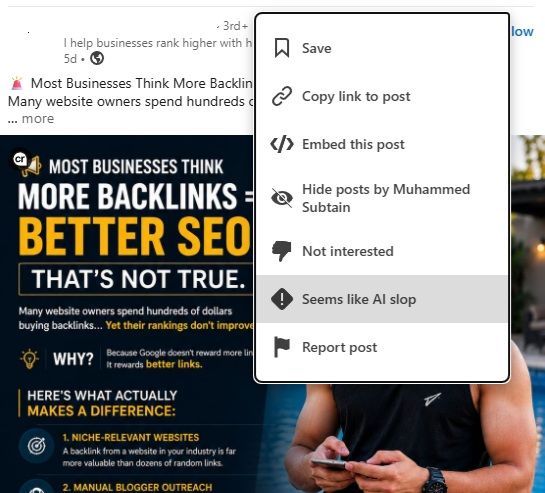
LinkedIn’s new “Seems like AI slop” reporting option is part of a wider effort to limit the spread of low-quality, AI-generated content across the platform.
Alongside the new reporting tool, the company is expanding its automated defences, blocking hundreds of thousands of automated comment attempts every day and millions of other suspicious automation attempts in recent months.
New classifiers are also being developed to identify AI slop and other low-value posts before they appear in recommended content feeds outside a user’s direct network.
Reports submitted through the new button will provide additional signals to improve these detection systems and help identify content lacking originality, expertise or genuine human input.
Users may also receive private notifications if their posts appear to rely too heavily on AI-generated writing. The aim, according to LinkedIn, is not to discourage people from using AI for editing or improving their work, but to encourage more authentic communication.
As part of the changes, LinkedIn is removing its previous “enhance your post” AI writing feature and replacing it with a proofreading tool that corrects errors while preserving the writer’s original voice and style.
The move reflects a growing problem across professional networks. Generative AI has made it easier than ever to create polished content quickly, but it has also fuelled a wave of generic posts designed around engagement rather than experience, expertise or meaningful discussion.
For LinkedIn, the challenge is finding the balance between supporting AI-powered productivity and protecting the human connections that made the platform valuable in the first place.
The issue is not simply whether AI has been used. Many professionals, journalists and businesses now rely on AI tools for research, editing and workflow improvements.
The bigger concern is whether the technology is assisting human creativity or replacing it with automated content built purely to attract attention.
A post based on real-world experience, original analysis or professional knowledge can still benefit from AI assistance. Content created entirely to imitate expertise, increase visibility and satisfy algorithms presents a different challenge.
Similar concerns are emerging across other online platforms. Newsletter service Substack recently partnered with Pangram to help readers identify content that may have been produced using AI, while Pangram secured $9 million in funding to develop technology focused on detecting AI-generated material.
Smaller platforms are also feeling the impact. Digg shut down its Reddit competitor in March after struggling to manage the volume of bots overwhelming the service.
Cloudflare has warned the problem is accelerating, reporting that bot traffic across the internet has now surpassed human-generated requests — a milestone the infrastructure company said arrived sooner than expected.