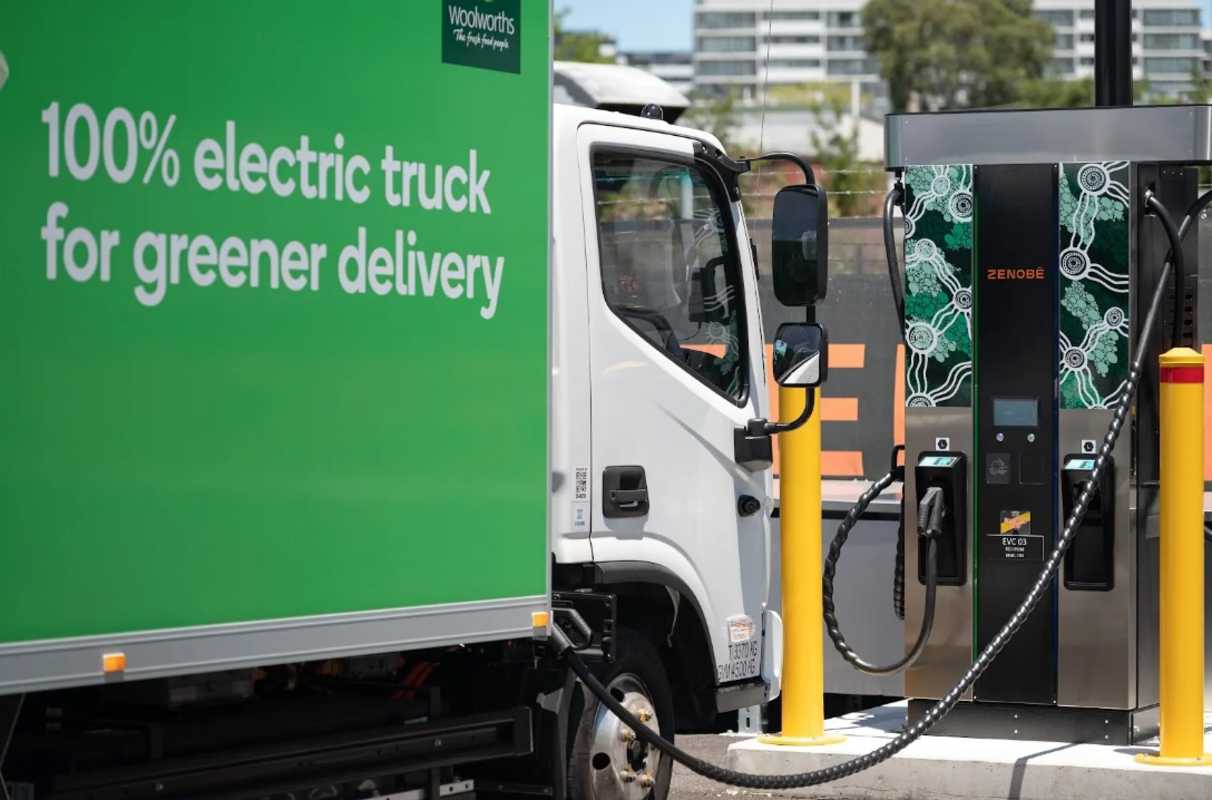


The CEFC has committed up to $22 million to back the large-scale deployment of battery electric trucks (BETs), helping electric fleet specialist Zenobe Australia acquire a fleet of up to 148 BETs to deliver low emissions groceries.
The transaction backs what will be the largest fleet rollout of electric trucks in Australia, the Foton T5 BETs will be leased to Woolworths for last mile delivery across New South Wales and Victoria, with additional vehicles in Queensland, Western Australia and South Australia.
The BETs will be leased to Woolworths with the full fleet rollout completed over the course of 2027.
CEFC Head of Infrastructure Julia Hinwood said, “By increasing the uptake of BETs we’re helping develop the market to bring them closer to price parity with their non-electric counterparts,”
“This investment reflects the commercial viability of BETs and enables Zenobē to set competitive rentals to incentivise customers to lease BETs,” said Hinwood
“Backing deployments in hard-to-abate sectors like freight helps normalise new technologies and bring in wider private investment,”
“With fuel price volatility and supply risks increasingly material for freight operators, early large‑scale deployments are critical to generating the real‑world performance data and operating benchmarks needed to underpin a secondary market for electric heavy vehicles.” she said.
Under the model, Zenobē retains ownership of the trucks, allowing Woolworths to deploy BETs during the lease term without taking on end-of-life risk.
The model represents a ‘one-stop-shop’ for customers who take up the lease rental, inclusive of vehicle maintenance, warranties and upgrades.
Gareth , Country Director, Australia and New Zealand at Zenobē, said, “This project is evidence that electrification is a commercial opportunity.”
“Woolworths is already rolling out hundreds of electric trucks at scale, that’s almost unheard of in Australia’s freight sector and proof that with the right business model and competitive pricing from Zenobē, electrification stacks up right now.” said Ridge
“Together with Woolworths and the CEFC, we’re proving that large-scale zero-emissions logistics is no longer a pilot, it’s commercially viable and operationally proven.” he said.
The commitment builds on an earlier CEFC investment to deploy BETs with Zenobē and focuses solely on vehicle acquisition and leasing. Last-mile delivery operations are suited to electrification, with predictable routes, high vehicle utilisation and depot-based operations.
The investment forms part of a broader CEFC focus on the decarbonisation of Australian transport, alongside commitments across passenger vehicles, fleet electrification, and charging infrastructure.
In contrast to the recent strong uptake of passenger EVs in Australia, uptake of BETs has been slow in Australia. Of the 12,003 trucks and heavy vans sold in Australia in 2026 to date, only 0.9% were electric.
Transport accounts for up to 23% of Australia’s national emissions, and road freight activity is projected to grow approximately 35% between 2025-2040, driving a 10% increase in truck emissions.
By 2035, road transport is projected to make up 83% of all transport emissions.
To 31 March 2026, the CEFC has directly committed over $260 million in electric vehicle related projects since inception to help decarbonise Australia’s transport sector.
Investments include accelerating Team Global Express’ fleet electrification, working with Volvo Group Australia to switch to medium and heavy-duty BETs and backing Australia’s first electrified bus fleet and depot, delivered by Zenobē.
Australia’s transition away from diesel freight is gaining momentum, with the CEFC making heavy vehicle electrification a growing priority.
The organisation has now helped finance more than 20,000 electric vehicles, worth more than $1.2 billion, including third-party capital raised through its co-finance programs.