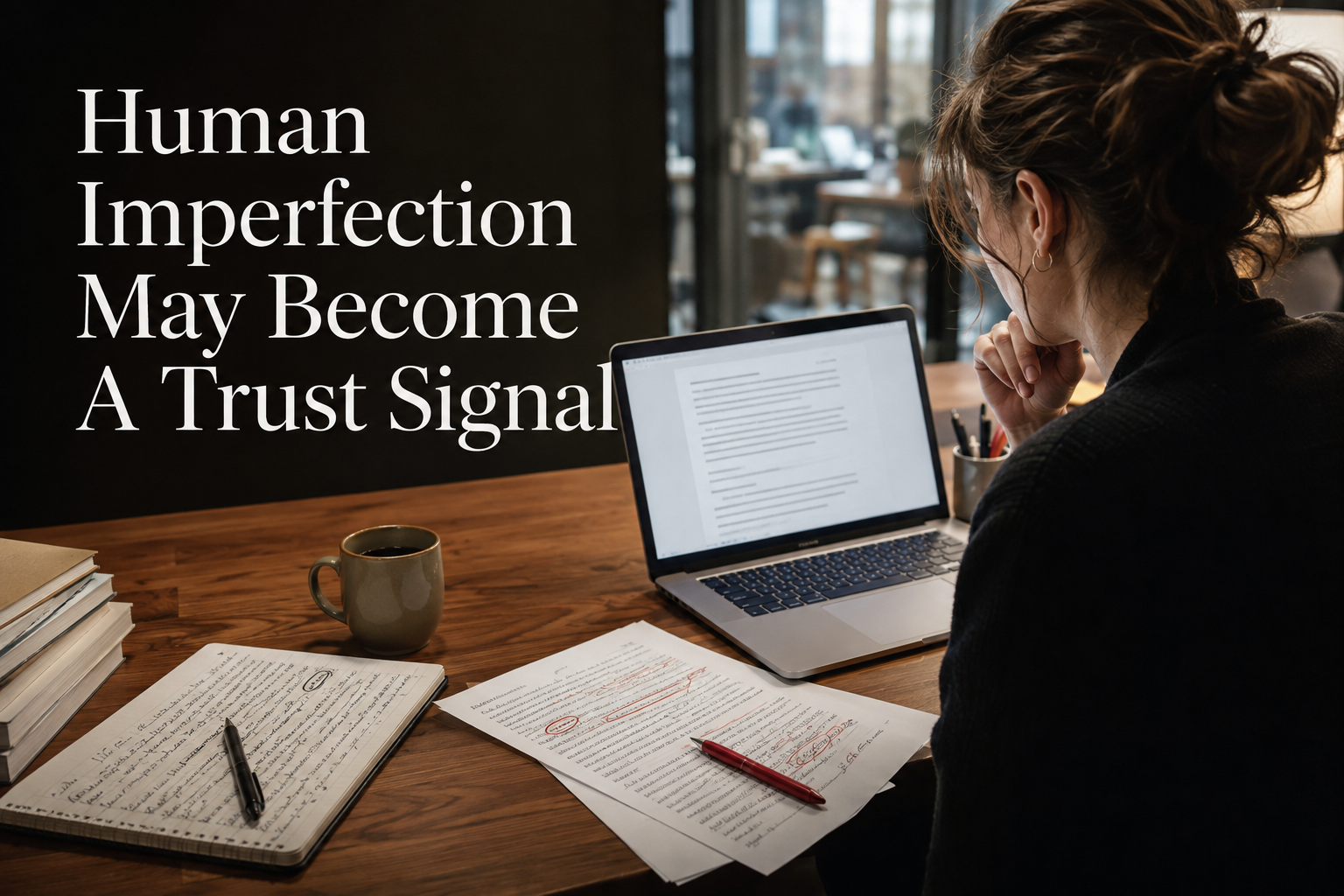


Something strange is starting to happen to writing online. The better AI gets at making everything clean, polished and technically correct, the less impressive that polish starts to feel.
There was a time when a well-written article suggested somebody had spent a fair amount of time on it, going back over sentences, changing things around, checking facts, deleting parts that sounded terrible and eventually deciding it was good enough to publish.
Now much of that surface-level finish can be produced in seconds, and I think that changes the way we judge whether something feels genuine.
For years we were taught that mistakes were the enemy of good writing. A typo looked careless, a sentence that ran a little too long needed tightening and repeating the same word too often was something an editor was supposed to pick up.
I still believe in editing, obviously, and I don’t want to read journalism that looks like nobody bothered checking it.
But I do wonder whether we became so obsessed with making writing perfectly clean that we slowly removed some of the person from it, even before generative AI came along.
Human beings don’t naturally communicate in perfectly balanced paragraphs.
We sometimes take too long to get to the point, use the same word twice because it happens to be the right word both times, or change direction halfway through a thought because another idea occurs to us.
Sometimes a sentence is completely grammatical but still sounds a little strange because that happens to be how the person writing it thinks.
Those little inconsistencies used to be treated almost entirely as weaknesses, but in a web filling rapidly with machine-produced language, I suspect some of them are going to start carrying a different meaning.
The change is already happening against a fairly remarkable backdrop.
There is no reliable way to calculate exactly what percentage of every word on the internet was written by AI, particularly now that people routinely edit AI drafts and AI systems rewrite human work.
Researchers themselves warn that the line between human and machine authorship is becoming difficult to define. Even so, the available studies give some idea of the scale.
Graphite analysed articles collected through Common Crawl and found that by the first quarter of 2026, about 49.9% of newly published articles in its sample were primarily AI-generated, compared with 50.1% that were primarily human-written.
Just three years earlier, immediately after ChatGPT’s November 2022 launch, human-written material still overwhelmingly dominated the same trend.
The growth happened incredibly quickly.
Graphite found that primarily AI-generated articles had reached 35.9 per cent of its sample only 12 months after ChatGPT launched, climbing to around half of newly published articles by early 2025 and then remaining close to that level through early 2026.
The researchers used three separate AI detectors in their latest analysis and reported false-positive and average false-negative rates below 2%, although even that should be treated as an estimate of the sampled web rather than a census of the entire internet.
Another study points to an even broader level of AI involvement because it measured pages containing AI-generated material rather than pages judged to be primarily written by AI.
Ahrefs examined 900,000 newly discovered English-language pages across 900,000 different domains in April 2025 and estimated that 74.2 per cent contained some AI-generated content.
That doesen’t mean three quarters of those pages were wholly written by machines, because a human-written article with an AI-generated section could fall into that category, but it does tell us how deeply AI assistance has already worked its way into ordinary web publishing.
Interestingly, the volume does not necessarily translate into the content people actually find through search.
Originality.ai’s ongoing analysis of the top 20 Google results for 500 popular keywords estimated that AI-generated material accounted for 17.31% of those results in September 2025, down from a peak of 19.56% in July.
Graphite separately estimated that about 14 per cent of articles appearing in Google Search during 2025 were AI-generated, with the remaining 86 per cent classified as human-written.
Different methodologies produce different numbers, which is exactly why I would be wary of anyone confidently declaring that a precise percentage of the whole internet is now AI.
What’s much harder to argue with is the direction of travel. AI-written material has moved from a curiosity to a significant part of web publishing in only a few years.
The story did not actually begin with ChatGPT, either. Machine-written journalism was appearing online years before most readers had heard the phrase generative AI.
Automated Insights, a company founded in 2007, was already developing software capable of converting structured data into written stories, while The Associated Press began using automation in its sports operations in the early 2010s and rolled out automated corporate earnings stories in 2014.
By 2015, AP says its system was automatically producing more than 3,000 U.S. corporate earnings stories every quarter, roughly ten times what reporters and editors had previously produced manually.
That earlier form of automated publishing was very different from what we now call generative AI. The systems were generally working from structured datasets and carefully designed templates rather than being asked to freely produce an article about almost anything.
AP’s system could take financial data and turn it into a short earnings report, while similar technology was used for sports scores and player statistics.
It later said automation freed roughly 20 per cent of the staff time previously spent producing earnings reports, allowing journalists to spend more time on enterprise and breaking-news reporting.
In some ways, that was probably the healthier version of the relationship between journalism and automation. Let the machine process thousands of predictable numbers and give the reporter more time to work out what those numbers actually mean.
The problem we face now is very different because modern generative AI does not merely automate repetitive data processing.
It can imitate the finished product of human thought, including the tone, structure and confidence we have traditionally associated with somebody who knows what they are talking about.
That distinction matters to me because polished writing used to contain at least some evidence of effort. Writing 1,000 decent words about something required time.
Writing 1,000 decent words about something you genuinely understood took considerably more. If it involved journalism, somebody also had to make calls, speak to people, read documents, check conflicting claims and eventually work out which parts actually mattered.
Generative AI has separated the appearance of that work from the work itself.
Someone can now know very little about a subject and still produce an article that looks authoritative enough at first glance. The grammar can be excellent, the terminology can sound convincing and every paragraph can sit exactly where you expect it to sit.
Nothing jumps out as obviously wrong, yet the person publishing it may never have spoken to anyone, seen anything or understood the subject beyond the information supplied to the machine.
That bothers me more than the occasional obvious AI error because facts can at least be checked. What becomes harder to check is whether there was ever any genuine knowledge behind the writing in the first place.
Did this person spend years dealing with the subject, or five minutes generating something about it? Did they interview somebody, or did the machine simply reproduce what other websites had already said?
When the finished article looks equally polished either way, the old visual signals of competence begin to lose some of their value.
This is where human imperfection becomes interesting. There are little things in writing that do not necessarily make an article better in the traditional sense, but they make it feel inhabited.
A strangely specific observation, an unusual description, somebody admitting they initially misunderstood what was happening, or a sentence that is perhaps a little rough but says exactly what the writer meant can give the reader something beyond technically correct language.
Journalism makes this particularly obvious because two articles can contain the same basic facts while having completely different relationships with the event being reported.
One reporter may be sitting at home rewriting a company announcement while another is physically in the room.
The first version could actually be cleaner. It could have a better structure and fewer unnecessary words, yet the reporter in the room has access to everything the announcement leaves out and that often ends up being the part that matters.
They can notice that the room suddenly went quiet when a particular question was asked, or that someone who had been speaking confidently paused for several seconds before answering another one.
They can notice that the supposedly enormous launch attracted almost nobody outside the company, or that an executive keeps avoiding one very simple question.
None of those details automatically turns into some explosive revelation, but they affect how a reporter understands what happened and, more importantly, they came from being there.
That is the part I think is going to become increasingly valuable. AI can reconstruct the language around an event from information available to it, but it cannot independently have attended that event.
It can’t notice something in the room unless somebody else first noticed it and recorded it somewhere. As more online material is produced by systems drawing from material that already exists, original observation moves closer to the scarce end of the equation.
There is something almost funny about where this could take us. We spent decades building technology specifically to remove imperfections from writing, and now a few of those imperfections may occasionally make us more comfortable that an actual person was involved.
I certainly don’t mean that a page full of spelling mistakes should suddenly become a mark of credibility.
Careless work remains careless work, and bad journalism does not become good journalism because somebody forgot how to use an apostrophe.
What I think will change is our reaction to smaller irregularities. A slightly awkward sentence can have personality. An unusual choice of words can become recognisable as belonging to a particular writer.
Somebody doubling back briefly to explain what they really meant can feel more natural than a perfectly engineered transition carrying the reader into another perfectly balanced paragraph.
I have always found writing more interesting when I can hear the person somewhere inside it, and perhaps I am going to value that even more now.
Uncertainty may become part of the same thing. Real people do not know everything, and journalists certainly don’t. Sometimes after speaking to three people you have a pretty good idea of what happened but there is still one part that doesn’t make sense.
Sometimes two credible people tell you different versions of the same event and there simply isn’t a neat sentence that magically resolves the contradiction.
There is something quite reassuring about a writer being prepared to tell me that rather than forcing everything into a confident conclusion.
Generative systems are extremely good at producing language that sounds certain and complete, which can make an unresolved question look much more settled than it actually is.
I would rather read someone genuinely working through an idea and showing me where the uncertainty sits than a flawless explanation that only looks certain because the machine knows how certainty is supposed to sound.
Journalism was already drifting toward this problem before generative AI arrived. Online publishing rewarded volume, search rewarded endless variations of the same useful answer and social platforms rewarded speed.
One organisation could do the original reporting and within hours dozens of websites would have rewritten essentially the same information. AI did not invent that system. It simply arrived as an almost perfect machine for producing the kind of repetitive content the system had already encouraged.
That is why I think the argument about AI replacing journalists is often framed too broadly. It depends heavily on what the journalist is actually doing.
If the work consists mostly of taking information that already exists and rearranging it into another article, then AI is an obvious competitor because that is exactly the sort of task automation has been moving toward for years.
If the job is finding information that did not exist publicly before the journalist went looking for it, the equation changes considerably.
You still have to call someone who doesn’t want to talk to you.
You have to know when an answer sounds wrong, or when the impressive statistic in the media release becomes much less impressive once you find the number from last year.
Sometimes you have to sit through something painfully boring because a small comment three hours later turns out to be the actual story.
You make judgement calls, occasionally get something wrong, correct it, ask another question and sometimes end up writing a very different story from the one you thought you were covering.
That process isn’t perfectly clean because neither journalism nor people are perfectly clean, and perhaps that mess is part of what separates reporting from content generation.
There is, however, an obvious problem with treating imperfection itself as evidence of humanity. AI can imitate that too.
A chatbot can be instructed to use rougher grammar, introduce hesitation, make sentences less polished or deliberately insert a typo.
The moment people begin associating a particular writing habit with human authorship, there is nothing stopping a generative system from copying the same habit.
So the real trust signal probably will not be the typo itself. It will be everything behind the article.
Who wrote it? What have they reported before? Did they speak to people? Are there original documents, photographs, recordings or firsthand observations? Can the claims be checked? Does this person have a history of actually engaging with the subjects they write about?
That feels like a much more useful definition of authenticity than asking whether a piece of text simply “sounds human”.
The real test may end up being what sits behind the words. Credibility will come from showing that someone actually did the work, spoke to people, checked the facts and brought something of their own to the story, rather than simply producing text that happens to sound human.
Perhaps we confused professionalism with perfection for too long anyway. A professional journalist can still have personality. A knowledgeable writer can repeat a word occasionally or write a sentence another editor would have arranged differently.
Someone can admit they don’t completely understand something yet without destroying their credibility. In fact, I would argue that knowing where your own knowledge ends is a fairly important part of being credible.
AI will continue getting better at producing technically excellent language, so trying to beat it by making human writing increasingly sterile seems like a strange response.
The things worth protecting are the things machines made us forget were valuable in the first place: experience, judgement, curiosity, memory, original observation and having an actual opinion after spending enough time with something to earn one.
The future of credible writing may therefore look a little less polished than we once imagined. Not deliberately messy, and certainly not careless, but recognisably written by somebody with their own habits, thoughts and occasional rough edges.
When almost half of newly published articles in one major web study can already be classified as primarily AI-generated, the most valuable part of an article may eventually be the part no machine can produce by itself:
Evidence that somebody actually went out into the world, paid attention to what was happening, noticed something others might have missed and came back with something genuinely worth saying.