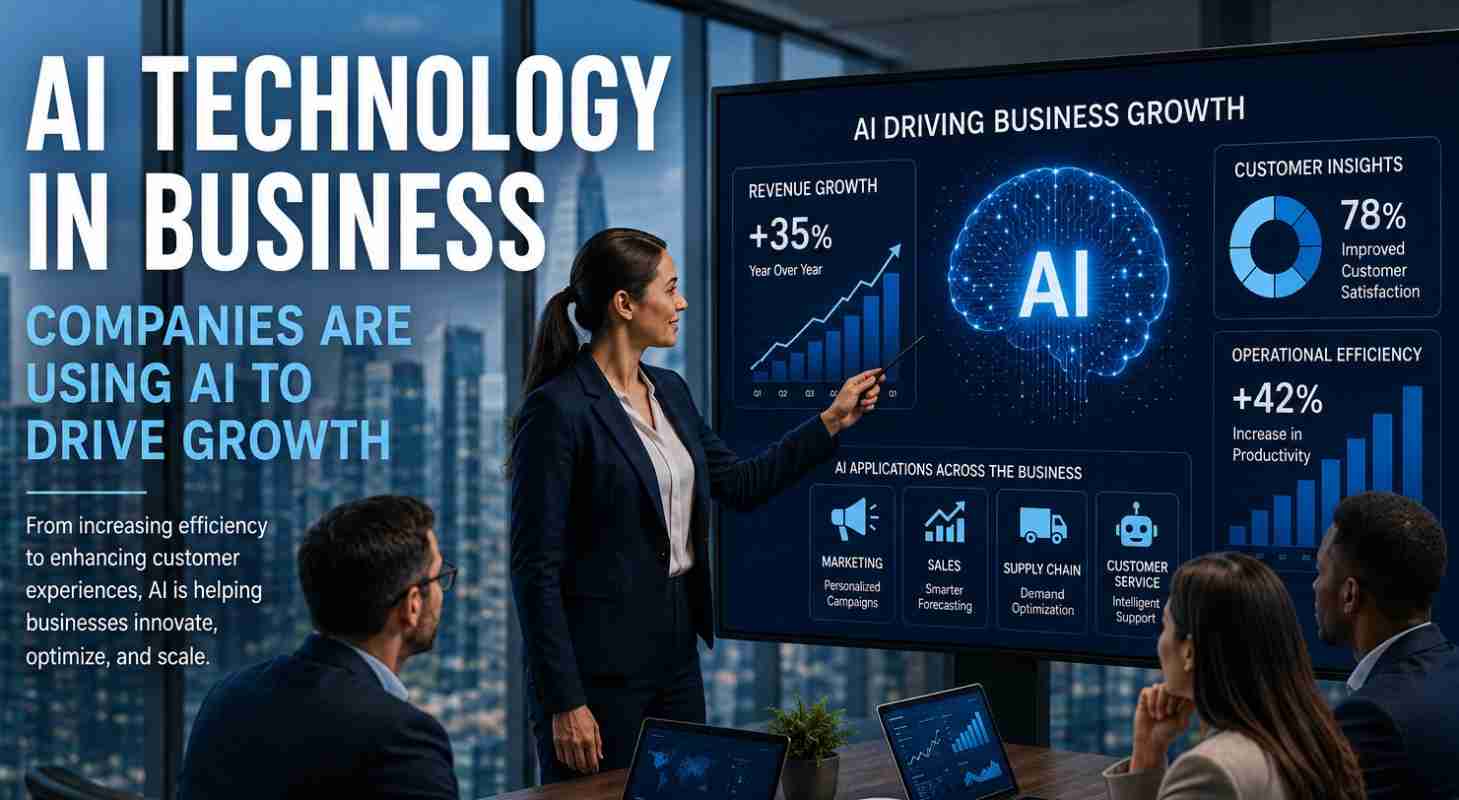


Artificial intelligence has moved well beyond Silicon Valley hype.
What was once considered an experimental technology is now becoming part of everyday business operations across industries ranging from retail and finance to healthcare, logistics and professional services.
Whether it’s automating customer enquiries, predicting consumer behaviour or streamlining internal workflows, AI technology in business is rapidly changing how organisations compete — and how quickly they can adapt.
According to reports, 88% of organisations now use AI in at least one part of their business operations.
That figure has climbed sharply over the past few years as companies race to integrate generative AI and automation tools into daily operations.
But while adoption is widespread, experts say many businesses are still struggling to turn AI experimentation into measurable long-term value.
AI Readiness Checklist for Businesses
Strategy & Objectives
- ☐Define clear business objectives for using AI
- ☐Identify processes AI could improve
- ☐Align AI initiatives with overall business strategy
- ☐Set measurable success metrics and KPIs
- ☐Determine the expected return on investment (ROI)
Data Readiness
- ☐Ensure business data is accurate and up to date
- ☐Organise and centralise data sources
- ☐Remove duplicate or incomplete data
- ☐Establish data privacy and security policies
- ☐Confirm compliance with relevant regulations
Technology & Infrastructure
- ☐Assess current IT systems and software capabilities
- ☐Ensure systems can integrate with AI tools
- ☐Upgrade cloud storage or computing power if required
- ☐Implement appropriate cyber security protections
- ☐Ensure reliable digital infrastructure
Team & Skills
- ☐Educate leadership teams on AI opportunities and risks
- ☐Train employees on AI tools and workflows
- ☐Identify internal AI champions
- ☐Hire or consult AI specialists if required
- ☐Encourage a culture open to innovation and change
Risk Management & Ethics
- ☐Assess risks linked to AI implementation
- ☐Monitor for bias or inaccurate outputs
- ☐Protect customer and employee data
- ☐Ensure transparency in AI-assisted decision-making
- ☐Establish ethical standards for AI usage
Testing & Continuous Improvement
- ☐Begin with small pilot projects
- ☐Test AI tools before full implementation
- ☐Monitor performance regularly
- ☐Measure results against KPIs
- ☐Continuously refine and improve AI systems
1. Customer Service Is Becoming Faster — and More Automated
One of the clearest examples of AI technology in business can be seen in customer service.
AI-powered chatbots and virtual assistants are now handling millions of customer interactions every day, helping businesses respond faster while reducing pressure on support teams.
Companies are using AI systems to:
- Answer common questions
- Route enquiries automatically
- Handle basic complaints
- Provide 24-hour customer support
- Reduce wait times
For consumers, that often means quicker responses. For businesses, it can significantly reduce operating costs.
The shift is particularly noticeable in banking, telecommunications and retail, where large customer volumes make automation increasingly attractive.
2. Businesses Are Using AI to Make Faster Decisions
Executives are increasingly relying on AI to process large volumes of data and identify patterns that would otherwise take teams weeks to uncover.
Modern AI platforms can analyse:
- Customer trends
- Sales performance
- Supply chain risks
- Market conditions
- Consumer behaviour
Rather than relying solely on instinct or historical reporting, businesses are beginning to use predictive insights to guide strategic decisions in real time.
Industry analysts say this could become one of AI’s most valuable long-term applications.
3. Marketing Teams Are Producing Content at Scale
Marketing departments have become some of the biggest adopters of generative AI.
AI tools are now helping businesses create:
- Blog articles
- Advertising copy
- Email campaigns
- Product descriptions
- Social media posts
While concerns remain around quality control and originality, many businesses say AI is helping teams produce content faster and more efficiently.
The technology is also increasingly being used to personalise campaigns based on customer behaviour and purchasing patterns.
4. Personalisation Is Driving Customer Engagement
Consumers now expect highly personalised online experiences — and AI is making that possible at scale.
Retailers, streaming platforms and online services are using AI recommendation engines to suggest products, content and promotions tailored to individual users.
Businesses are also using AI to personalise:
- Email marketing
- Website experiences
- Product recommendations
- Advertising campaigns
- Loyalty programmes
For many brands, better personalisation is translating directly into stronger engagement and higher conversion rates.
5. AI Is Changing How Companies Forecast Revenue
Sales forecasting has traditionally involved spreadsheets, historical trends and educated guesses.
AI is changing that.
Businesses are increasingly using machine learning models to predict:
- Future sales
- Customer churn
- Buying intent
- Seasonal demand
- Revenue growth
The goal is not simply accuracy, but faster decision-making in rapidly changing markets.
6. Supply Chains Are Becoming More Predictive
Recent global disruptions exposed weaknesses in supply chains across multiple industries.
In response, many companies are turning to AI to improve forecasting and logistics planning.
AI systems can help businesses:
- Predict inventory shortages
- Monitor shipping delays
- Optimise warehouse operations
- Forecast customer demand
- Reduce operational waste
For industries heavily reliant on logistics, predictive planning has become a growing competitive advantage.
7. AI Is Strengthening Fraud Detection and Cybersecurity
Cybersecurity threats are becoming more sophisticated — and businesses are increasingly relying on AI to respond.
AI security systems can monitor networks continuously and identify suspicious behaviour far faster than traditional manual systems.
Applications include:
- Fraud detection
- Threat monitoring
- Automated security alerts
- Risk assessment
- Compliance monitoring
Financial institutions in particular have accelerated AI investment as digital fraud becomes more advanced.
8. Recruitment and Human Resources Are Being Automated
Human resources departments are also embracing AI tools to streamline recruitment and workforce management.
AI is now being used to:
- Screen resumes
- Match candidates to roles
- Analyse workforce trends
- Assist with onboarding
- Identify skills gaps
Supporters argue the technology improves efficiency, although concerns remain around algorithmic bias and hiring transparency.
9. AI Agents Are Emerging as the Next Major Trend
One of the fastest-growing developments in AI technology in business is the rise of AI agents.
Unlike standard chatbots, AI agents can complete multi-step tasks independently, manage workflows and interact with multiple business systems simultaneously.
According to McKinsey, 62 per cent of organisations are already experimenting with AI agents in some form.
Industry experts believe AI agents could significantly reshape workplace productivity over the next several years.
10. Financial Teams Are Using AI for Forecasting and Planning
Finance departments are increasingly using AI to improve forecasting accuracy and identify financial risks earlier.
Applications include:
- Cash flow forecasting
- Budget analysis
- Risk modelling
- Financial reporting
- Investment planning
For many organisations, the shift towards predictive finance is reducing reliance on purely historical data.
11. AI Is Accelerating Product Development
Businesses are also using AI to speed up research and development processes.
AI can help teams:
- Analyse customer feedback
- Identify product trends
- Simulate outcomes
- Test concepts
- Improve innovation cycles
According to McKinsey, 64 per cent of organisations say AI is contributing to innovation within their business.
12. Operational Efficiency Remains a Key Driver
Despite growing interest in innovation, cost reduction remains one of the biggest reasons companies adopt AI.
Businesses are using automation to reduce repetitive administrative tasks and improve operational efficiency across departments.
That includes:
- Document processing
- Workflow automation
- Scheduling
- Data entry
- Internal reporting
However, analysts warn that businesses focused solely on cost-cutting may miss AI’s larger strategic opportunities.
13. The Economic Impact Could Be Enormous
The broader economic implications of AI are becoming increasingly significant.
According to PwC, AI adoption could contribute up to a 15 per cent increase in global economic output by 2035.
That would make artificial intelligence one of the most economically transformative technologies introduced since the internet.
Governments and regulators are now racing to balance innovation with concerns around privacy, employment disruption and ethical use.
Key Statistics About AI Technology in Business
88% of Organisations Now Use AI
McKinsey reports that nearly nine in ten organisations are now using AI in at least one business function, highlighting how quickly adoption has entered the mainstream.
Only 39% Say AI Is Delivering Enterprise-Wide Financial Impact
While adoption is growing rapidly, many companies are still struggling to scale AI effectively across the organisation.
AI Could Increase Global Economic Output by 15% by 2035
PwC estimates AI could become one of the largest contributors to future economic growth globally.
The Challenges Businesses Still Face
Despite the enthusiasm surrounding AI, significant challenges remain.
Businesses continue to face concerns around:
- Data privacy
- Cybersecurity
- AI regulation
- Integration costs
- Skills shortages
- Employee trust
- Governance frameworks
There are also growing concerns about misinformation, copyright issues and overreliance on automated systems.
For many organisations, the challenge is no longer whether to adopt AI — but how to implement it responsibly.
Key Cyber Security Risks in AI Systems for Small Businesses
Artificial intelligence (AI) tools are becoming increasingly common in small businesses, helping improve efficiency, automate tasks, and support decision-making.
However, adopting AI systems also introduces cyber security and privacy risks that businesses need to understand and manage.
Before implementing AI technologies, businesses should be aware of three major cyber security risks:
- Data leaks and privacy breaches
- Reliability and manipulation of AI outputs
- Supply chain vulnerabilities
Data Leaks and Privacy Breaches
AI tools often require access to sensitive business information to generate responses or perform tasks. This may include customer records, employee information, financial data, or proprietary business content. If not properly managed, this creates significant privacy and security risks.
For example, uploading customer or staff information into generative AI platforms without anonymising the data can expose sensitive personal information.
Some AI providers may also use customer-submitted data to train or improve their AI models. Depending on the platform’s configuration settings and subscription type, information entered into these systems could potentially be reused or exposed in unexpected ways.
Small businesses are particularly vulnerable because they may lack dedicated cyber security resources or strong data governance frameworks. This can increase the risk of:
- Accidental data leaks through cloud-based AI platforms
- Unauthorised access to customer information
- Misuse of data by third-party AI providers
In early 2025, a contractor working with an Australian organisation uploaded personal information — including names, contact details, and health records — into an AI system. The incident resulted in a serious data breach and became a notifiable privacy incident.
How to Reduce the Risk
To minimise the risk of AI-related privacy breaches, businesses should:
- Review internal data management and security practices
- Identify and protect sensitive or proprietary information
- Carefully review AI vendor privacy policies and data handling practices
- Establish clear internal AI usage policies
- Define what information must never be uploaded into AI tools
- Train staff on the responsible use of AI systems
- Remove or anonymise personal information before using AI platforms
Traditional cyber security measures such as role-based access controls and strong encryption standards (such as AES-256) can also help strengthen data protection.
Reliability and Manipulation of AI Outputs
AI systems are not always reliable. They can be manipulated by malicious actors using techniques such as prompt injection, where harmful instructions are disguised as legitimate requests to mislead the AI system.
AI tools can also produce “hallucinations” — responses that sound convincing but are inaccurate or completely false. These unreliable outputs can create serious business, operational, and legal risks.
In 2025, a lawyer used AI to help prepare court documents. The AI system generated fake legal case references, which were not verified before submission. After the errors were discovered, the lawyer was barred from practising law.
How to Reduce the Risk
Businesses can reduce the risk of manipulated or inaccurate AI outputs by:
- Training staff to verify AI-generated information
- Reviewing outputs for inaccuracies, bias, or unethical content
- Keeping humans involved in high-risk decision-making processes
- Using trusted AI vendors that prioritise security and regular updates
- Monitoring AI systems for unusual behaviour or anomalies
- Conducting regular reviews of AI-integrated processes
Supply Chain Vulnerabilities
Many businesses rely on AI Software as a Service (SaaS) platforms such as chatbots, customer relationship management systems, and automated support tools. These services often depend on third-party providers for infrastructure, AI models, and data storage.
As a result, businesses can become exposed to supply chain risks if vulnerabilities exist within the provider’s systems or software.
In April 2024, an education provider experienced a major data breach affecting tens of thousands of students, parents, and staff.
Attackers exploited a known vulnerability that had not been patched, exposing highly sensitive information including medical certificates, welfare requests, and childcare records.
How to Reduce the Risk
To manage supply chain vulnerabilities, businesses should:
- Assess the AI vendor’s reputation and security practices
- Understand whether third-party tools or services are involved
- Review vendor terms related to data ownership, storage, and protection
- Understand the vendor’s cyber incident response and notification processes
- Ensure providers apply security updates and patches promptly
Implementation Example: Secure Deployment of AI Chatbots
Many businesses are deploying AI chatbots to improve customer service and streamline support operations. While standard IT security controls remain important, businesses should also implement chatbot-specific safeguards.
Limit Data Collection
Only collect the minimum amount of information necessary for the chatbot to function effectively.
Human Oversight for High-Risk Use Cases
For sensitive areas such as legal, medical, or financial advice, ensure a qualified human reviews chatbot responses before any action is taken.
AI Cyber Security Checklist for Small Businesses
Use this checklist to help your business adopt AI tools safely and reduce cyber security risks.
- ☐I understand the benefits and risks of using AI in my business.
- ☐I know what business information can be safely shared with AI tools.
- ☐I have checked what data the AI tool collects and where it is stored.
- ☐I know who owns the data — my business or the AI vendor.
- ☐I have confirmed whether my business data will be used to train AI models.
- ☐I know how and where to fact-check AI-generated outputs.
- ☐I have provided AI security training and guidance to staff members.
- ☐I have verified that the AI vendor follows recognised cyber security standards, such as ISO 27001 or the NIST AI Risk Management Framework.
- ☐I understand the process for responding to a cyber security incident involving an AI tool.
Businesses Using AI and How They’re Applying It
- Pfizer (Healthcare): Uses AI in drug discovery to analyse large datasets and accelerate the development of new medications by identifying promising drug candidates faster.
- Barclays (Banking): Uses AI-powered fraud detection systems to monitor transaction patterns, identify suspicious activity, and reduce financial fraud in real time.
- United States Postal Service (Postal Services): Uses AI-powered optical character recognition (OCR) technology to improve mail sorting, routing efficiency, and delivery accuracy.
- General Electric (Manufacturing): Applies AI-driven predictive maintenance to monitor equipment health, predict failures, and minimize costly downtime.
- Amazon (Retail): Uses AI for inventory management, personalised product recommendations, and improving fulfillment center operations.
- Hilton Hotels (Hospitality): Uses “Connie,” an AI-powered robot concierge, to provide guests with personalised recommendations and instant assistance.
- Apple (Technology): Introduced Apple Intelligence, which combines generative AI with personal context to support writing tools, intelligent photo search, and email prioritisation while maintaining user privacy.
- Duolingo (Education): Uses AI to create personalised language-learning experiences, including real-time conversations with AI-powered characters through its Video Call feature.
- Discord (Social Media): Uses AI through AutoMod to automatically detect and filter spam, offensive language, and harmful content across online communities.
- DHL (Logistics and Supply Chain): Uses AI to optimise delivery routes, warehouse operations, demand forecasting, and package delivery accuracy.
The AI Imperative Summary — What the Data Shows
AI in business is no longer speculative — it is measurable, and the numbers are decisive.
Enterprise AI adoption reached 78% of organisations in 2025, up from 55% just two years prior, with companies reporting an average return of $3.70 for every dollar invested — and top performers achieving as high as $10.30.
The global AI market is projected to grow at 35.9% annually through 2030, reaching $1.81 trillion — a trajectory that signals infrastructure-level transformation, not a passing technology cycle.
Yet adoption alone does not determine outcomes. Only 5% of enterprises qualify as truly AI-mature, but those leaders generate 1.7× more revenue growth, 1.6× higher profit margins, and 3.6× greater shareholder returns than slower-moving competitors.
The differentiator is not the tools.
Research consistently shows that roughly 70% of successful AI transformation comes down to people and processes — yet most organisations invest in the opposite ratio, prioritising technology over the organisational change needed to unlock its value.
For businesses still treating AI as a peripheral experiment, the window is narrowing.
AI leaders are three times more likely to be scaling deployments in production, and the performance gap between leaders and laggards is compounding every quarter.
The conclusion is not that every business must transform overnight. It is that the cost of inaction is rising faster than the cost of investment — and the companies seeing the strongest results are not simply adding AI to what they already do, but using it to fundamentally rethink how work gets done.