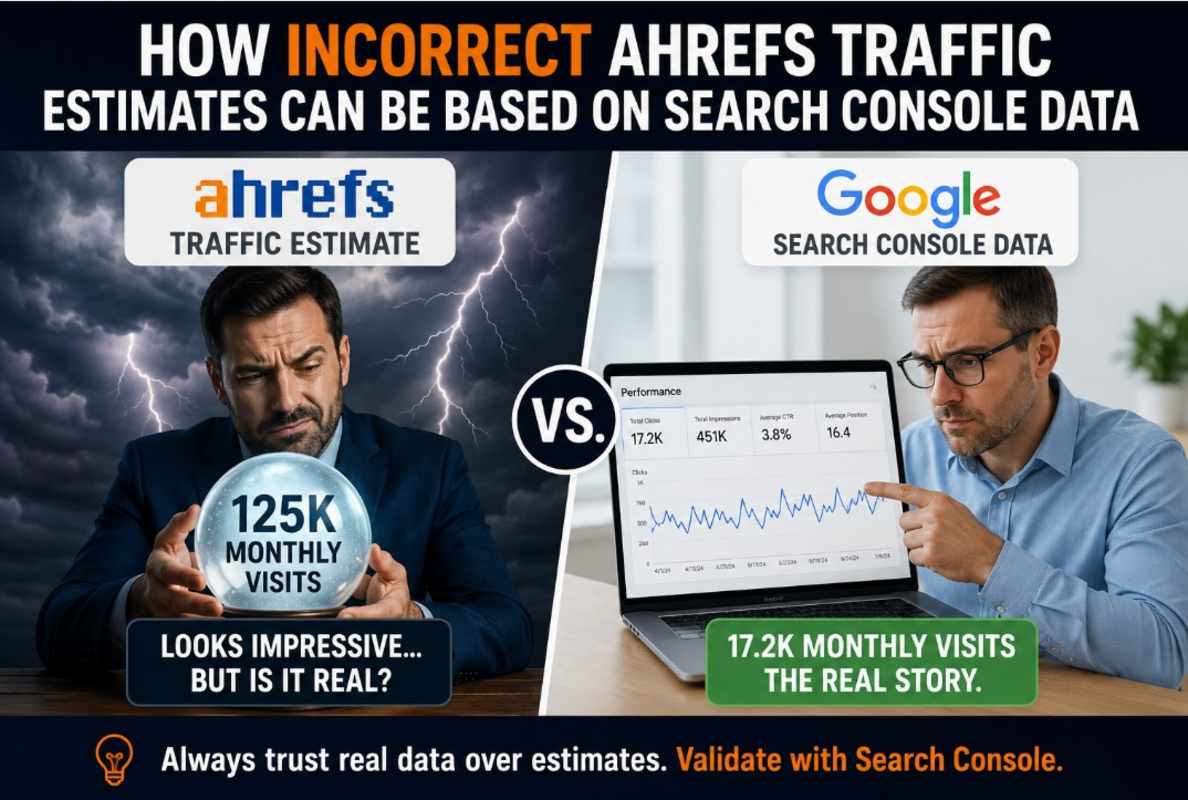


Ahrefs is one of the most widely used SEO platforms in the world.
Marketers, founders, agencies, investors, journalists and analysts routinely use it to estimate how much organic search traffic a website receives. In many industries, Ahrefs traffic numbers have become a shorthand metric for measuring online visibility and growth.
But there is an important distinction that often gets lost:
Ahrefs does not measure actual website traffic. It estimates traffic.
That distinction matters because the accuracy of those estimates can vary significantly depending on the website, industry, keyword profile and search behaviour involved.
The most interesting part is that Ahrefs itself has published research quantifying these limitations.
How Ahrefs Actually Calculates Organic Traffic
According to Ahrefs, its Organic Traffic metric is an estimate of how many monthly clicks a website receives from Google Search.
The methodology works as follows:
- Identify keywords a website ranks for in Google’s top 100 search results
- Estimate the monthly search volume of those keywords
- Determine ranking positions
- Apply an estimated click-through rate (CTR) model
- Sum the estimated traffic across all detected keywords
In simple terms, Ahrefs does not see actual visitor data.
Instead, it models traffic using a chain of estimated variables:
Keywords → Search Volume → Rankings → CTR → Estimated Clicks
Every stage introduces uncertainty.
Search volumes are estimates. Rankings fluctuate continuously. CTR varies by industry, brand strength, SERP features, user intent, location, device type and countless other variables.
Ahrefs explicitly states that users should treat these figures as estimates rather than actual traffic measurements.
Ahrefs’ Own Research Found a Median Error Rate of Nearly 50%
The strongest evidence regarding Ahrefs’ accuracy comes directly from Ahrefs itself.
Ahrefs conducted a study comparing its traffic estimates against actual Google Search Console (GSC) traffic data across 1,635 websites.
The findings were notable:
- Median deviation from GSC: 49.52%
- Pearson correlation with GSC traffic: 0.76
- Some websites showed discrepancies exceeding 1,000%
The median deviation figure deserves particular attention.
A deviation of 49.52% means that for a typical website in the sample, Ahrefs’ estimate differed from actual GSC traffic by roughly half of the true value.
Ahrefs summarised the finding directly:
“Most of the time you can expect Ahrefs to misreport a website’s U.S. traffic by up to half of its value.”
This does not mean Ahrefs is wrong by 50% for every website.
Some domains were reported with less than 5% deviation. Others were off by more than 1,000%.
The key takeaway is that individual domain estimates can vary dramatically.
Why Large Discrepancies Occur
Ahrefs publicly identifies several reasons why its estimates differ from Google Analytics and Google Search Console.
1. Ahrefs Cannot Track Every Ranking Keyword
Ahrefs acknowledges that it does not track every keyword a website ranks for.
Instead, it tracks a subset of keywords that it has discovered and indexed.
The challenge is scale.
Google processes billions of searches, and many search queries are rare, highly specific or entirely new.
Ahrefs notes that it is technically impossible to track all ranking keywords across the web.
This creates a particular problem for websites that receive large amounts of long-tail traffic.
A site may generate substantial traffic from thousands of low-volume search queries that never appear prominently in third-party SEO databases.
If those keywords are missing from the model, the resulting traffic estimate will be lower than reality.
2. Search Volume Is Itself an Estimate
Another limitation is that keyword search volume is not known with certainty.
Ahrefs estimates search volume using data sources including Google Keyword Planner, Google Trends, clickstream data and other third-party datasets.
However, Ahrefs explicitly states that search volume figures are estimates and that only Google has access to exact search data.
Any inaccuracy in search volume calculations directly affects traffic estimates.
3. CTR Models Are Inherently Imperfect
A ranking position alone does not determine traffic.
Two websites ranking in the same position can receive very different click-through rates.
CTR can be influenced by:
- Brand recognition
- SERP features
- AI Overviews
- Featured snippets
- Shopping results
- Local packs
- Ads
- Search intent
- Device type
Because only Google has complete click data, Ahrefs relies on estimated CTR models.
Those models are useful, but they cannot perfectly predict real-world user behaviour.
4. Rankings Change Constantly
Google rankings are highly dynamic.
Ahrefs notes that ranking positions can change continuously and that keyword tracking frequency varies depending on keyword popularity.
For highly searched keywords, rankings may be refreshed frequently. For less popular keywords, updates may occur much less often.
This introduces another source of estimation error, particularly for websites operating in fast-moving industries.
Correlation Is Stronger Than Accuracy
One of the most misunderstood aspects of SEO traffic tools is the difference between accuracy and correlation.
A metric can be inaccurate while still being useful.
In the same study where Ahrefs reported a median deviation of 49.52%, it also found a Pearson correlation of 0.76 between Ahrefs estimates and actual GSC traffic.
That matters because correlation measures whether higher-traffic websites generally appear as higher-traffic websites within the model.
In other words:
- If Site A receives more traffic than Site B in reality
- Ahrefs will often still show Site A receiving more traffic than Site B
- even if both estimates are individually inaccurate
This is one reason Ahrefs remains valuable for competitive analysis despite estimation errors.
The platform may not always tell you the exact traffic a competitor receives, but it can often help identify relative differences between competitors and broad traffic trends.
Real-World Reports Frequently Show Large Gaps
The discrepancies identified in Ahrefs’ own research are also reflected in discussions among SEO professionals.
In multiple SEO community discussions, users report traffic differences of 2x, 3x or more between Ahrefs estimates and their actual analytics data.
One recent example involved a website receiving approximately 7,000 monthly organic visits according to Google Analytics while Ahrefs estimated roughly 1,800 visits.
Commenters correctly noted that Ahrefs must estimate traffic using partial keyword coverage, estimated search volumes, ranking data and CTR assumptions rather than actual analytics access.
Similar discussions repeatedly emphasise the same point:
SEO tools estimate traffic because they do not have access to first-party analytics data.
Those reports are anecdotal rather than scientific, but they align closely with the limitations Ahrefs publicly describes.
What Ahrefs Is Actually Best Used For
The evidence does not suggest that Ahrefs is unreliable.
Rather, it suggests that many users misunderstand what the traffic metric represents.
Ahrefs is exceptionally useful for:
- Keyword research
- Backlink analysis
- Competitive SEO research
- Content gap analysis
- Trend monitoring
- SERP visibility analysis
Even Ahrefs recommends using Organic Traffic estimates primarily for comparison and trend analysis rather than as a substitute for actual analytics data.
When used in that context, the metric can be extremely valuable.
Problems arise when estimated traffic is interpreted as measured traffic.
The Bottom Line
The data shows two things can be true at the same time.
First, Ahrefs traffic estimates are often directionally useful. Second, they can be significantly inaccurate at the individual domain level.
According to Ahrefs’ own study of 1,635 websites:
- Median deviation from Google Search Console was 49.52%
- Correlation with GSC traffic was 0.76
- Some domains showed discrepancies exceeding 1,000%
Those findings do not mean Ahrefs is a poor SEO tool.
They mean that Ahrefs Organic Traffic should be understood for what it is:
A statistical estimate of search visibility, not a measurement of actual website traffic.
For understanding a competitor’s relative SEO performance, that estimate can be extremely useful.
For knowing how much traffic a website actually receives, Google Search Console and first-party analytics remain the closest available sources to ground truth.
Third-Party Vanity Metrics
Ahrefs traffic numbers are ultimately third-party vanity metrics, not actual traffic data.
They can be useful for spotting trends, comparing competitors and estimating relative search visibility, but they should never be treated as ground truth.
Even Ahrefs states that its Organic Traffic metric is an estimate based on rankings, search volume and CTR modelling rather than real analytics data.
Because these metrics rely on external data sources, keyword databases and estimation models, they can also be influenced by factors that do not necessarily reflect real user activity. (Manipulation)
Changes in keyword coverage, search volume models, ranking fluctuations, SERP features or even artificial signals can cause significant swings in reported traffic estimates.
For that reason, it is always best to cross-reference multiple sources. Compare Ahrefs data with Google Search Console, Google Analytics, Similarweb, ranking data and other independent sources wherever possible.
If multiple datasets point in the same direction, you can have greater confidence in the trend, whereas conflicting data is usually a sign that further investigation is needed before drawing conclusions.