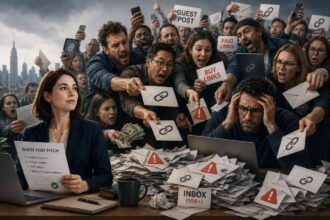


Writing these posts isn’t always easy. I try to focus on things that actually matter, which often means tackling topics that lean negative.
I usually dig in with research and do my best to approach each post with intention and care. But that process? It’s led me down more than a few grim rabbit holes over the years.
And yeah, it takes a toll. Some weeks, it’s just plain depressing. And that’s just me, doing this every day of the week. I can’t help but wonder—what if this is my only job option?
What if I were a journalist, tasked with making sense of an increasingly chaotic world every single day? Where would I find the energy to keep going?
Turns out, a lot of journalists are asking the same question. A recent Muck Ruck survey of 402 journalists found that over half—56%—seriously considered leaving the profession last year.
That’s not shocking, honestly. I’ve talked before about the state of journalism, and it’s bleak. The ad-based model that once supported quality reporting is crumbling.
Meanwhile, publishers have learned it’s easier—and more profitable—to double down on bias and feed people what they already believe, rather than challenge them with uncomfortable truths.
In that sense, maybe Colonel Jessup from A Few Good Men had a point: we really can’t handle the truth. We’d rather be fed highly polarised takes than sift through complex realities.
And if your business model is built on clicks, it’s a lot cheaper and faster to churn out opinion than to dig for evidence. The result? Newsrooms slashed, reporters laid off, and a profession under constant economic strain.
According to that same Muck Rake survey, most journalists are burnt out—not just from working longer hours with fewer resources, but from the shifting nature of news itself.
It used to be that the news followed a 24-hour cycle. That sounds quaint now. Today, stories break, trend, and disappear in the time it takes to refresh your feed.
There’s no downtime. No chance to unplug. Even with all the tech out there to help manage the flood of information, journalists are expected to be perpetually online, constantly scanning, constantly reacting.
It’s exhausting.
But maybe what’s most heartbreaking isn’t just the hours or the money—it’s the disillusionment. Most journalists didn’t get into this line of work for fame or fortune.
They did it because they believed in something: that facts matter, that truth has value, that journalism can elevate discourse and maybe even make a difference.
Given the current state of things, who can blame them for questioning whether that belief still holds?
And that’s the part that really worries me. At a time when we desperately need solid, trustworthy reporting—people who are trained to cut through the noise and tell us what’s actually happening—those same people are walking away.
And who, exactly, will take their place?