


A man calling himself “Jonathan James” recently contacted me with an offer from WebRankers, a supposed digital agency specialising in website development, SEO and paid guest-post placements.
The pitch sounded polished until I checked who was behind it. Within minutes, the entire operation began to look like another hastily assembled web-development scam built around spam lists, fake credibility and what appears to be an AI-generated website.
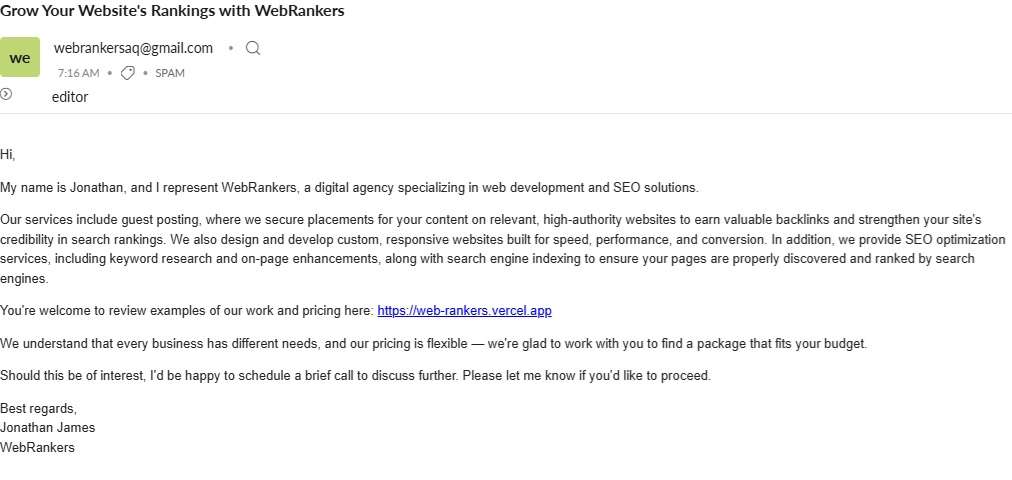
The sender claimed WebRankers could design custom websites, improve search rankings and place content on “relevant, high-authority websites”. He also offered flexible pricing and invited me to arrange a call.
Yet the man selling professional web development could not even present a professional business identity of his own.
The email came from a free Gmail account rather than an address connected to WebRankers. There was no company address, business registration, telephone number or verifiable information identifying who operates the agency.
Then there was “Jonathan James”.
I couldn’t find anything connecting that name to this particular WebRankers operation.
That does not conclusively prove the name is false, but an ordinary name typed beneath a sales email is hardly proof of identity. Anyone can invent a name, create a Gmail address and begin contacting businesses within minutes.
The website did little to improve matters.
Instead of operating from its own business domain, WebRankers directed potential customers to web-rankers.vercel.app, a free project address automatically provided when a website is deployed through Vercel.
Vercel is a legitimate hosting ,AI and deployment platform, but its projects automatically receive a free vercel.app address when deployed.
For a supposed web-development company, failing to register and configure a proper domain is an extraordinary display of amateurism.
The website itself has the appearance of a basic AI-generated template produced to support the sales pitch.
It offers broad promises about development, deployment, SEO and ranking, but provides little confidence that an established agency or experienced development team exists behind it.
There is no shame in using AI tools or Vercel to create a website. The problem begins when someone uses a disposable-looking site to present themselves as an experienced digital agency and then asks strangers to trust them.
WebRankers also promotes the claim “Rank #1 on Google Guaranteed”.
That statement should disqualify the agency immediately in the eyes of anyone who understands SEO. Google expressly warns that nobody can guarantee a number-one ranking and tells businesses to be wary of SEO providers making that promise.
An SEO company making guarantees that Google says cannot be made is either displaying a serious lack of knowledge or relying on customers who do not know any better.
The guest-posting offer was equally revealing. WebRankers claimed it could secure placements on high-authority websites to strengthen credibility, despite showing almost no authority or credibility of its own.
This is the grubby end of the backlink industry, where people scrape publishers’ contact details, send mass emails and pretend to operate digital agencies.
They sell links, rankings and web-development expertise from behind free email accounts and temporary websites that would struggle to survive the most basic background check.
The email I received also contained no clear unsubscribe facility. Australian rules require commercial messages with an Australian connection to identify the sender accurately and provide a functional way for recipients to opt out.
The Australian Communications and Media Authority also warns that businesses remain responsible for consent when using purchased marketing lists.
I did not request the email, recognise the sender or consent to marketing from WebRankers, and the message did not explain how my address was obtained.
This is becoming easier as generative AI lowers the cost of manufacturing a fake business presence.
A plausible agency name, corporate-looking logo, promotional website and lengthy sales email can now be produced in less time than it takes to verify whether the supposed company exists.
That convenience is useful for genuine small businesses, but it is equally useful to people who want the appearance of a company without doing the work required to build one.
A real web-development agency should be able to demonstrate its own ability before approaching potential customers.
It should have a credible identity, verifiable work, proper contact details and a website that does not look like it was generated five minutes before the spam campaign began.
WebRankers supplied none of that in its approach to me.
All the pitch proved was that someone could create a Gmail account, deploy a template on Vercel and paste a sales script into an unsolicited email. That is not evidence of web-development experience or SEO expertise.
It is a low-effort attempt to manufacture credibility, and it reeks of desperation.