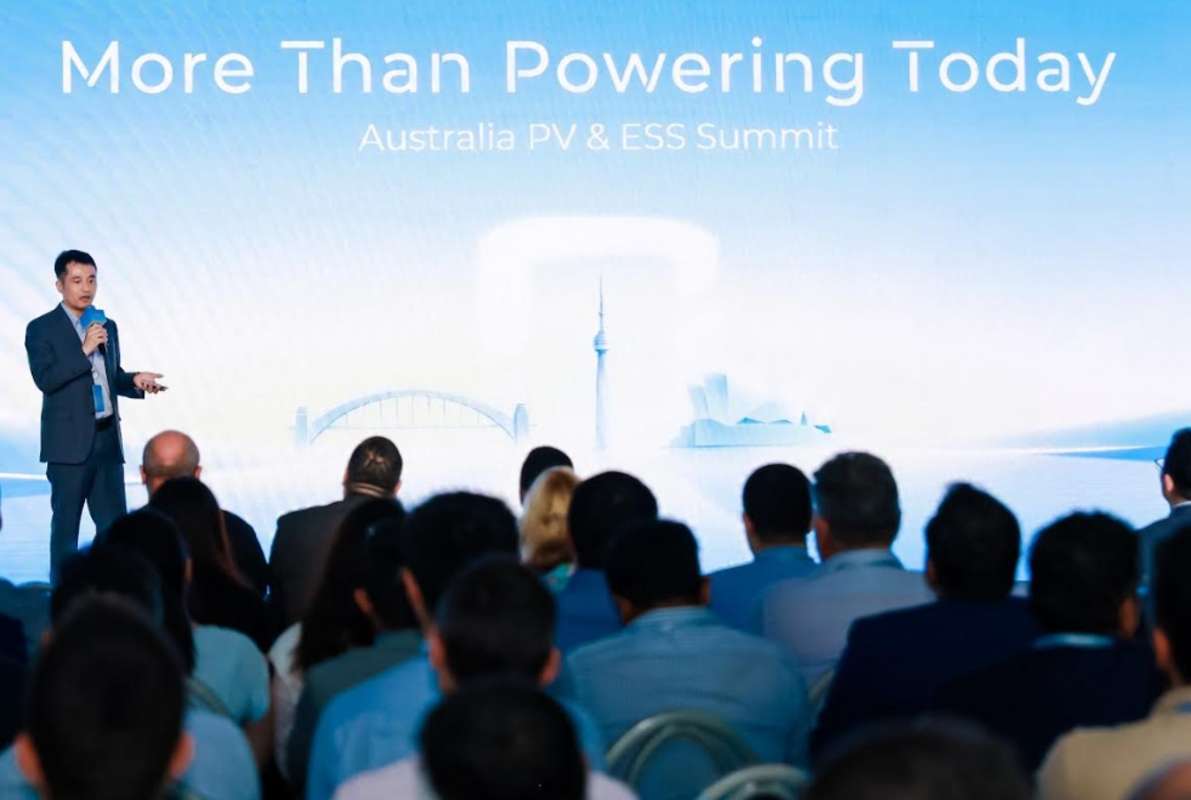


In a clear signal of the accelerating transformation underway across Australia’s energy sector, Sungrow has used its Sydney summit to position itself at the centre of the nation’s next phase of large-scale renewable deployment.
Before an audience of more than 300 industry stakeholders, Sungrow unveiled its latest utility-scale technologies, including the PowerTitan 3.0 platform and a new hybrid PV and energy storage solution.
Both systems are designed to respond to the mounting technical and commercial pressures reshaping Australia’s grid.
The timing is significant. Across the National Electricity Market, battery energy storage systems are moving from supplementary assets to critical infrastructure.
Federal Capacity Investment Scheme (CIS) incentives, aggressive state-based renewable targets, and sustained investor appetite have driven a surge in large-scale battery projects. Yet as deployment accelerates, so too does complexity.
Developers are now contending with weak grid conditions, tightening technical standards, and protracted connection processes—alongside persistent challenges including system strength limitations, voltage instability, and increasingly stringent requirements for grid-forming capability.
Against this backdrop, Sungrow’s PowerTitan 3.0 has been pitched not merely as an incremental upgrade, but as a system designed for the realities of a renewables-dominant grid.
The platform centres on a high-density architecture built around 600+ Ah stacked battery cells and a silicon carbide-based power conversion system.
Each 20-foot container integrates 1.78 MW of PCS capacity with 7.14 MWh of storage, scaling up to multi-megawatt blocks while reducing land footprint and project costs.
Efficiency has been pushed to a reported 99.3% at the inverter level, with system-level round-trip efficiency reaching 92%.
Equally notable is the emphasis on deployment speed—a growing pressure point for developers navigating tight project timelines.
Sungrow claims its AC block design enables factory pre-installation and rapid commissioning, compressing timelines to the extent that a 1 GW project could be deployed in under two weeks.
The company is also targeting Australia’s often harsh operating conditions, with the system rated for high ambient temperatures, low noise output, and corrosion resistance suited to coastal and remote installations.
Alongside PowerTitan 3.0, Sungrow introduced its hybrid PV and battery solution, underscoring a broader industry shift toward deeper integration between generation and storage assets.
Built on a single-platform architecture, the system combines photovoltaic generation, energy storage, and power conversion into a unified framework.
Its DC-coupled design—paired with a dedicated energy management system—aims to deliver higher efficiency and lower project costs compared to conventional configurations, with gains of up to five percent at the system level.
Crucially, the solution reflects a growing preference among developers for flexible, long-duration storage capable of supporting grid stability while maximising renewable output.
Grid stability itself has become one of the defining issues of Australia’s energy transition. As renewable penetration increases, traditional synchronous generation is being displaced, heightening the need for technologies capable of maintaining frequency and voltage stability.
Sungrow used the summit to highlight its advances in grid-forming (GFM) capability—an area rapidly emerging as a cornerstone of future power systems.
The company’s technology suite includes voltage and frequency support, oscillation damping, black start capability at gigawatt scale, and system strength enhancement.
Industry discussion at the event reinforced the scale of the challenge ahead, with experts pointing to the need for closer alignment between technology providers, developers, and regulators to ensure grid reliability keeps pace with renewable expansion.
The company also used the platform to release an energy storage safety white paper in partnership with TÜV Rheinland, reflecting growing scrutiny around the safe deployment of large-scale battery systems.
Sungrow’s ambitions in Australia are far from theoretical. According to Asia Pacific Vice President Joe Zhou, the company has spent more than a decade building its local footprint, delivering utility-scale solar and storage projects nationwide.
Operational assets such as the Cunderdin DC-coupled project and Templers BESS, alongside the Pelican Point BESS currently under construction, form part of an expanding portfolio that continues to scale in both size and complexity.
Looking forward, the company points to a pipeline extending into 2026 and beyond, including multi-gigawatt-hour developments that would rank among the largest in the region.
As Australia’s energy transition enters a more technically demanding phase, the message from Sydney was clear: the next wave of innovation will not be defined solely by capacity, but by the ability to deliver stability, speed, and integration at scale.