

Australian business leaders are warning that the race to dominate artificial intelligence is no longer about who builds the best models — but who can deploy them fastest at scale.
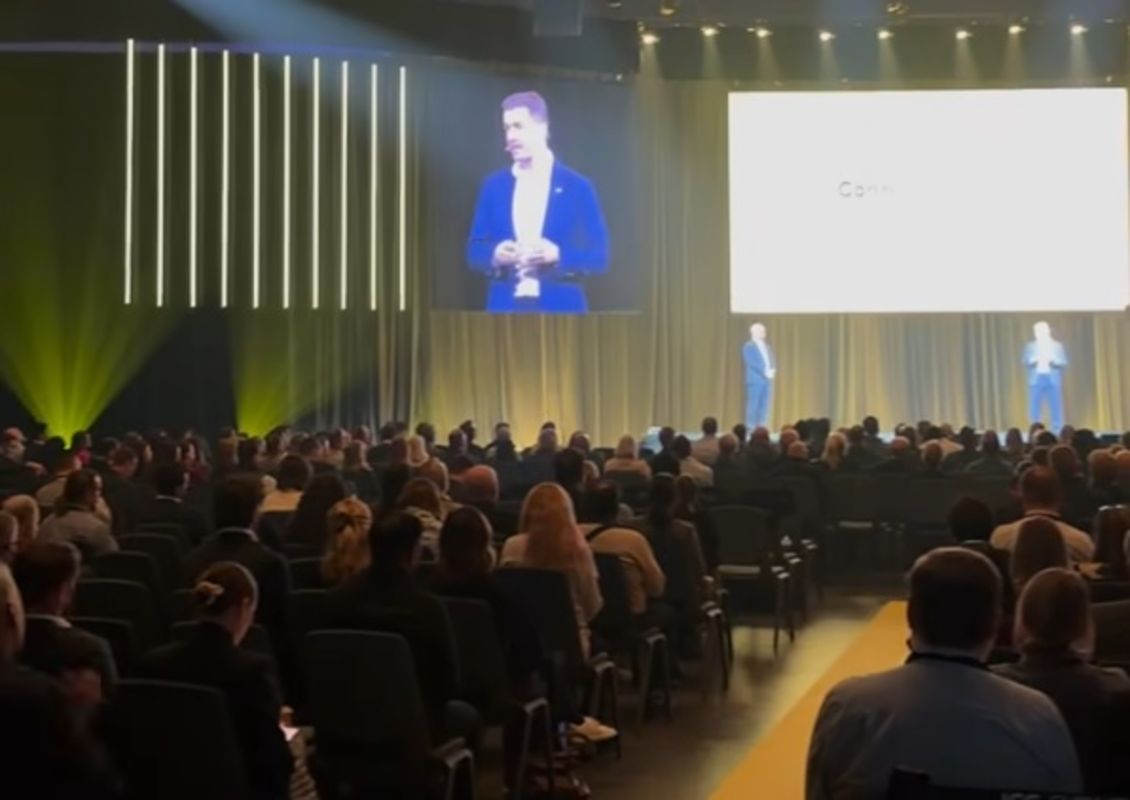
That was the key message emerging from Commonwealth Bank’s inaugural AI conference in Sydney this week, where executives, investors and technology leaders gathered to discuss how AI is already being embedded into Australia’s economy.
Among the strongest voices was Craig Scroggie, the chief executive of NEXTDC, who described the event as a turning point in how Australia’s corporate sector approaches AI adoption.
In a post following the conference, Scroggie said it was significant that the event was hosted not by a technology vendor or hyperscale cloud provider, but by Commonwealth Bank of Australia itself.
“Technology conferences usually showcase vendors selling capability,” Scroggie said.
“CBA did something different. A major bank showed how AI is already operating inside its own business and put customers on stage doing the same.” he said.
Held at the International Convention Centre Sydney, the conference attracted around 1,000 attendees and featured presentations from major enterprises already deploying AI in production environments.
OpenAI chief executive Sam Altman opened the event alongside CBA chief executive Matt Comyn, arguing that the biggest obstacle to AI progress is no longer the technology itself.
Altman says the “bottleneck has shifted from invention to absorption”, with organisations now struggling more with implementation speed than model capability.
Retail giant Coles Group provided one of the clearest examples of AI at industrial scale, revealing it now analyses 109 million demand predictions every day across its 850-store network.
Scroggie later joined investor Paul Bassat and Angus Dawson for a panel discussing Australia’s infrastructure readiness for AI growth.
The discussion focused heavily on the physical demands of AI systems, including energy supply, data centres, cooling, connectivity and compute capacity.
“AI competitiveness is no longer primarily a technology issue,” Scroggie said. “It is now an infrastructure, capital and execution challenge at national scale.”
The comments come as Australia faces mounting pressure to expand sovereign digital infrastructure while competing against massive investment programs underway in the United States, China and the Middle East.
Scroggie argued the debate around “sovereign AI” also needs to become more nuanced, saying countries do not need to control every layer of the technology stack, but must identify which strategic capabilities are critical to national and economic security.
He also suggested the next competitive advantage will belong to organisations capable of shortening the gap between experimentation and deployment.
“Advantage is going to organisations that compress the distance between experimentation, decision and rollout,” said Scroggie.
The broader message from the conference was that AI’s economic benefits are expected to become increasingly measurable over the next year — and that businesses delaying adoption risk falling behind.
Scroggie praised CBA for hosting what he described as a rare enterprise-led discussion about operational AI, warning that countries that hesitate may miss the opportunity to build long-term competitive advantage.
“The countries and companies that operationalise AI quickly will compound advantage fastest. Australia needs to lead and not talk ourselves out of the opportunity.” he said.