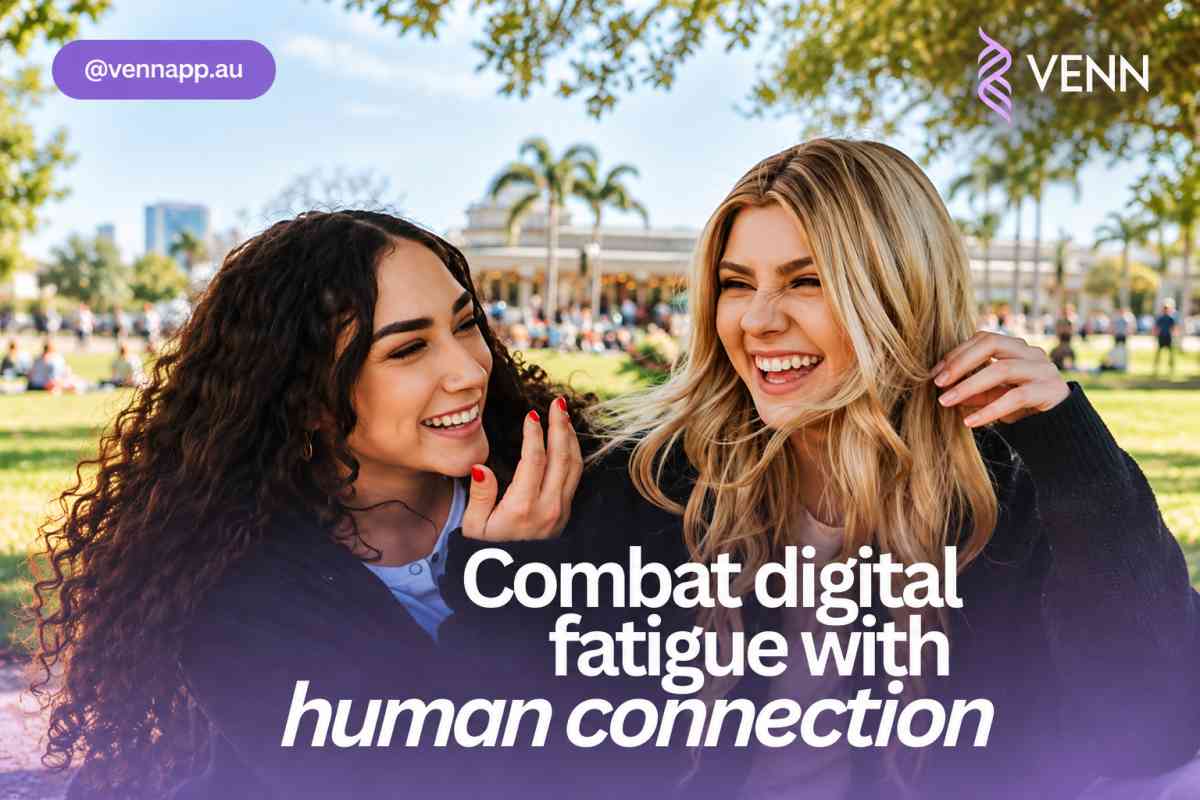


An innovative app has launched to assist Australians to connect with others at venues, parks, beaches and other locations. The app is called Venn and it has been designed by an industry expert who understands the level of loneliness people are experiencing.
Australians have never been more digitally connected, yet according to psychologist and Venn App founder Bethany Fortuin-Hathway, social disconnection is reaching disturbing levels.
Despite constant access to social media, messaging platforms and online communities, Bethany highlights many people are struggling to form genuine human relationships and maintain meaningful connections.
“We are communicating more than ever, but connecting less,” Bethany said.
“People can have hundreds or even thousands of online contacts and still isolated.”
As a registered psychologist, Bethany has spent years working in private practice with people experiencing anxiety, depression, low self-esteem and social isolation. Increasingly, she has observed a common thread running through many of these challenges.
“People have lost confidence in their ability to connect with others in real life,” she said.
“We have become so accustomed to interacting through screens that many people now find face-to-face connection intimidating, awkward or difficult.”
The loneliness epidemic hiding in plain sight
Bethany believes social isolation has become one of Australia’s most significant yet least discussed public health issues.
“Loneliness doesn’t just affect how we feel emotionally. It impacts mental health, physical health, resilience and overall wellbeing,” she said.
“Human beings are wired for connection. It is not a luxury or an optional extra. It is a fundamental human need.”
She said social isolation and disconnection affects all generations and age groups.
“University students, young professionals, parents, people who have relocated, travellers, retirees and even highly successful professionals are all experiencing it,” she added.
She said social media often creates the illusion of connection while failing to deliver the benefits of genuine human interaction.
“Scrolling through other people’s lives is not the same as sharing experiences, having conversations or feeling genuinely seen and understood,” she said.
Why making friends has become harder
Bethany said one of the biggest challenges facing modern Australians is that they no longer know where or how to meet new people.
“In previous generations, connection often happened naturally through neighbourhoods, community groups, sporting clubs, workplaces and local activities,” she said.
“Many of those opportunities still exist, but people are increasingly isolated within their own routines.”
She said uncertainty also prevents people from reaching out.
“One of the biggest barriers is not knowing whether someone else wants to connect.”
“People worry about rejection, awkwardness or being perceived the wrong way, so they avoid taking the first step altogether.”
As a result, many people find themselves wanting friendships and connection but feeling unsure how to create them.
Technology isn’t always the problem
While digital platforms are often blamed for rising loneliness, Bethany believes technology can also become part of the solution.
“The issue is not technology itself. The issue is how we use it,” she said.
“Technology should be helping people connect in the real world, not replacing human interaction altogether.”
This belief ultimately inspired Bethany to create Venn – The Human Connection, an Australian-developed app designed to help people form genuine, face-to-face connections.
From psychologist to tech founder
After years of helping clients navigate loneliness and social disconnection, Bethany recognised a recurring problem.
“People wanted more connection, but they didn’t know where to find it,” she said.
“They wanted to meet new people, build friendships and engage with their communities, but there was no simple way to do it.”
Venn was created to address that challenge.
Using location-based technology, users can check into venues, events and locations and indicate they are open to meeting and connecting with others nearby.
The platform is designed to facilitate authentic, real-world interactions rather than endless online conversations.
“I wanted to create something that removed some of the uncertainty around meeting new people,” Bethany said.
“If you know other people are open to connecting, it becomes much easier to start a conversation.”
Relearning the art of connection
Bethany believes many Australians need to actively rebuild their connection skills.
“Connection is like any other skill. If you don’t use it, it becomes harder,” she said.
“We need to become comfortable again with introducing ourselves, having conversations, joining groups, attending events and putting ourselves out there.”
She said meaningful relationships are built through small moments of courage.
“Most friendships begin with a simple conversation. The challenge is that many people have forgotten how powerful that first conversation can be,” she said.
A challenge for all Australians
Bethany wants people to know that if they are feeling lonely, they are not alone.
“So many people are looking for the same thing: friendship, belonging and connection,” she said.
“The solution starts with making connection a priority again. We need to stop assuming everyone else has their social life figured out because they don’t.”
“Many people are searching for meaningful relationships and waiting for someone to make the first move.”
“The future of mental wellbeing will not just be about therapy, medication or treatment. It will also be about rebuilding community, fostering belonging and helping people reconnect with one another.”
“Because at the end of the day, human connection remains one of the most powerful protective factors we have.”
“I am really delighted to be in a position to found an App like Venn and I look forward to the Venn team taking the App to the world to help people connect with others in a real and meaningful way,” Bethany said.