Outdated technologies are causing customer frustration, inaccuracies, and slow response times, say contact centre workers
A global study, conducted by research firm Savanta, surveyed customer service agents from six countries in the Americas, Europe, and Asia-Pacific to uncover the difficulties they have helping customers and the resulting negative effects on customer outcomes.
The research found that outdated technologies were causing customer-facing staff a number of headaches, leading to frustration for both agents and the customers they serve.
These include:
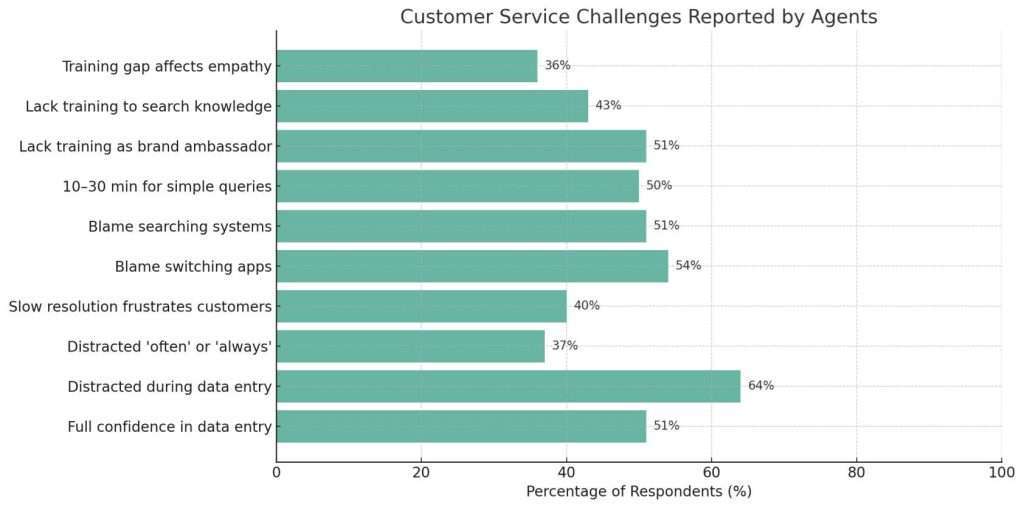
- Accuracy of information: Only half (51%) of agents say they have full confidence when they accurately take down customer information when manually entering it into systems.
Nearly two thirds (64%) say they sometimes become distracted while taking down customer information and are unable to be ‘present’ and fully understand their customer’s needs as a result.
Of this number, more than one in three (37%) say it happens either ‘all the time’ or ‘often’, making manual data entry errors even more likely.
- Existing systems harming speed of response: Respondents see slow resolution of issues as the leading frustration for their customers, with nearly 40% citing it as a problem.
When asked what is responsible for slowing them down, over half (54%) of respondents blame the need to switch between applications to enter customer information.
A similar percentage (51%) say they are slowed down by having to search systems to find the information for the customer. Half of all respondents say it takes them between 10 and 30 minutes just to resolve simple, everyday customer queries, which leads, in turn, to customer frustration.
- A lack of relevant training: More than half (51%) of respondents do not feel they’ve been given the training they need to operate as the ‘voice’ of their organisation and a true brand ambassador.
Almost half (43%) said they had not received sufficient training to search relevant knowledge spaces on behalf of customers to be able to find the answer to their question.
Meanwhile, more than one in three (36%) contact centre workers report a lack of training is also responsible for the second largest cited customer frustration – contact centre staff being unable to provide the best, most empathetic responses.
The overwhelming majority of respondents say that embracing new technologies to help counter these issues would significantly improve their working lives.
Eighty-three percent say they would benefit from all apps they use being available on one screen, while 76% say their lives would be made easier by not having to copy and paste information between screens.
Sixty-nine per cent also feel eliminating the need to manually fill out forms would make a positive difference in improving their working life, while 87% said the same of being able to immediately access knowledge centres that would allow them to answer customer queries quickly and directly.
“There’s never been a more important time for businesses to arm their customer service operatives to operate as brand ambassadors,” said Sabrina Atienza, director, product management, Pegasystems.
“Over the last two years, customer expectations have skyrocketed to the point where exceptional service is now demanded as standard across every interaction,”
“It’s no longer seen as going ‘above and beyond’ to provide quick, context-aware, empathetic responses – it is expected,” Atienza said.
“As expectations continue to rise, organisations must prepare themselves by investing in the right solutions to deliver the outcomes their customers not only demand, but also deserve — or risk being left behind.” she said.
With half of service agents admitting to mishandling customer interactions, the need for better training, tools, and support systems has never been more urgent.
Businesses that fail to address these shortcomings risk damaging customer trust and loyalty—while those that invest in improving frontline performance stand to gain a clear competitive edge.
Customer Service Performance Crisis: New 2025 Data Reveals Training and Support Gaps
Latest industry research exposes significant disparities in agent performance and customer satisfaction across service organisations.
A comprehensive analysis of customer service industry data for 2025 reveals concerning gaps in agent performance and training that are directly impacting customer experiences across organisations worldwide.
New statistics show a stark divide between high-performing and underperforming service agents, with training being the critical differentiator.
83% of top-performing service agents feel they receive the training needed to excel in their roles, while just 52% of underperforming agents share that sentiment, according to recent Salesforce data.
The performance gap extends beyond training to organisational support systems. 88% of high performers have clear guidelines on how flexible they can be with clients compared to 46% of underperformers, highlighting how structural support directly correlates with service quality.
1. Customer Dissatisfaction Reaches Critical Levels
The impact of poor service performance is creating significant customer relationship challenges. Research indicates that 42% of people who had a bad customer care experience felt disappointed, 43% felt unhappy, and 41% felt angry, demonstrating the emotional toll of substandard service interactions.
Despite technological advances, customers still strongly prefer human assistance. 99% of customers feel more comfortable with a human assisting to resolve their issues, while 80% of customers expect chat agents and support agents to assist them with everything they need.
2. AI Integration Accelerates Amid Human Performance Issues
Organisations are rapidly adopting artificial intelligence to address service challenges. Industry projections show that by 2025, 80% of companies will have adopted or plan to adopt AI-powered chatbots to support their customer service operations, with 85% of customer interactions expected to be handled without a human agent by 2025.
The shift toward AI-assisted service is showing measurable productivity gains. Classifying service issues with artificial intelligence (AI) and automatic routing of incoming customer contacts increases contact center agent productivity by 1.2 hours a day.
3. Channel Preferences Evolve
Customer communication preferences continue to shift toward digital channels. 37.4% of customers prefer to contact a business via email for customer service issues, making it one of the most popular channels for communication, while 41% of customers prefer live chat for quick inquiries, reflecting the growing trend towards digital communication channels.
Looking ahead, by 2025, 80% of customer service organisations will move away from native mobile apps and use messaging instead for a better customer experience.
4. Revenue Impact Drives Investment
The financial implications of customer service quality are driving increased organizational investment. By 2025, 85% of decision-makers expect customer service to contribute a larger share of revenue, while research shows that 86% of customers say good service makes one-time buyers become loyal fans of a brand.
The data suggests that while organisations recognise the critical importance of customer service quality, significant work remains to bridge the performance gap between top and underperforming agents through improved training, clearer guidelines, and better technological support systems.
Research Summary
The research conducted by Savanta in 2022 highlights the ongoing challenges faced by customer service agents worldwide, with half admitting to mishandling customer interactions—ultimately impacting customer satisfaction and loyalty.
The insights, drawn from six countries across the Americas, Europe, and Asia-Pacific, underscore the need for urgent improvements in tools, training, and support systems.
Looking ahead to 2025, the industry is already pivoting: 80% of customer service organisations are expected to abandon native mobile apps in favour of messaging platforms to deliver faster, more intuitive customer experiences.