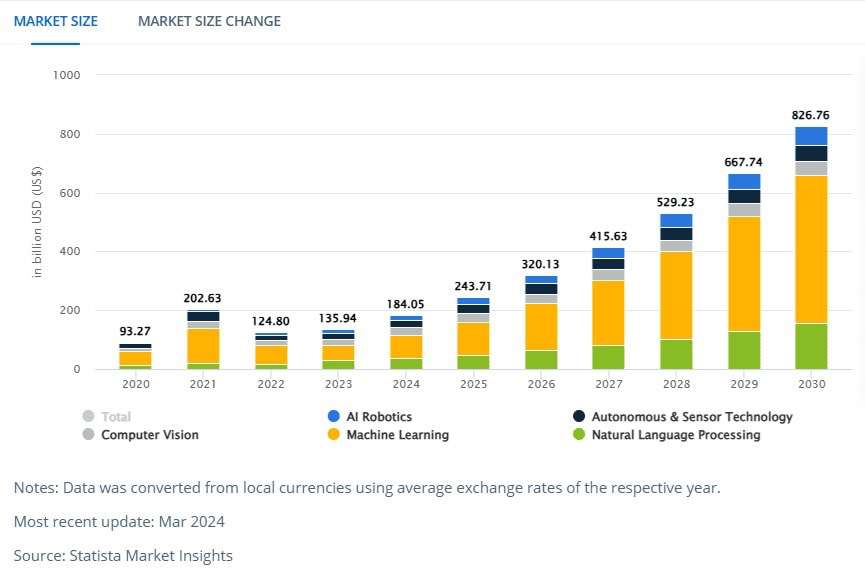
The artificial intelligence (AI) industry is not just growing — it’s going full supernova. New forecasts reveal that the global AI market is set to reach $244.22 billion by the end of 2025, marking a significant milestone in what many experts are calling the defining technological revolution of our time.
But the real story? This is only the beginning. Analysts predict that the AI sector will maintain an extraordinary compound annual growth rate (CAGR) of 26.60% through 2031, pushing the market’s value to a staggering $1.01 trillion within just six years.
US Leads the Pack
While AI is gaining ground worldwide, the United States is expected to remain the global powerhouse, with a market valuation projected at $73.98 billion by 2025.
Thanks to Silicon Valley’s unrelenting innovation machine and strong federal and private investment, the U.S. is shaping up to be the beating heart of the global AI boom.
“The U.S. has a unique ecosystem that supports rapid AI development—world-class universities, deep-pocketed venture capital, and a tech industry that’s not afraid to take risks,” says Dr. Lauren Hsu, a senior technology analyst at Global Insights.
What’s Driving the Boom?
Several key trends are accelerating AI’s rise at warp speed:
- Advancements in Core Technology: Improvements in machine learning algorithms, processing power, and cloud infrastructure are making AI systems faster, smarter, and more accessible.
- Record-Breaking Investment: Tech giants like Google, Microsoft, and Amazon are pouring billions into AI research and development, alongside a stampede of venture capital funding for AI-focused startups.
- Widespread Industry Adoption: AI is no longer confined to research labs or sci-fi movies. It’s now being deployed across industries—from healthcare and finance to agriculture and manufacturing.
In fact, sectors like autonomous vehicles, speech recognition, predictive analytics, and robotic process automation are seeing explosive growth. - Demand for Efficiency and Personalisation: In an increasingly digital economy, businesses are racing to integrate AI solutions to improve efficiency, cut costs, and deliver hyper-personalised customer experiences.
A Market Touching Every Corner of Life
The reach of AI is becoming almost universal. Some of the most dynamic areas include:
- Speech and Language Processing: From smart assistants like Siri and Alexa to AI-driven customer service bots, natural language processing is changing how humans interact with machines.
- Computer Vision and Image Processing: Think facial recognition, medical imaging analysis, and self-driving car navigation—AI is making machines better at ‘seeing’ than ever before.
- Autonomous Vehicles: Car manufacturers are deep in an AI arms race, vying to perfect the self-driving car dream. Companies like Tesla, Waymo, and GM’s Cruise are investing heavily in AI to crack the code on full autonomy.
- Healthcare Innovation: From diagnostic AI to robotic surgery, healthcare is one of the fastest-growing sectors for AI application, promising life-saving advancements that were once science fiction.
Challenges on the Horizon
Of course, no gold rush comes without its share of growing pains. As AI systems become more powerful and autonomous, new concerns are emerging around ethics, regulation, data privacy, and the risk of job displacement.
“AI’s growth is inevitable, but it’s a double-edged sword,” warns Professor Raj Patel of the Global Technology Institute. “We must balance innovation with thoughtful governance to ensure that AI technologies benefit all of humanity—not just a select few.”
Regional AI Market Overview: Global Growth Leaders and Laggards
While global powerhouses like the United States and China are racing ahead, heavily investing in AI innovation to boost their economies, other regions are still catching up — highlighting a growing digital divide in the AI era.
United States: Setting the Pace
- The U.S. AI market is projected to reach a value of $594 billion by 2032, growing at a steady 19.1% compound annual growth rate (CAGR) from 2023 to 2032.
- America leads globally in AI investment, with $250 billion invested across 4,643 AI-focused companies.
- In 2022 alone, the U.S. witnessed the founding of 524 AI startups, which collectively attracted a massive $47 billion in private, non-governmental funding.
Clearly, the U.S. remains a global leader in AI development and commercialization, thanks to its strong tech infrastructure and vibrant startup ecosystem.
China: Rapid Growth and Rising Dominance
- China’s AI market is expected to grow at an impressive 37.3% annually from 2023 to 2030, reaching a total market size of $1,811.8 billion by 2030.
- China also ranks second globally in the number of AI startups, with 1,337 startups backed by $95 billion in private investment between 2013 and 2022.
- In 2022, China had the highest global rate of AI exploration and deployment, demonstrating its aggressive push to integrate AI technologies across industries and society.
Europe: Emerging Strong Player
- The European AI market is projected to reach $66.4 billion in 2024, with an anticipated annual growth rate of 33.2% from 2025 to 2030.
- Within Europe, the United Kingdom leads the charge, accounting for 24.8% of the region’s AI market revenue in 2023. This growth is fueled by rapid digital transformation across sectors like banking, healthcare, and insurance.
- Germany is also making significant strides, with its AI market expected to grow at 30.9% annually between 2024 and 2030. Government programs like the German AI Strategy and the establishment of the National AI Competence Center are driving momentum.
- France is bolstering its AI sector through national programs like the National Strategy for AI and the broader France 2030 initiative, aiming to secure a strong position in the global AI race.
Middle East and Africa: A Region on the Rise
A major focus for AI development in the region is the enhancement of Arabic language processing technologies, reflecting regional priorities and creating new opportunities for innovation in education, customer service, and e-commerce.
The AI market in the Middle East and Africa (MEA) is forecasted to reach $166.33 billion by 2030.
The Road to 2031: An AI-First World?
Looking ahead, experts predict that AI won’t just be a tool we use — it will become a foundational layer of our economy, our infrastructure, and even our personal lives.
From predictive healthcare to automated logistics networks to AI-powered creativity, the technology’s potential seems almost limitless.
By 2031, when the AI market is expected to officially surpass the $1 trillion mark, the question won’t be how much AI has changed the world — but whether there’s any part of life it hasn’t touched.