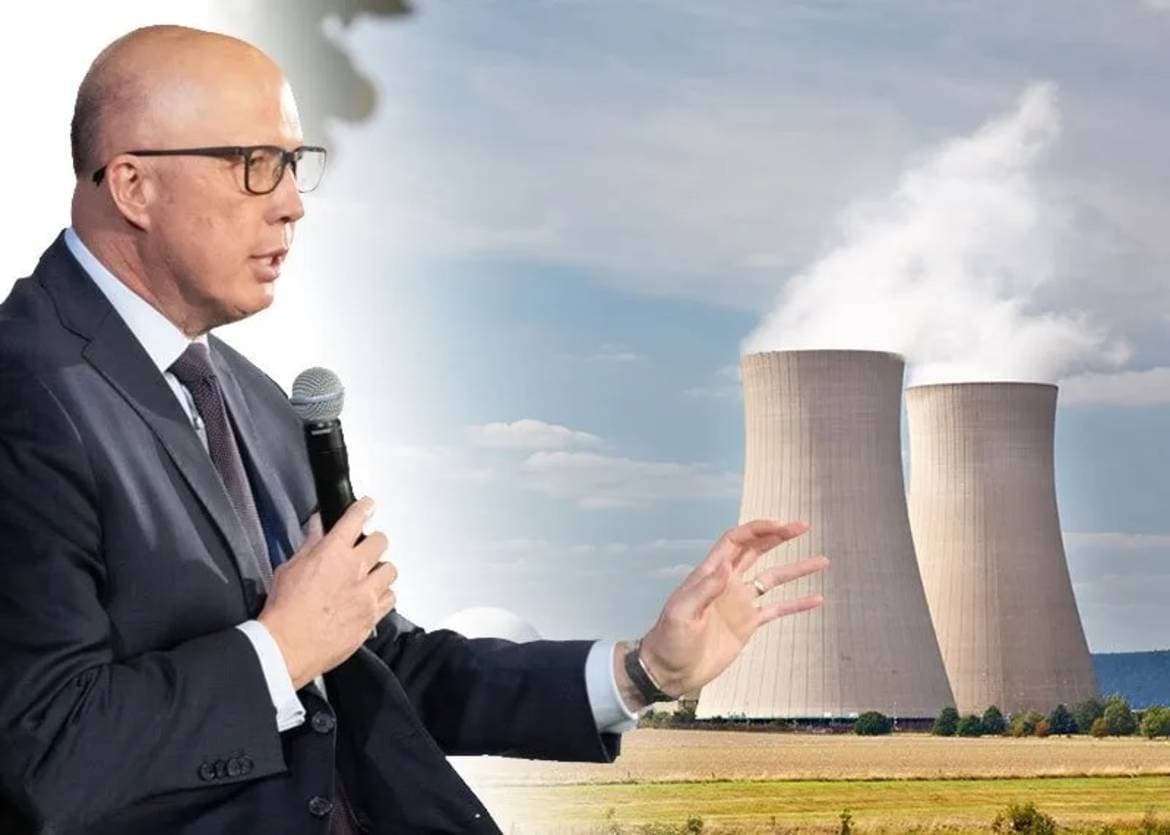
The CSIRO’s Gencost report consultation draft released this week shows nuclear is more than 15 years away even with the most generous timeline assumptions, and any energy it produces will cost more than double power produced by large-scale solar PV.
The report models the cost in 2030 of 90 percent wind and solar mix, including integration costs, at up to $150 per megawatt hour (MWh) while the small modular reactors (SMR) – an unproven technology favoured by Mr Dutton’s plan – are modelled at up to and beyond $500/MWh (though the report concedes there is no prospects of any nuclear being built by 2030).
For 2040 the report shows solar PV at $25-50/MWh, while SMRs are up to and beyond $400/MWh and large scale nuclear between $150 and $250/Mwh. By 2050 it shows solar PV below $50MW/h while nuclear costs range from around $150 to around $375/MWh across small and large reactors.
The modelling is generous in its treatment of nuclear plants, allowing for an extension of the working life of a plant from the standard 30 years used in previous Gencost reports to 60 years.
ETU National Secretary Michael Wright says the events of this week showed that renewable energy and battery was the fastest, lowest cost path to energy transition, while nuclear is too slow and too expensive for Australia’s energy needs.
“Australia’s energy transition is being powered by licensed electricians and apprentices, and it is happening today,” Mr Wright said.
“Renewable energy, battery storage and transmission technology projects are creating the skilled electrical jobs that will sustain the next generation of electrical professionals and underpin Australia’s future industries.
“The CSIRO Gencost report shows that Australians will pay the price for Mr Dutton’s nuclear fantasy, which won’t be ready for an absolute minimum of 15 years” said Mr Wright.
During the 2022 election, Labor presented independent modelling suggesting its energy plan would cut household power bills by $275 annually by 2025, countering Coalition criticisms about renewable energy costs.
However, power bills have since increased by $475, driven by global inflation, according to the Australian Energy Market Operator. This has sparked concerns about the reliability of political party modelling.