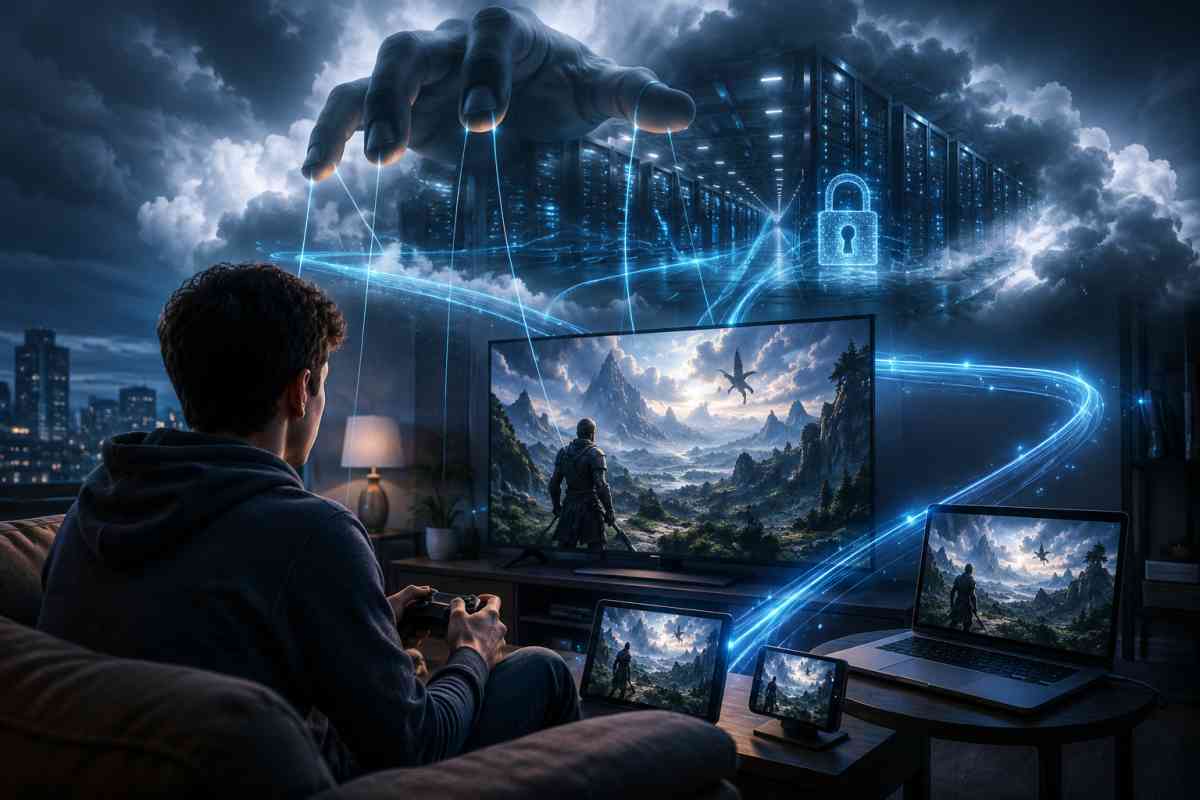


Cloud gaming is moving into the mainstream, cutting the upfront cost of high-end play while shifting ownership, pricing power and long-term access from consumers to technology platforms.
Players can now stream demanding titles to televisions, phones and basic laptops without buying a new console, powerful graphics card or large storage drive for use at home.
Microsoft says Xbox cloud gaming hours rose 45% year-on-year, suggesting streaming is becoming a regular way to play rather than a technical experiment for early adopters.
For families priced out of premium hardware, cloud services can remove a major barrier and extend the life of older devices. The trade-off, however, is becoming harder to ignore.
The machinery has not disappeared. It has moved into remote data centres controlled by companies that determine subscription prices, catalogue access and the conditions under which players can use games.
The Console Moves Into the Data Centre
Traditional games run on hardware inside the home, where the console or computer processes graphics, stores files and responds directly to the player’s commands.
Cloud gaming shifts that work to a remote server. Players receive a live video stream while each button press travels across the network, is processed and returns as a new frame.
That makes broadband quality part of the product. Microsoft recommends at least 10Mbps on mobile devices and 20Mbps elsewhere, but speed alone does not guarantee reliable performance.
Latency, packet loss, network congestion and the distance between a player and the server can all affect whether a game feels responsive or frustratingly delayed.
Nvidia says GeForce NOW supports more than 4,500 games through libraries including Steam, Epic Games, GOG, PC Game Pass and Ubisoft without requiring high-end local hardware.
Australia’s Broadband Divide Becomes a Gaming Divide
Australia’s broadband divide could determine who benefits most. Cloud gaming depends on low latency, stable routing and minimal packet loss, not merely a strong advertised download speed.
The ACCC found latency to Australian gaming servers generally averaged between 15 and 30 milliseconds, although distance, routing and connection type produced significant regional differences.
In June 2026, fixed-line users received 99.4% of advertised download speeds during busy periods, yet FTTN accounted for 86% of underperforming 50Mbps and 100Mbps services tested.
A fibre household near a major server may receive smooth and consistent play. A regional customer on a weaker line may pay the same subscription while facing lag, blur and sudden dropouts.
Cheaper Entry Can Conceal Higher Long-Term Costs
Cloud gaming can reduce the initial cost of playing, but subscriptions, faster broadband and separate game purchases can accumulate over time. Australian gaming subscription spending rose 16% in 2024.
Heavy users may eventually pay more while retaining less control. Higher resolutions, shorter queues and longer sessions can also be locked behind more expensive membership tiers.
The lower entry price therefore does not necessarily mean lower lifetime spending. It can instead spread costs across years while leaving customers dependent on recurring payments.
Players May Be Paying for Access, Not Ownership
The central consumer issue is ownership. Physical games can often be kept, lent or resold, while cloud access may disappear when licences expire or commercial strategies change.
Google Stadia demonstrated that risk when it closed in January 2023. Google refunded many purchases, but the shutdown showed how quickly an entire gaming ecosystem could vanish.
Cloud-only games also create a preservation problem. When servers close, players, historians and researchers may be left without a complete copy that can be archived or restored.
Convenience Gives Platforms Greater Power
Cloud gaming gives players greater flexibility, but it also gives Microsoft, Nvidia and other operators tighter control over distribution, pricing, catalogues and customer accounts.
Platforms can decide which games appear, what quality is available and which features require a higher fee, while customers remain dependent on infrastructure they do not own.
That imbalance matters because a purchased game can begin to resemble temporary permission rather than property, particularly when continued access depends on a subscription and active servers.
Consoles and Gaming PCs Will Not Disappear
Consoles and gaming PCs are unlikely to disappear soon. Competitive players still demand low delay, predictable performance, offline access and control over hardware settings.
Cloud services are more likely to sit beside traditional systems, allowing players to test games instantly, continue away from home and run demanding titles on cheaper devices.
The technology can broaden access and reduce large upfront costs, but it can also leave players paying indefinitely for products they cannot keep, repair, preserve or fully control.
Gaming’s future will depend on affordable broadband, enforceable consumer rights and whether buying a game still means ownership or merely temporary access granted by a platform.