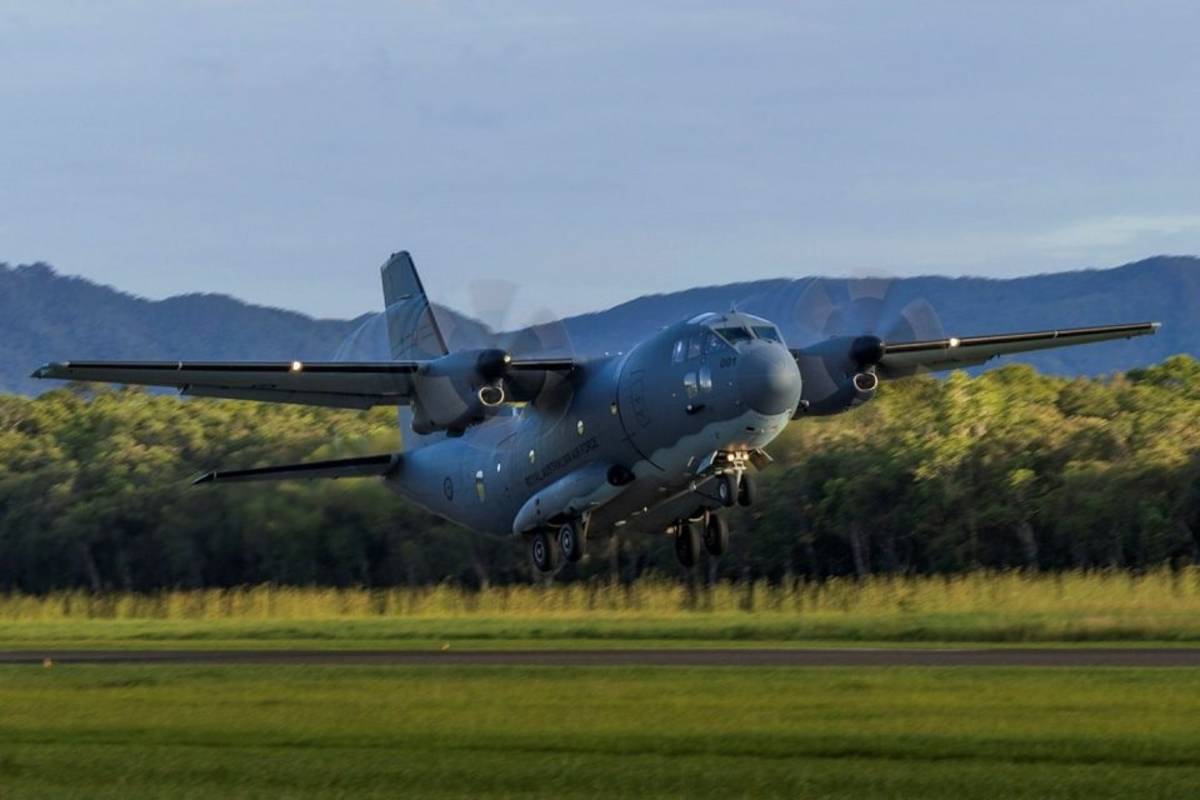


The Royal Australian Air Force’s fleet of 10 C-27J Spartan transport aircraft will be retired after barely a decade in service, according to details revealed in the Federal Government’s 2026 National Defence Strategy and recent Defence budget.
Australia spent approximately AUD $1.4 billion acquiring the Royal Australian Air Force’s fleet of 10 C-27J Spartan transport aircraft under a US Foreign Military Sales agreement announced in 2012.
The package included the aircraft themselves, simulators, training systems, logistics support and associated infrastructure,
While Defence has not announced an exact retirement date, the documents confirmed the Spartans would be replaced by a commercial aircraft as part of a broader reshaping of the Australian Defence Force to focus on long-range power projection.
However, several media reports suggest the aircraft could be withdrawn by the end of 2026, potentially leaving a capability gap before a replacement enters service.
The C-27J Spartan entered RAAF service in 2015 as a replacement for the ageing Vietnam-era DHC-4 Caribou under the AIR 8000 Phase 2 Battlefield Airlifter program.
The aircraft was selected for its rugged performance, short-field capability and commonality with the larger C-130J Hercules fleet already operated by the RAAF.
Australia’s 10 aircraft were built by Italian manufacturer Leonardo and modified by L3Harris in the United States under a US Department of Defense Foreign Military Sales arrangement tied to the now-defunct Joint Cargo Aircraft (JCA) program.
But the American program collapsed before Australia received its first aircraft, leaving the RAAF operating what critics describe as an “orphan fleet” — a highly modified version of the C-27J with a limited global sustainment network and uniquely Australian certification requirements.
The Spartan program has faced ongoing challenges since entering service, including lower-than-expected availability rates, spare parts shortages and integration issues involving missile warning systems.
Despite the problems, the aircraft has carved out an important operational role in the Pacific. In 2020, the Spartan’s mission shifted from battlefield airlift to a light tactical transport role supporting humanitarian assistance, aerial surveillance and fisheries patrols under Operation Solania.
The aircraft’s ability to operate from short and unprepared airstrips has made it particularly valuable across the Pacific region, where larger aircraft such as the C-130J and C-17A cannot easily operate.
Recent Defence reports also suggest fleet performance has improved significantly. In 2023-24 the Spartans flew 4,916 hours against a target of 5,500 hours, while in 2024-25 the fleet exceeded expectations with 5,048 flying hours against a planned 4,800.
Defence insiders say one of the key issues driving the retirement decision is the need to upgrade the fleet’s ageing Mode 4 Identification Friend or Foe (IFF) system to the newer encrypted Mode 5 standard required for modern operations in contested airspace.
Because Australia’s aircraft differ significantly from Leonardo’s standard configuration, much of the engineering and certification work for the upgrade would need to be conducted locally at considerable cost.
However, critics argue that upgrading the existing fleet would still be far cheaper and faster than replacing the aircraft entirely, particularly given the Spartans are fully paid off and already supported by an established training and sustainment system.
The decision has drawn comparisons to the controversial retirement of the MRH-90 Taipan helicopter fleet, where 45 helicopters were withdrawn and replaced by Black Hawks despite still being considered operationally capable.
Questions are now being raised over whether Defence is repeating past mistakes by retiring a specialised capability without a clear replacement ready to enter service.