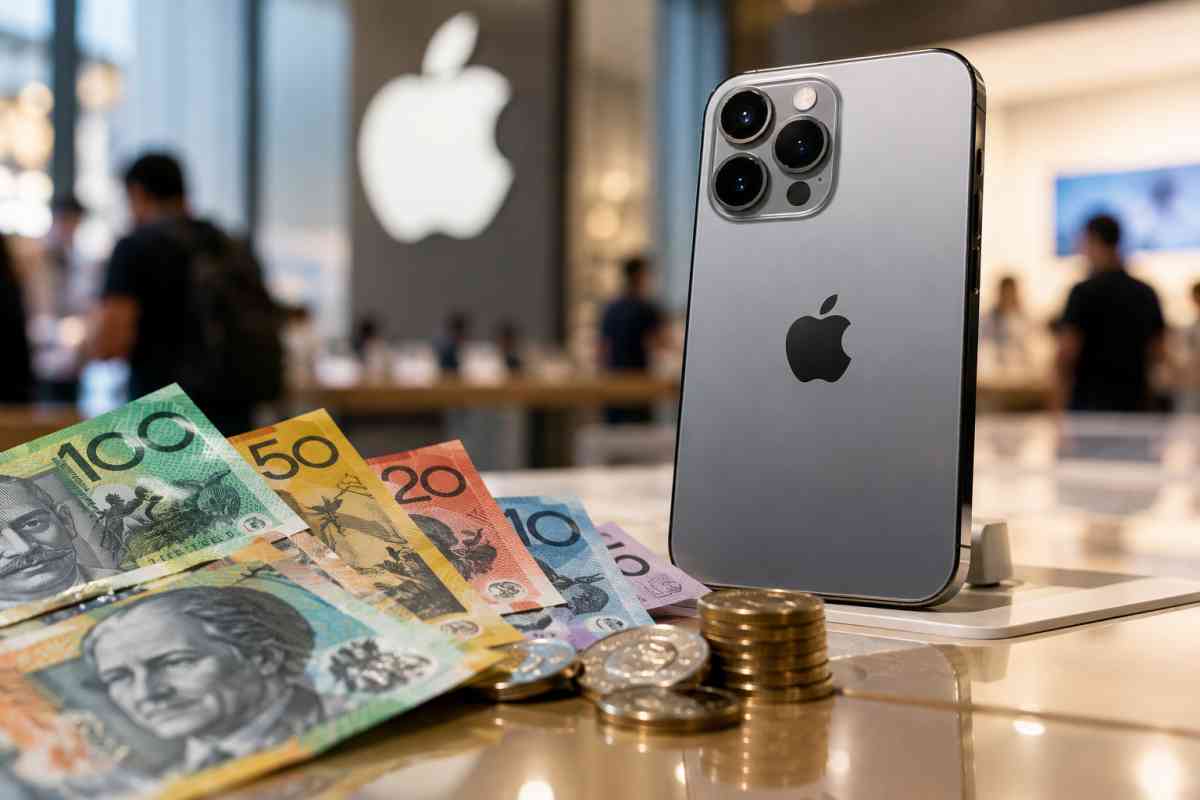


Australians preparing to spend thousands on Apple’s latest iPhones face a sizeable price premium compared with buyers in several overseas markets, while some existing models have also increased sharply.
New research from Compare the Market found Australians could pay hundreds more for identical Apple hardware than consumers in the United States, Hong Kong, Japan, Singapore and New Zealand.
At the top end, the differences stretch into the thousands, raising an important question for Australian consumers: why does identical premium technology cost significantly more depending on location?
The 2026 iPhone Price Comparison Index examined Apple pricing across 26 countries, converting local prices into Australian dollars using exchange rates recorded on September 10.
Researchers sourced device pricing directly from Apple’s country websites and adjusted US and Canadian prices to account for local sales taxes before making international comparisons.
The clearest example is Apple’s new 2TB iPhone Duo, which Apple lists in Australia for $5,899, making it one of the company’s most expensive smartphones locally.
According to Compare the Market’s calculations, the equivalent California price was $4,828.40 after the study applied its adjustment for local US sales tax.
That leaves an Australian buyer paying about $1,070 more for the same storage configuration, representing a premium of roughly 22.2 per cent under the study’s calculations.
Across the Tasman, the difference is smaller but remains significant for Australian consumers comparing Apple’s pricing between two neighbouring and broadly comparable technology markets.
The same iPhone Duo 2TB was calculated at $5,348.34 in New Zealand, meaning the Australian price is about $551 higher despite the countries being neighbouring markets.
Existing Australian iPhones have also become more expensive
The international price gap is only part of the story, with Compare the Market also identifying considerable increases affecting several existing iPhone configurations sold in Australia.
The research tracked pricing around Apple’s September announcements and found increases ranging between 5 and 19 per cent across several devices already available to Australian consumers.
The standout was the 1TB iPhone Air, which increased from $2,599 to $3,099, representing a $500 jump and an increase of just over 19 per cent.
Archived Apple pricing indexed in September showed the model at $2,599, while Apple’s Australian store now lists the same 1TB configuration for $3,099.
That supports the underlying price movement identified by Compare the Market and shows the increase was not simply produced by currency conversion or international pricing comparisons.
A $500 increase on an existing smartphone is substantial, particularly because it occurred around a major Apple launch period when consumers are considering whether to upgrade.
Buyers are simultaneously deciding whether to purchase Apple’s newest hardware or save money by choosing an earlier device, making changes to existing model pricing particularly relevant.
The increase also substantially outpaces Australia’s broader inflation rate, although movements in an individual consumer product should not be directly compared with economy-wide inflation measures.
Australia’s annual consumer inflation rate was running at 4 per cent in August, considerably below the approximately 19 per cent increase recorded for this particular iPhone configuration.
Why Australians pay more is more complicated than currency conversion
International technology pricing is rarely determined by currency movements alone, particularly when manufacturers operate across markets with different tax systems, regulatory requirements and distribution structures.
Taxes, regulatory costs, distribution, warranty obligations, logistics, market size, pricing strategies and currency hedging can all influence what consumers ultimately pay for identical technology in different countries.
US prices are particularly difficult to compare directly because advertised prices generally exclude sales taxes, which are added separately and vary depending on the purchaser’s location.
Compare the Market attempted to address part of that problem by adding an 8.9 per cent sales tax to its California pricing before converting prices into Australian dollars.
The research similarly applied a 13 per cent tax to its Ontario pricing, allowing Canadian figures to be compared more consistently with tax-inclusive prices advertised in Australia.
Currency conversions were based on XE exchange rates recorded on September 10, meaning the international comparison represents a pricing snapshot rather than a permanent difference between markets.
That distinction matters because exchange rates can move quickly, and relatively small currency movements can make a noticeable difference when products are priced at several thousand dollars.
It does not change what Australian customers currently see locally, with Apple’s Australian store asking $5,899 for the highest-capacity 2TB version of the iPhone Duo.
Apple has not suggested its products should carry identical prices internationally, and region-specific pricing remains common among multinational technology companies operating across different consumer markets.
What the comparison exposes is the scale of those regional differences after prices from each market are converted into a common currency and placed alongside each other.
Flying overseas to buy one is not necessarily a $1,000 shortcut
On paper, paying $4,828 in California or below $5,000 in Hong Kong instead of $5,899 locally appears to offer Australian consumers an obvious potential saving.
That calculation becomes considerably more complicated once Australian customs requirements, taxation, warranty arrangements, consumer protections and exchange-rate movements are considered alongside the overseas purchase price.
Australian Border Force allows travellers aged 18 or older to bring up to $900 worth of general goods into Australia under the available duty-free passenger concession.
Electronic equipment is specifically included within that category, making expensive smartphones purchased overseas subject to the same passenger concession requirements as other general goods brought into Australia.
When the general-goods allowance is exceeded, duty and tax can potentially apply to the entire relevant purchase rather than only the amount exceeding the $900 allowance.
An Australian returning with a phone costing around $5,000 therefore should not assume the overseas retail price represents the complete financial cost of buying the device abroad.
Goods exceeding the passenger concession must be declared, while Australian Border Force warns that travellers who fail to declare applicable goods can face penalties at the border.
Warranty support creates another consideration because Apple’s warranty terms state hardware warranty service may be restricted to the country where Apple or an authorised distributor sold it.
Available servicing options and replacement components can also differ internationally, potentially making an overseas purchase less convenient if the device subsequently requires warranty repairs or replacement.
Australian Consumer Law protections may also become more difficult to rely upon when the consumer purchases a product while physically overseas from an overseas seller.
The ACCC says Australian Consumer Law generally does not cover transactions completed entirely overseas when the consumer was also overseas when the relevant transaction was made.
For Australians already travelling through Hong Kong, Japan, Singapore or New Zealand, genuine savings may remain available depending on the particular iPhone model and individual circumstances.
However, assessing those savings requires looking beyond the price displayed on Apple’s overseas websites and considering tax, warranty protection and potential customs obligations when returning home.
A smartphone is becoming a major household purchase
The broader issue exposed by the figures is how far premium smartphone pricing has moved from the relatively disposable consumer electronics category phones once comfortably occupied.
At $5,899, the highest-capacity iPhone Duo costs more than many televisions, desktop computers, refrigerators and other products Australians would traditionally consider significant household purchases.
Apple’s Australian store lists the device from $3,499 with 256GB of storage, increasing to $3,899 when buyers select the higher-capacity 512GB version instead.
Moving to 1TB raises the Australian price to $4,699, while selecting Apple’s largest 2TB storage configuration pushes the purchase price to $5,899.
The iPhone Duo also represents a new product category for Apple, featuring a foldable 7.6-inch internal display alongside a smaller 5.4-inch external screen.
Storage options extend to 2TB, putting the highest-capacity configuration into a price range previously associated with premium computers rather than mainstream consumer smartphones.
Apple says Australian pre-orders for the iPhone Duo will begin on October 16, with the device scheduled to become available through retail channels from October 23.
That timing exposes another inconsistency in Compare the Market’s report, published on September 22, which described the iPhone Duo at the time as “newly released”.
Apple’s own release schedule shows the device had been announced and priced by then, but had not actually been released to Australian customers when the report appeared.
The distinction does not undermine the central pricing comparison, but consumers deserve clear differentiation between a product being announced, priced, available for pre-order and officially released.
What Apple’s 2TB iPhone Duo costs around the world
Prices across 26 markets, converted to Australian dollars. Australia sits near the middle of the table, but remains substantially more expensive than several major markets.
| Rank | Market | Price in AUD |
|---|---|---|
| 1 | Türkiye | $9,559.80* |
| 2 | Brazil | $8,411.48 |
| 3 | India | $6,548.41 |
| 4 | Mexico | $6,396.72 |
| 5 | Sweden | $6,358.67 |
| 6 | Italy | $6,238.45 |
| 7 | France | $6,190.08 |
| 8 | Spain | $6,190.08 |
| 9 | Netherlands | $6,190.08 |
| 10 | Germany | $6,125.58 |
| 11 | United Kingdom | $6,005.41 |
| 12 | Poland | $5,974.88 |
| 13 | Australia LOCAL | $5,899.00 |
| 14 | Saudi Arabia | $5,724.58 |
| 15 | Vietnam | $5,564.99 |
| 16 | Switzerland | $5,478.03 |
| 17 | China | $5,471.00 |
| 18 | Canada, Ontario | $5,439.49 |
| 19 | Thailand | $5,381.54 |
| 20 | Singapore | $5,368.96 |
| 21 | New Zealand | $5,348.34 |
| 22 | South Korea | $5,268.91 |
| 23 | Japan | $5,188.29 |
| 24 | United Arab Emirates | $5,130.05 |
| 25 | Hong Kong | $4,948.36 |
| 26 | United States, California LOWEST | $4,828.40 |
Source: Compare the Market, iPhone Price Comparison Index 2026. Prices converted to Australian dollars.
Insurance industry sees another consequence of rising phone prices
Compare the Market’s interest in increasingly expensive smartphones extends beyond technology pricing because the company also operates a comparison service covering home and contents insurance products.
Its report argues higher smartphone prices make it increasingly important for consumers to understand whether their insurance policies cover portable devices while those products are outside their homes.
Compare the Market’s Chris Ford said smartphones costing well above $1,000 can create substantial repair or replacement expenses following accidental damage, theft or other covered incidents.
This becomes particularly relevant for smartphones because consumers routinely carry the devices outside their homes, increasing their exposure to accidental damage, loss and theft.
“A home and contents policy that includes portable contents cover can provide a level of peace of mind, especially for items regularly taken outside the home,” Ford said.
“However, not all insurers automatically cover phones away from home, so it’s essential to check the policy wording for specific inclusions and exclusions,” he said.
The company’s published webpage also contains an editorial inconsistency involving the attribution of these comments, despite initially identifying Chris Ford as the source of the remarks.
One quotation is subsequently attributed to “Mr Taylor”, suggesting the online report contains an attribution error that consumers and publishers relying on the material should recognise.
The bigger question for Australian buyers
There is no single international price for an iPhone, and Australia remains far from being the most expensive Apple market included within Compare the Market’s research.
Consumers in Türkiye, Brazil, India and several European markets face substantially higher converted prices when purchasing the most expensive iPhone configuration.
Different tax structures, currency movements and regional business costs also mean direct comparisons between countries will never provide a perfectly equivalent measure of what consumers ultimately pay.
What the figures show is that Australians pay a measurable premium compared with several major markets, including countries geographically much closer to Australia than the United States.
At the same time, certain existing iPhone configurations have become considerably more expensive locally, adding another financial consideration for consumers deciding whether and when to upgrade.
For someone spending around $1,500 on a smartphone, a difference of several hundred dollars between international markets may already represent a meaningful additional household expense.
Once the purchase price approaches $6,000, however, a difference of $500 or $1,000 becomes significant money and warrants the scrutiny Australians apply to other major purchases..