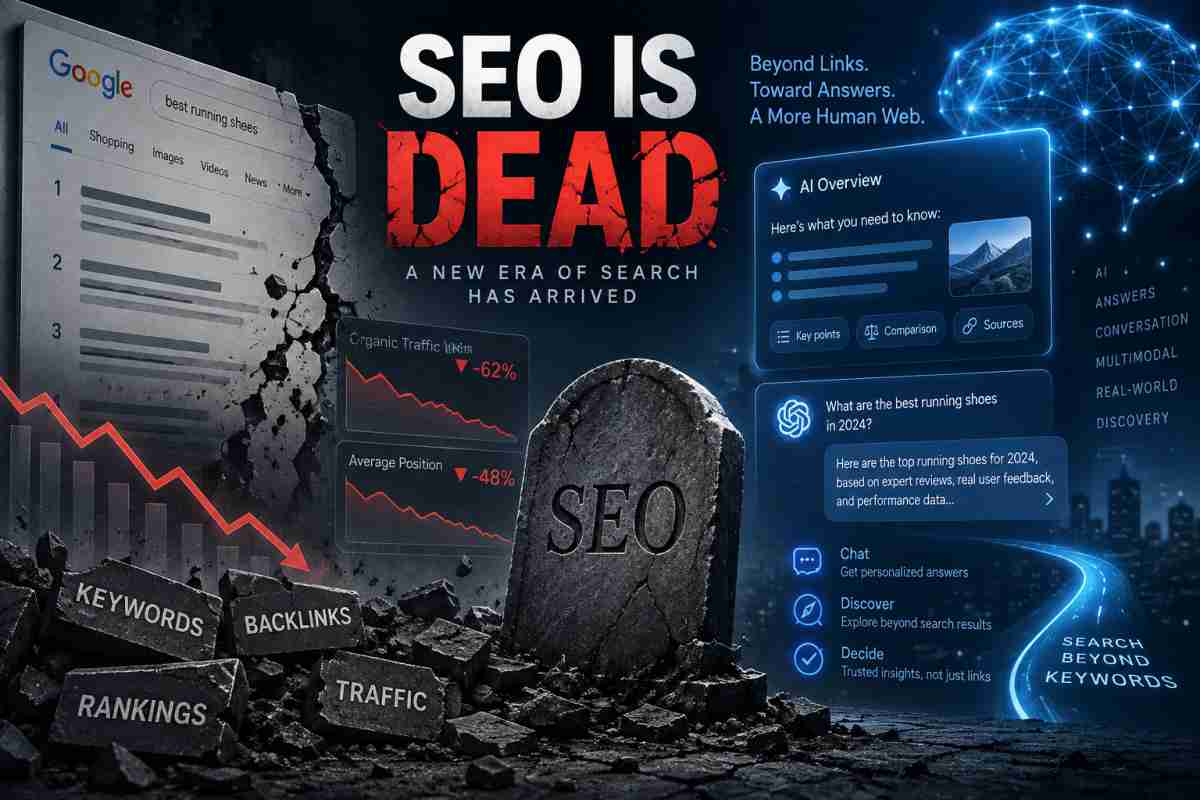
For more than two decades, businesses were told that digital marketing followed a reasonably predictable formula: build a website, identify some keywords, publish enough content, acquire backlinks, improve your Google rankings and watch organic traffic arrive.
In 2026, that model is breaking down.
SEO itself has not literally disappeared, nor has digital marketing stopped mattering. What is dying is the idea that either can still operate as a narrow, standalone discipline built around rankings, keyword positions, backlinks and website traffic.
Search has become fragmented across Google Search, Google AI Overviews, AI Mode, ChatGPT, Gemini, Perplexity, Bing Copilot, social networks, marketplaces, video platforms and increasingly autonomous AI agents.
A person researching a product, company or subject may receive an answer without ever visiting the website that supplied the underlying information.
That changes almost everything marketers have traditionally measured.
Similarweb and SparkToro data published in 2026 found that 68.01 per cent of Google searches during the first four months of the year ended without a click to the open web. In 2024, the equivalent figure was around 60.45 per cent.
AI-generated answers, instant results and increasingly sophisticated search interfaces are accelerating a trend that was already underway long before generative AI arrived.
Google, meanwhile, says AI Mode has surpassed one billion monthly users, while queries within AI Mode have been more than doubling each quarter.
In May 2026, the company described its latest Search overhaul as the biggest change to the search box in more than 25 years, combining text, images, files, video and conversational follow-up queries within an increasingly AI-driven interface.
The consequences are significant.
A business can rank first and receive fewer clicks. A publisher can produce the information that answers a search query while Google presents the answer itself.
A company can appear prominently in an AI-generated recommendation without ranking first for any conventional keyword, while another company with strong traditional rankings may barely appear in AI-generated answers at all.
The old digital marketing funnel is being rewritten.
SEO is no longer about ten blue links
For years, SEO revolved around a relatively understandable objective: convince Google that a page deserved to appear above competing pages.
That basic objective still exists, but the environment surrounding it has changed dramatically.
Google Search now generates summaries, comparisons and direct answers through AI Overviews and AI Mode.
Searchers can ask follow-up questions without returning to a traditional results page, while Google’s AI systems can break complicated queries into multiple searches, analyse different sources and construct a response from them.
Google said in May that AI Overviews and AI Mode were being brought together into a more seamless search experience, allowing users to move from a question to an AI-generated summary and then directly into a conversational follow-up.
The commercial implication is difficult to ignore.
Being indexed is still important. Ranking remains valuable. Technical SEO remains necessary. Search engines still need to crawl, understand and retrieve content.
But ranking is increasingly only one part of visibility.
The more important question is becoming: when an algorithm, AI assistant or search engine constructs an answer, does it know who you are, understand what you are authoritative about and consider your information sufficiently trustworthy to use?
That is a much bigger problem than SEO.
SEO Is Not Dead. The Old SEO Model Is.
In 2026, online visibility is moving beyond traditional Google rankings. AI search, zero-click results, answer engines and generative platforms are changing how people discover brands, businesses and information.
Traditional SEO
- Keyword rankings
- Backlink building
- Search traffic
- Keyword-focused articles
- Google ranking reports
- Optimising for ten blue links
Search Visibility in 2026
- AI search visibility
- Brand and entity authority
- Digital PR and third-party mentions
- Original and trusted content
- Technical SEO and structured data
- Search engine and AI citations
The New Search Optimisation Ecosystem
What Drives Search Visibility in 2026
How Search Discovery Is Changing
Welcome to the alphabet soup: SEO, AEO, GEO, AIO and LLMO
The marketing industry has responded to the disruption in predictable fashion by inventing more acronyms.
SEO remains Search Engine Optimisation.
AEO, or Answer Engine Optimisation, generally describes structuring information so search engines and AI systems can extract it as a direct answer.
GEO, or Generative Engine Optimisation, focuses on improving the likelihood that a brand, organisation or source will be mentioned or cited within generative AI responses.
AI SEO is increasingly used as an umbrella term covering visibility across traditional and AI-driven search environments.
LLMO, or Large Language Model Optimisation, is another emerging term describing attempts to increase brand visibility within large language models.
Other variations continue to appear, but there is considerable overlap between them. Even within the search industry there is no universal agreement about where conventional SEO ends and GEO, AEO or AI SEO begins.
Search Engine Land reported in August 2026 that marketers continue to use SEO as the broader description despite the proliferation of AI-search terminology.
That tells us something important.
The acronym is less important than the underlying change.
For most organisations, there will eventually be little practical distinction between optimising for a search engine and optimising for the AI systems sitting on top of it. The objective is digital visibility wherever people ask questions and make decisions.
Search traffic is no longer the only measure of search success
One of the most uncomfortable changes for marketers is that impressions, rankings and traffic are becoming increasingly disconnected.
Traditionally, moving from position eight to position two in Google could produce a noticeable increase in clicks. A marketer could then connect those visits with leads, conversions or advertising revenue.
AI search complicates that relationship.
A user may see a company mentioned in an AI Overview, ask three follow-up questions, research the company elsewhere and return days later through a branded search or direct visit.
The original AI exposure may have influenced the decision without generating a measurable referral.
Similarweb’s 2026 research estimates generative AI platforms now receive about 9.5 billion visits per month globally, up roughly 70 per cent year over year. Its separate Generative AI Landscape report says more than 40 per cent of US searches now trigger an AI Overview.
This is forcing marketers to rethink attribution.
Website sessions remain important, but so do branded search volume, citations, mentions, share of voice, direct traffic, assisted conversions, AI referrals and whether a company appears when people ask an AI system questions about its market.
The objective is gradually shifting from winning a click to influencing the answer.
Zero-click search changes the economics of publishing
The zero-click problem is particularly significant for publishers.
Search engines historically operated as intermediaries. A user entered a question, Google identified relevant websites and the user visited one of them.
Increasingly, the search engine can complete the information transaction itself.
In 2026, Similarweb described zero-click behaviour as the default outcome for a large proportion of queries. Its data suggests around 68 per cent of Google searches now end without an external click.
For publishers, that can create an uncomfortable arrangement.
News organisations, specialist websites, researchers and businesses spend money producing original information. Search and AI systems can then analyse that information, summarise it and present an answer directly to the user.
The source may receive recognition, a citation or a link, but it may not receive the visit.
That does not mean publishing useful information has become pointless. It means the value of publishing can no longer be measured solely through Google traffic.
Original reporting, proprietary data, specialist expertise, investigations, first-hand experience and genuinely new information become more valuable because they create something that cannot easily be reproduced by generating another generic article.
Commodity content is moving in the opposite direction.
AI has destroyed the economics of average content
The internet does not have a shortage of words anymore.
Generative AI can produce a reasonably competent 1,500-word article about almost any mainstream topic in seconds. Businesses that once paid writers to produce large quantities of basic informational content can now generate enormous volumes at negligible marginal cost.
That has dramatically reduced the value of average content.
Publishing fifty articles covering slightly different versions of the same keyword is no longer a meaningful competitive advantage when every competitor can do exactly the same thing.
Google’s spam policies specifically identify scaled content abuse as producing large quantities of unoriginal material primarily to manipulate rankings, including the use of generative AI when pages provide little additional value.
The important distinction is not whether AI was involved in producing the content.
The question is whether the content contributes anything worth finding.
A company with original research, real customer data, specialist knowledge, expert commentary, testing, field experience or exclusive information has something an AI model cannot simply manufacture.
A company publishing another generic article titled “10 Ways Technology Is Transforming Business” probably does not.
In that sense, AI has not killed content marketing.
It has killed much of the economic value of mediocre content marketing.
Keywords are becoming questions, conversations and tasks
Traditional SEO frequently started with a spreadsheet containing hundreds or thousands of keywords.
Those keywords still provide useful information about demand, but search behaviour is becoming considerably more conversational.
Someone who once searched “best business laptop 2026” might now ask:
“What is the best lightweight business laptop under $2,000 for someone who travels twice a month, mainly uses Microsoft 365, wants good battery life and occasionally edits video?”
The second query contains substantially more context, commercial intent and personal requirements.
AI systems are designed for exactly this type of interaction.
Google reported in 2026 that AI Mode queries were becoming increasingly sophisticated, while Similarweb found average Google query length had increased after the introduction of AI Mode.
This shifts optimisation away from mechanically repeating keywords and towards understanding subjects, entities, relationships, questions and user intent.
The website that explains a subject comprehensively, clearly and credibly has a better foundation for both conventional search and AI retrieval than one built around an arbitrary keyword density target.
Backlinks still matter, but the backlink industry has a problem
Backlinks are not dead either.
Links remain useful for discovery, authority, reputation and understanding relationships between websites. What has become increasingly questionable is the enormous commercial industry built around manufacturing them.
For years, businesses have been bombarded with offers to purchase guest posts, insert links into existing articles, rent high-authority domains or acquire hundreds of backlinks through networks of questionable websites.
That model has become increasingly risky.
Google’s spam policies prohibit link schemes intended to manipulate rankings, while its site reputation abuse policy specifically targets situations where third-party content is published on established websites primarily to exploit the host site’s ranking signals.
Google further updated its site reputation enforcement policy in August 2026.
There is also a larger strategic problem.
A backlink created solely because somebody paid for it does very little to establish whether a business actually matters.
A mention in an independent news story, industry report, university paper, government publication, respected specialist publication or genuine customer discussion sends a very different signal.
This is where digital PR increasingly intersects with search.
Instead of buying links, companies have a stronger reason to become worth mentioning.
That means producing research, releasing useful data, providing expert commentary, contributing to industry debate, building products people discuss and doing work journalists consider worth reporting.
The hyperlink becomes a consequence of visibility rather than the entire purpose of the exercise.
Entity authority is replacing keyword obsession
Modern search systems increasingly need to understand entities rather than pages alone.
An entity can be a company, person, product, organisation, place or concept.
If an AI system is asked for the leading companies operating within a particular market, it needs to determine which organisations exist, what they do, whether information about them is consistent and which external sources discuss them.
That means brand information scattered across the web matters.
Your website matters, but so do reputable media references, business databases, industry organisations, customer reviews, social profiles, structured data and authoritative third-party sources.
This creates an important shift from page optimisation to entity optimisation.
The objective is no longer simply to make a page relevant for a keyword.
The objective is to make the organisation itself understandable.
Digital PR is becoming search infrastructure
This is one reason public relations and SEO are moving closer together.
Historically, an SEO team might build backlinks while a PR team pursued media coverage and a social media team managed brand awareness.
AI discovery increasingly collapses those boundaries.
When an AI system attempts to determine whether a company is credible, external corroboration becomes useful. It can find what the company says about itself, but it can also find what journalists, customers, industry organisations and independent sources say about it.
Strong digital PR therefore does considerably more than create referral traffic.
It creates a distributed evidence trail around a brand.
Search Engine Land’s 2026 coverage of GEO increasingly describes brand context, third-party mentions and citation visibility as important parts of AI-search strategy.
This does not mean companies should flood the internet with manufactured press releases.
It means genuinely newsworthy activity has increasing search value because independent coverage helps establish the existence, relevance and context of an entity beyond its own website.
Technical SEO is becoming infrastructure rather than marketing
There is another part of SEO that is very much alive: technical SEO.
Search engines and AI retrieval systems still need accessible websites.
If important pages cannot be crawled, render properly or be understood, none of the broader marketing strategy matters very much.
Technical SEO therefore continues to include areas such as crawlability, indexing, canonicalisation, redirects, XML sitemaps, internal linking, structured data, performance, mobile usability, JavaScript rendering and overall site architecture.
The difference is that these activities increasingly resemble basic digital infrastructure.
A fast, accessible and technically coherent website should no longer be considered an exotic marketing strategy any more than maintaining a functioning server should.
Technical SEO creates the conditions under which information can be discovered.
It does not create authority by itself.
SXO matters because getting the click is only half the job
Another acronym becoming increasingly relevant is SXO, or Search Experience Optimisation.
The concept combines search visibility with what happens after someone arrives.
A site may perform brilliantly in Google and still fail commercially because it is slow, confusing, untrustworthy or overloaded with advertising.
Conversely, a site that answers the user’s question clearly and provides an excellent experience can turn fewer visits into considerably more value.
This matters even more in a zero-click environment because every external visit becomes more valuable.
If search engines are sending fewer clicks, wasting the clicks that remain becomes increasingly expensive.
E-E-A-T still matters, but it is not a magic score
Experience, Expertise, Authoritativeness and Trustworthiness, commonly abbreviated as E-E-A-T, continues to appear throughout discussions about search quality.
It should not be treated as a mysterious numerical score that can be increased by adding an author biography and several outbound links.
Its real importance is much simpler.
Who produced the information? Why should anyone believe them? Have they actually experienced what they are writing about? Is the claim supported? Can the organisation be independently verified? Is there accountability when something is wrong?
These questions matter to people, search engines and AI systems alike.
As synthetic content becomes abundant, demonstrable human experience becomes more valuable rather than less.
Social search is now part of search
Google is also no longer the only place where people deliberately search.
Consumers increasingly search TikTok, YouTube, Reddit, Instagram, LinkedIn, marketplaces and AI assistants depending on what they are trying to discover.
A person looking for instructions may begin on YouTube.
Someone researching a restaurant may use TikTok, Google Maps and Instagram.
A technology buyer may search Reddit for first-hand experiences before checking Google.
A business executive may ask ChatGPT to compare several vendors before visiting any of their websites.
Discovery has become distributed.
That is why separating “SEO”, “social media”, “PR”, “content marketing” and “brand marketing” into isolated departments increasingly makes little sense.
The customer does not experience those departments.
They experience the brand.
The old SEO agency model is under pressure
This transformation creates an uncomfortable problem for traditional SEO agencies.
It is increasingly difficult to justify a strategy consisting primarily of monthly keyword reports, a fixed number of blog posts and a predetermined quota of backlinks.
Those outputs may look productive on a report, but they do not necessarily correspond with how people discover companies in 2026.
Search visibility now requires technical competence, editorial judgement, brand development, PR, research, user experience, data analysis and increasingly an understanding of how AI systems retrieve and synthesise information.
That is a considerably more complicated service than “ranking ten keywords”.
It is also harder to fake.
Businesses should therefore be cautious about anyone guaranteeing specific rankings, promising instant AI visibility or claiming to have discovered a secret formula for appearing in ChatGPT.
There is no magic switch.
There is still marketing.
What replaces traditional SEO?
In reality, nothing replaces SEO completely.
It gets absorbed into something broader.
A modern visibility strategy in 2026 increasingly combines technical SEO, AI SEO, AEO, GEO, content strategy, digital PR, brand building, social discovery, structured data, user experience and traditional marketing.
The terminology will probably continue changing.
The fundamental objective will not.
Businesses have to become discoverable, understandable, credible and useful wherever customers search for information.
That could be a Google result.
- It could be an AI Overview.
- It could be ChatGPT.
- It could be a Reddit discussion.
- It could be a YouTube video.
- It could be a journalist’s article.
It could be an AI agent comparing suppliers without the customer manually visiting any of their websites.
Visibility now exists across the entire information ecosystem.
The new search strategy is remarkably old-fashioned
There is an irony in all of this.
After decades of algorithm tricks, link schemes, keyword density formulas, content farms, mass guest posting and endless attempts to reverse-engineer Google, the direction of search appears to be moving back towards something surprisingly traditional.
- Do something worth talking about.
- Know your subject.
- Publish information people cannot find somewhere else.
- Build a company people trust.
- Answer real questions properly.
- Make your website technically sound.
- Earn independent coverage.
- Be present where your audience spends time.
Give journalists, customers, search engines and AI systems strong reasons to recognise your organisation as a legitimate source.
Google’s own guidance for generative AI search in 2026 points businesses in broadly the same direction, emphasising useful, reliable, people-first and non-commodity content rather than a separate collection of tricks designed specifically for AI systems.
The tools have changed dramatically.
The principle has not.
Frequently Asked Questions
SEO and AI Search FAQ
Search is changing rapidly in 2026 as AI Overviews, ChatGPT, answer engines and zero-click results reshape how businesses, publishers and brands are discovered online.
Is SEO dead in 2026?
No. SEO is not dead, but the traditional model built around keyword chasing, backlink quotas and ranking reports is becoming less effective on its own. Modern search visibility now extends across Google Search, AI Overviews, ChatGPT, answer engines, social platforms and other discovery channels.
What has replaced traditional SEO?
Traditional SEO is being absorbed into a broader search visibility strategy that includes technical SEO, AEO, GEO, AI search optimisation, digital PR, entity authority, trusted content and user experience.
What is AEO?
AEO stands for Answer Engine Optimisation. It focuses on making information clear, structured and authoritative so search engines and AI systems can easily extract it and use it in direct answers.
What is GEO?
GEO stands for Generative Engine Optimisation. It refers to strategies designed to improve the likelihood that a brand, company or source is mentioned, cited or used within AI-generated answers.
What is LLMO?
LLMO stands for Large Language Model Optimisation. It focuses on how brands, businesses and information are understood and represented by large language models such as ChatGPT and other generative AI systems.
Do backlinks still matter?
Yes, backlinks still matter, but their value depends heavily on quality, relevance and context. Independent editorial links, genuine media coverage and trusted third-party mentions are far more valuable than large volumes of manufactured or paid links.
Is keyword optimisation still important?
Keywords still help search engines understand topics and user intent, but modern optimisation is moving beyond exact-match phrases. Search systems increasingly analyse entities, context, meaning, relationships and conversational queries.
What are zero-click searches?
Zero-click searches occur when a user receives the information they need directly from the search results or an AI-generated answer without visiting an external website. This means businesses can gain visibility without necessarily receiving a traditional search click.
How are Google AI Overviews changing SEO?
Google AI Overviews can summarise information from multiple sources directly within search results, reducing the need for users to visit individual websites. This makes citations, authority, original information and strong brand signals increasingly important.
How does ChatGPT affect search marketing?
ChatGPT and other AI assistants are becoming discovery platforms in their own right. Users can research products, companies, services and complex topics through conversational queries, which means brands increasingly need visibility beyond traditional Google rankings.
Why is digital PR becoming more important for SEO?
Digital PR creates independent references to a company across trusted websites, media outlets and industry sources. These mentions can help establish brand authority, entity recognition and credibility across both search engines and AI systems.
What is entity authority?
Entity authority describes how clearly and credibly a search engine or AI system understands a company, person, product or organisation. Consistent information, independent mentions, authoritative sources and recognised expertise can strengthen that understanding.
Does technical SEO still matter?
Yes. Technical SEO remains essential because search engines and AI systems still need to crawl, index and understand website content. Site speed, structured data, internal linking, sitemaps, canonicalisation and crawlability remain important foundations.
Is AI-generated content bad for SEO?
AI-generated content is not automatically bad for SEO, but low-value, repetitive or mass-produced content can perform poorly. Search engines increasingly reward useful, original and trustworthy information regardless of how it was produced.
What matters most for search visibility in 2026?
The strongest search strategies combine authoritative content, technical SEO, digital PR, entity authority, user experience and visibility across both traditional search engines and AI-generated answers.
SEO is no longer only about ranking higher. The bigger objective is to make sure search engines, AI systems and users recognise your brand as a credible source worth including in the answer.
SEO isn’t dead. The shortcut is.
So is SEO dead?
The version of SEO that promised businesses they could manipulate their way to relevance through enough keywords, backlinks and formulaic articles is certainly becoming harder to defend.
Traditional digital marketing built around cheap traffic, mass content production and easily measured clicks is also losing much of its certainty.
But search optimisation itself is not disappearing.
It is expanding.
The industry is moving from Search Engine Optimisation towards Search Everywhere Optimisation, whether or not that becomes the acronym marketers eventually settle on.
Success in 2026 is increasingly about whether people and machines recognise a brand as a credible source when a question is asked.
- Rankings still matter.
- Traffic still matters.
- Links still matter.
- Content still matters.
What has changed is that none of them means very much in isolation.
The companies most likely to remain visible will be those producing information, products, expertise, research and experiences sufficiently useful that people want to find them, journalists want to reference them and AI systems have credible reasons to include them in the answers they generate.
That is less glamorous than discovering a new ranking trick.
It is also much closer to what marketing was supposed to be in the first place.