A Chinese satellite communication breakthrough first reported in 2025 is drawing renewed attention as the global race to build faster, cleaner and more efficient space-based internet systems accelerates.
The test, carried out by Chinese researchers, demonstrated a satellite-to-ground laser communication system capable of reaching a peak data speed of 1Gbps using a laser with just 2 watts of power.
The result was notable not only for its speed, but for the distance involved, with the satellite positioned about 36,000km above Earth.
At the time, the development was framed as another sign of China’s growing strength in advanced technology, alongside electric vehicles, artificial intelligence and clean energy. But nearly a year on, the demonstration now looks more significant than a single laboratory success.
It raises a bigger public question:
Whether the next generation of satellite internet will be shaped not just by companies launching thousands of satellites into low Earth orbit, but by higher-orbit systems capable of moving large amounts of data through narrow, low-power laser beams.
The Three Numbers Behind The Breakthrough
| Statistic | Why it matters |
|---|---|
| 2 watts | Shows that high-speed satellite data transmission may be possible with very low optical output power. |
| 1Gbps | Puts the test in serious broadband-speed territory. |
| 36,000km | Shows the link was reported from geostationary-style distance, far beyond low Earth orbit. |
What Is 2-Watt Laser Satellite Communication?
Laser satellite communication, also called free-space optical (FSO) communication or optical inter-satellite links, uses focused beams of light instead of radio waves to carry data between a satellite and the ground.
The core advantage is physics: light carries far more information per unit of power than radio frequency signals, and laser beams are narrow enough to avoid the congestion and interference that plagues crowded RF spectrum.
The challenge has always been the atmosphere. Turbulence bends, scatters, and deforms optical signals before they reach the ground. That is the problem the experiment set out to solve, and it did so in a way that nobody had managed at this altitude before.
A Small Laser With Big Implications
The Chinese system was developed by researchers from Peking University of Posts and Telecommunications and the Chinese Academy of Sciences.
According to reporting at the time, the project used a form of wireless optical communication known as AO-MDR synergy, combining adaptive optics with mode diversity reception.
In simpler terms, the system was designed to solve one of the most difficult problems in laser satellite communication: keeping a signal stable after it travels through Earth’s atmosphere.
Laser communication has long been considered a promising alternative to traditional radio-based satellite links because it can carry large volumes of data through a tightly focused beam.
It also has potential security advantages, as a narrow optical signal is harder to intercept than a broad radio transmission.
But the technology faces a serious weakness. Weather, turbulence, rain, smog and airborne particles can distort or weaken a laser signal before it reaches the ground.
That is why the Chinese test matters. It was not just about sending a laser from space. It was about recovering a usable signal through difficult atmospheric conditions.
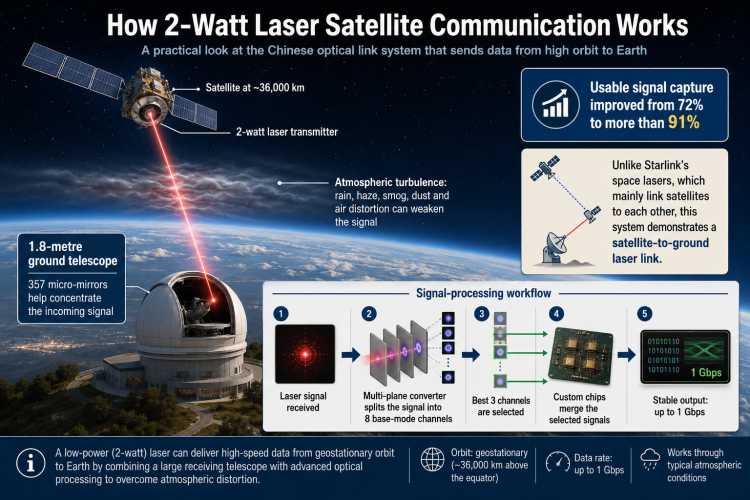
How The System Worked
The Tiny Beam That Could Reshape Space Internet
The transmission was received on the ground using a 1.8-metre telescope fitted with 357 micro-mirrors to collect and concentrate the incoming laser signal.
The system then used a multi-plane converter to split the laser into eight base-mode channels. Three of those signals were selected and merged using custom chips, increasing the chance of collecting a usable signal from 72% to more than 91%.
It also used a method known as AO-MDR synergy, combining adaptive optics with mode diversity reception to improve signal recovery as the laser passed through atmospheric turbulence.
That technical improvement is central to the story.
Satellite laser communication is not held back by a lack of ambition. It is held back by reliability. A high-speed link that works only in perfect weather has limited real-world value.
A link that can maintain performance through turbulence becomes far more serious. The Chinese test showed one possible pathway for making that happen.
Why Starlink Is Part Of The Conversation
The development was widely compared with Starlink, the SpaceX-owned satellite internet network that has become the global leader in low Earth orbit broadband.
The comparison is understandable, but it needs care.
Starlink is a working commercial network with satellites already serving customers around the world. The Chinese project was a technical demonstration, not a consumer internet service.
Even so, the test is relevant because it points to a different satellite internet model.
Starlink satellites use optical lasers for communication between satellites, but the connection to users on Earth relies on radio-based links.
The Chinese demonstration focused on satellite-to-ground laser communication, which could become important for high-capacity data transfer, defence, remote sensing, emergency communications and future broadband infrastructure.
This does not make the Chinese system a Starlink replacement. It does suggest that the next phase of space internet competition may be about more than launch numbers.
It may be about who can move data from orbit to Earth most efficiently.
Starlink’s top speeds typically reach only a few hundred Mbps from low Earth orbit at 550 kilometres altitude. The South China Morning Post reported China’s laser transmission as five times faster than Starlink.
That comparison is imperfect because the systems serve different purposes, but the power-to-performance ratio is not imperfect at all.
Two watts versus hundreds of watts for comparable or superior throughput is an engineering result that holds regardless of how you frame the competitive story.
The achievement has also raised fresh questions about the future of satellite internet competition. Starlink remains the global leader in low Earth orbit broadband, but China’s test points to a different model: high-capacity satellite-to-ground laser links operating from much higher orbit.
It is not a direct replacement for Starlink, and it is not yet a consumer internet service. However, the public interest is clear.
If low-power laser links can be made reliable, they could play a major role in future broadband, defence communications, Earth observation and deep-space relay networks.
The Space Congestion Problem
The public interest in this technology extends beyond internet speed.
Low Earth orbit is becoming increasingly crowded. Starlink satellites commonly operate at around 550km above Earth, and other satellite networks, including Amazon’s Project Kuiper, are expected to add thousands more spacecraft over time.
Astronomers have raised concerns about the impact of large satellite constellations on the night sky. Bright satellites can leave streaks in telescope images, while unintended radio emissions can interfere with radio astronomy.
There is also the growing issue of orbital debris. More satellites mean more objects to track, more collision risks and greater pressure on space traffic management systems.
The Chinese laser communication test used a satellite much farther away, at around 36,000km from the receiving telescope. That does not remove every concern, and it does not make higher-orbit systems a simple substitute for low-latency broadband constellations.
But it does reopen an important policy debate.
If high-capacity communication can be achieved from higher orbits using low-power laser links, governments and industry may need to think more carefully about whether every future satellite internet solution should rely on dense low Earth orbit networks.
Not A Silver Bullet
Despite the excitement, laser satellite communication is not ready to replace radio-based systems across the board.
Cloud cover can block optical links. Bad weather can reduce reliability. Ground stations need precise equipment and favourable conditions.
In many real-world deployments, laser systems would likely operate alongside radio links rather than replace them entirely.
That hybrid model may be the most realistic path forward.
Radio would provide reliability and broad availability. Laser links would provide the high-speed data layer when conditions allow.
This is why the 2025 Chinese demonstration remains relevant.
It did not solve every problem, but it addressed one of the hardest ones: how to improve the odds of capturing a usable optical signal after it passes through a turbulent atmosphere.
China’s 2-watt laser satellite communication test
China’s 2-watt laser satellite communication test showed that gigabit-class data transfer from high orbit may be possible using far less power than many people would expect.
That matters because the future of satellite communication may not be won by the biggest constellation or the loudest signal.
It may be won by precision.
The 2025 test now stands as an early sign of where the space internet race could be heading: fewer wasted watts, sharper beams, smarter ground systems and a much bigger contest over who controls the data highways above Earth.
What Comes Next
The wider significance of the Chinese laser satellite test may not be limited to one country, one satellite or one experimental link.
The AO-MDR method behind the demonstration is the kind of optical engineering advance that could be licensed, copied, refined and built into satellite hardware over the next decade.
The underlying techniques — adaptive optics correction and mode diversity reception — are not exclusive to China. They are engineering methods that other space agencies, defence contractors and commercial satellite operators can study and adapt.
Its publication in Acta Optica Sinica also means the science is now part of the open research record, giving the wider industry a clearer view of how the system worked.
The implications are broad. A low-power laser system capable of pushing 1Gbps through the atmosphere from about 36,000 kilometres could influence commercial broadband, high-capacity Earth observation downloads, military communications and future deep-space relay networks.
The power efficiency is especially important beyond Earth orbit. On a lunar spacecraft, Mars probe or deep-space relay platform, every watt matters. Power used for communications is power that cannot be used for instruments, propulsion, thermal control or onboard processing.
That is why the public interest in this breakthrough goes beyond faster internet. It points to a future where space communication networks may become more efficient, more secure and less dependent on crowded low Earth orbit infrastructure.
The next phase of the satellite internet race may not be decided only by who launches the most satellites. It may be decided by who can move the most data, over the longest distance, with the least power.
The Bits-Per-Watt Space Race Has Begun
The real significance of China’s 2-watt laser satellite communication test may not be that it puts Starlink under immediate commercial pressure.
The bigger story is that it introduces a new benchmark for the satellite internet industry: bits per watt from orbit.
For years, space broadband has been judged by constellation size, coverage, latency and download speed. Starlink changed the market by proving that thousands of low Earth orbit satellites could deliver practical internet access across remote regions.
But China’s 2-watt laser demonstration points to a different competitive measure: how efficiently a satellite can move data without consuming large amounts of power.
That matters because power is one of the hardest limits in space. Every watt used for communication is a watt that cannot be used for onboard processing, sensors, propulsion, thermal control or mission-critical systems. If a satellite can push gigabit-class data from geostationary
Earth orbit using a laser no brighter than a household nightlight, the economics of space communication start to look very different.
The next phase of satellite competition may not be won by whoever launches the most hardware. It may be won by whoever builds the most efficient orbital data pipeline.
This is where the public interest becomes sharper. Low-power laser communication could reduce the need for dense satellite networks in some applications, ease pressure on crowded low Earth orbit, and create a new class of high-capacity optical relay systems sitting much farther from
Earth. These systems could support broadband backhaul, Earth observation, emergency communications, defence networks and future lunar or deep-space missions.
It also creates a new strategic question for countries such as Australia.
If space communication shifts towards laser-based data landing points, nations with large landmass, clear-sky regions and stable ground infrastructure could become valuable optical gateway hubs.
Remote desert areas, already useful for astronomy and space tracking, may become critical landing zones for high-speed orbital data.
That is the overlooked prediction from China’s 2-watt test: the future of satellite internet may not simply be a contest between Starlink and its rivals. It may become a race to build the most power-efficient space data network.
In that race, the headline number may no longer be how many satellites are in orbit.
It may be how many gigabits can be delivered per watt.