The rise of generative AI has forced schools into an uncomfortable question: when a student can ask an AI tool to research and write an essay in seconds, what does genuine learning look like?
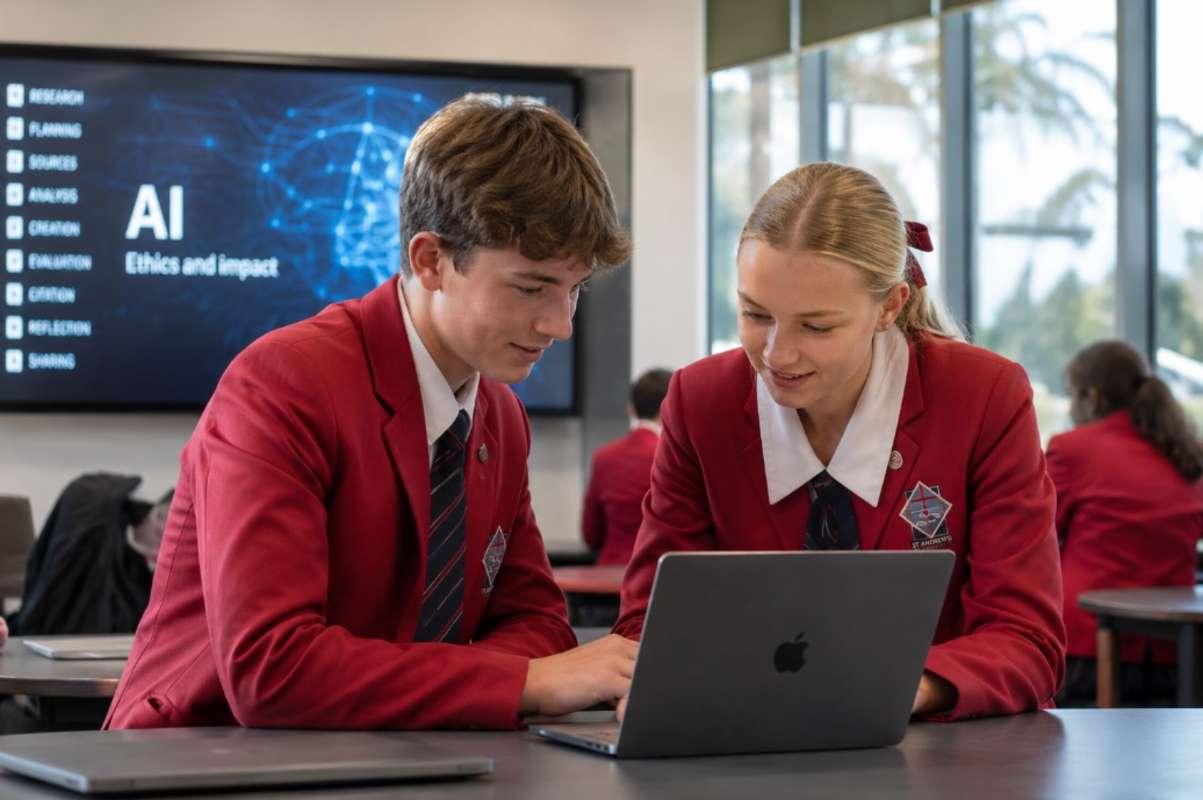
In response, Sunshine Coast school St Andrew’s Anglican College built a whole new Digital Research Hub that helps redefine how students use and think with AI and is now being nationally recognised for it.
The Peregian Springs-based school has been named an excellence awardee by The Educator in the 2026 Australian Excellence Awards for its use of technology.
It was recognised after responding to the challenges of the AI revolution by redesigning the traditional library model to help redefine how students learn to think in an evolving landscape.
Recognising that AI is part of the world our students are the future of, College Principal, Ms Karen Gorrie said she wanted St Andrew’s to move beyond restrictions and empower them with the skills to understand it and how they can harness it.
“We don’t want our students to fear AI or be naive about it,” said Ms Gorrie
“We wanted them to be the kind of thinkers who know how to interrogate any source and hold it to account.” she said
That conviction became the foundation of an ambitious project: the redesign of the College’s Digital Library into a structured Digital Research Hub, developed through a partnership between teaching staff, library specialists and the College’s IT team.
The new platform, which went live in 2025, gives secondary students a structured framework for research in an AI-enabled world.
Two learning pathways guide students through the full research process: defining questions, locating credible sources, evaluating information critically and constructing evidence-based arguments.
Crucially, AI tools sit inside that framework, not above it. Students are taught how AI systems generate responses, why errors and bias occur, and how every claim, whether it comes from a textbook, an academic database or a chatbot, must be tested against the same standard of evidence.
“AI tools are taught as one of many research aids. Not a shortcut, but a thinking partner. The goal is developing students who use these tools with real discernment,” Ms Gorrie said.
Five core thinking skill modules run through the platform: Inquiry and Investigation, Systems Thinking, Evidence and Data Literacy, Critical and Ethical Reasoning, and Communication. These are embedded directly into subject hubs so students apply the same research habits across all subjects.
Running alongside the Hub is an AI Learning Insights Dashboard, which tracks patterns of AI usage across curriculum contexts, helping teachers understand how students are actually engaging with AI tools during learning tasks and informing how they design assessments.
In the first 12 months, teachers are already seeing a shift in how students engage with AI tools, with data supporting it.
Following targeted classroom sessions on effective prompting and verification, the quality of student AI prompts improved by 40%, indicating students are beginning to approach these tools with greater intention and critical awareness.
Rather than accepting a generated response at face value, they are comparing outputs across platforms, identifying inconsistencies and verifying claims through academic databases.
“What we’re seeing is students who ask better questions. They’re not just prompting AI to give them an answer, they’re using it to think. That’s exactly what we hoped for,” Ms Gorrie said.
The Digital Research Hub is one strand of the College’s broader AI Action Research program, through which teachers are exploring how artificial intelligence can support both student learning and teacher practice through a whole-school approach.
St Andrew’s also received an Excellence Award for Regional School of the Year, recognising the College’s outstanding academic results, its breadth of student achievement and its deeply connected school community.
“I’m incredibly proud and grateful to work alongside staff who give so much, and to be part of a community that genuinely believes in the power of education to shape lives. We are proud to be a school where innovation and excellence go hand in hand,” Ms Gorrie said.
The recognition builds on a string of national accolades in recent years, including Secondary School of the Year (non-government) at the 2024 Australian Education Awards, as well is one of Australia’s Most Innovative Schools and a 5-Star Best School in 2025.