


In science, physics often serves as a lens through which we interpret the world — from the gravitational pull that orchestrates tides to the quantum-level tools that help us peek into cells.
But sometimes, the natural world pushes back, offering up mysteries that challenge the rules as we know them. That’s exactly what happened when a team of researchers turned their attention to the skin of a squid — and stumbled upon a phenomenon in physics never before observed in biology.
A new study, published in PRX, reveals that the cellular patterning in squid skin may be the first known biological instance of “hyperdisorder,” a physical concept that describes how systems can shift from order to apparent chaos as they grow.
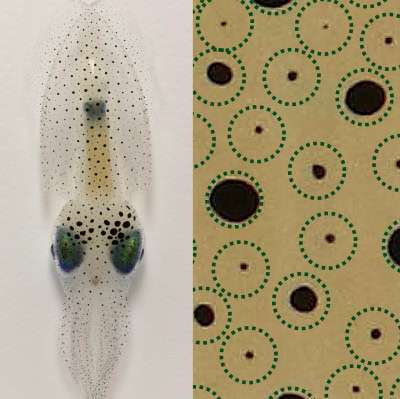
The discovery, made by an interdisciplinary team at the Okinawa Institute of Science and Technology (OIST), opens fresh avenues for understanding how physical laws apply to growing systems — not just in biology, but potentially across the physical sciences.
A Pattern Hidden in the Chaos
When researchers zoomed in on the pigment cells of the squid — known as chromatophores — they expected to find a familiar physics principle at play.
“In other growing systems, such as the cells in chicken eyes, studies have previously seen hyperuniformity, whereby there is long range order and patterning, despite randomness at a close scale,” said Dr. Robert Ross, OIST Interdisciplinary Postdoctoral Scholar and lead author of the study.
“This is what we expected to see in the squid. But what we actually observed was completely different, and we have not yet seen any other instances of this packing behavior in biology,”
“However, we think such disorder is very likely to be present in similar growing systems, highlighting the importance of growth on physical properties.” he said.
Rather than a tidy, predictable arrangement, the squid’s chromatophores displayed a spatial chaos that defied expectations.
On small scales, the cell positions seemed orderly — but as the view expanded, irregularities became dominant. This is the hallmark of hyperdisorder: the variation in point density grows faster than the space itself.
Capturing Complexity in Motion
The research team tracked the squid over a 12-week period, capturing 3D images to analyze how the chromatophores appeared and moved over time. The cells are critical to the squid’s camouflage and communication, making their arrangement biologically important and physically curious.
“The chromatophores appear at fixed positions in relation to one another, in a specific pattern,” explained Professor Sam Reiter, head of the Computational Neuroethology Unit and co-author of the study.
“They are essential in camouflage and communication. Therefore, we were interested in studying the spatial arrangement and the pattern development of these cells.” he said.
To make sense of the unexpected findings, the researchers turned to modeling. They built a mathematical representation using hard disks on a growing surface — a surprisingly simple system that nonetheless captured the squid’s complex reality.
Growth: A Key Player in Physical Systems
“This study exemplifies the importance of growth on the physical behavior of different systems, and the unique knowledge that can be gained by studying from interdisciplinary perspectives,” said Professor Simone Pigolotti, head of the Biological Complexity Unit and co-author of the study.
“We look forward to applying our model to other growing systems, both biological and beyond. The general nature of this model means there are endless possible scientific directions to take.” Pigolotti said.
At a glance, squid skin may seem an unlikely gateway to new physics. But as this study shows, nature continues to rewrite the rulebook — and sometimes, the next big insight hides in plain sight, just beneath the surface.