


Website owners and publishers are raising concerns about repeated paid link-building emails linked to Respona.com, as the wider SEO outreach industry comes under pressure over spammy backlink requests, low-quality unethical paid guest blogging placements.
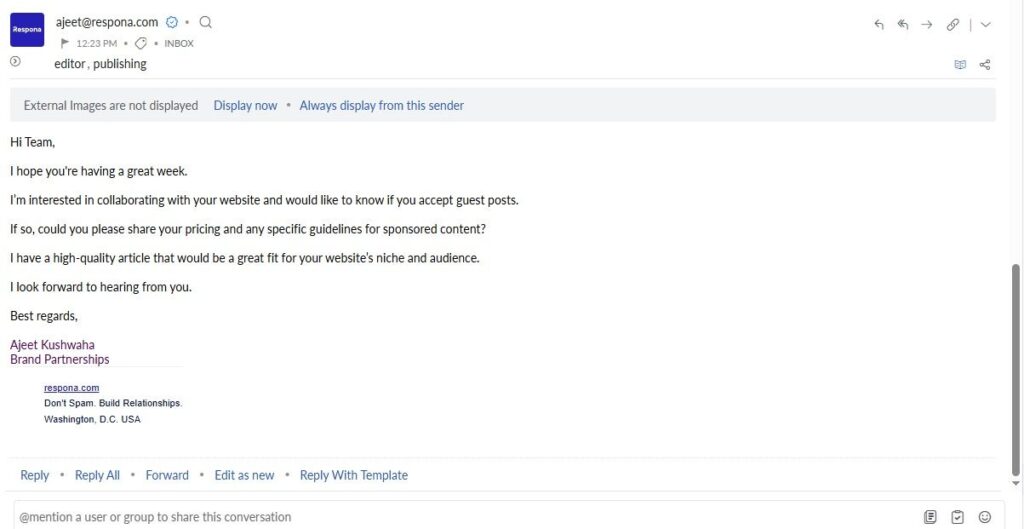
The email raises clear concerns about mass-distributed backlink outreach, with the sender asking for publishing guidelines and other basic information that is already publicly available.
In the case of Tech Business News, those guidelines are clearly published on the website, including requirements around editorial standards, acceptable submissions and content quality.
The request suggests the sender had not properly reviewed the publication before making contact, raising further questions about whether the outreach was based on genuine editorial engagement or simply part of a broader paid link-building email spam campaign.
The issue is no longer limited to one-off guest post pitches.
Publishers say they are being contacted with requests to buy links, place sponsored anchors, submit thin articles or insert backlinks into existing stories with little connection to the original content.
One of the more concerning practices involves outreach asking how much a news platform or blog would charge to randomly insert links into pre-published articles.
In the SEO industry, this is often described as a “link insertion” or “niche edit”. In other words, a black hat marketing tactic
For publishers, it raises a clear editorial concern: articles that were originally published for readers can later be altered to carry unrelated commercial backlinks.
Respona markets itself as a link-building service used to increase AI visibility and organic traffic from Google, with its website promoting “done-for-you placements” on sites “people actually read”.
The company also promotes software designed to help users find outreach prospects, locate contact information and send personalised pitches.
For website owners, that scale is the problem.
Many publishers are already dealing with heavy inbox volumes from PR agencies, marketing firms and SEO freelancers.
Paid link-building outreach adds another layer of noise, particularly when emails are sent repeatedly, ignore publishing guidelines, or ask for do-follow links that appear designed to influence search rankings rather than inform readers.
Respona’s own material frames link building as a numbers game. In one guide, the company says cold outreach reply rates hover around 10%, meaning 100 prospects may produce about 10 replies and only two to three placements.
The same guide says backlink outreach is “fairly easy to automate” with outreach tools and later suggests 100 to 200 personalised emails may be needed in a campaign to land five to 10 quality backlinks.
That is where the public-interest concern begins. When the business model accepts that only a small percentage of publishers will respond, the incentive is to increase volume.
For publishers, that means more cold emails, more follow-ups, more irrelevant pitches and more time spent filtering commercial backlink requests that have no clear editorial value.
The lower end of the market has become especially aggressive. Website owners are being offered content that is often generic, poorly researched or clearly written around a backlink (Hyperlink) rather than a story.
In some cases, links are pushed into awkward anchor text, unrelated paragraphs or old articles where the connection to the linked business is thin or non-existent.
That practice can damage both reader trust and site quality. A news website or blog risks becoming a dumping ground for paid placements when links are inserted into weak content, old articles or unrelated stories simply because someone is willing to pay.
Google’s spam policies warn that link spam includes creating links primarily to manipulate search rankings. Its examples include buying or selling links for ranking purposes, excessive link exchanges and using automated programs or services to create links to a site.
There are also email compliance concerns. In Australia, the ACMA says commercial electronic messages require consent, must identify the sender and must make it easy to unsubscribe.
The regulator also says businesses remain responsible even if another company sends marketing messages on their behalf.
The distinction between legitimate PR and link spam is important. A relevant pitch from a real company, sent to the right editor, can lead to useful coverage.
A paid request to insert a backlink into an unrelated article is different. It treats publishers not as editorial platforms, but as link inventory.
Respona is not the only company operating in this market. The broader SEO industry includes agencies, freelancers and outreach platforms built around backlink acquisition, guest posting, digital PR and authority-building campaigns.
But Respona’s visibility in the sector has made it a clear example of a larger problem: the normalisation of paid link outreach at scale.
For readers, the impact is less visible but still serious. When weak articles are published or old stories are edited mainly to carry paid backlinks, the information ecosystem becomes more polluted.
Search results can be shaped by commercial link placement rather than editorial judgement.
For website owners, the message is becoming harder to ignore. Paid link-building spam has moved well beyond casual guest post requests.
It has become an industrialised outreach machine, with publishers increasingly asked to sell access to their authority, their archives and their readers.