Tech News

Tech Business News

  • Home
  • Technology
  • Business
  • News
    • Technology News
    • Local Tech News
    • World Tech News
    • General News
    • News Stories
  • Media Releases
    • Tech Media Releases
    • General Media Releases
  • Advertisers
    • Advertiser Content
    • Promoted Content
    • Sponsored Whitepapers
    • Advertising Options
  • Cyber
  • Reports
  • People
  • Science
  • Articles
    • Opinion
    • Digital Marketing
    • Gaming
    • Guest Publishers
  • About
    • Tech Business News
    • News Contributions -Submit
    • Journalist Application
    • Contact Us
Reading: Researchers Develop Microrobots Capable Of Removing Microplastics And Bacteria From Water
Share
Font ResizerAa
Tech Business NewsTech Business News
  • Home
  • Technology News
  • Business News
  • News Stories
  • General News
  • World News
  • Media Releases
Search
  • News
    • Technology News
    • Business News
    • Local News
    • News Stories
    • General News
    • World News
    • Global News
  • Media Releases
    • Tech Media Releases
    • General Press
  • Categories
    • Crypto News
    • Cyber
    • Digital Marketing
    • Education
    • Gadgets
    • Technology
    • Guest Publishers
    • IT Security
    • People In Technology
    • Reports
    • Science
    • Software
    • Stock Market
  • Promoted Content
    • Advertisers
    • Promoted
    • Sponsored Whitepapers
  • Contact & About
    • Contact Information
    • About Tech Business News
    • News Contributions & Submissions
Follow US
© 2022 Tech Business News- Australian Technology News. All Rights Reserved.
Tech Business News > Science > Researchers Develop Microrobots Capable Of Removing Microplastics And Bacteria From Water
Science

Researchers Develop Microrobots Capable Of Removing Microplastics And Bacteria From Water

Scientists have engineered microrobots with the ability to extract microplastics and bacteria from water, effectively combating both pollution and the spread of diseases in aquatic ecosystems. Afterwards the tiny robots, each measuring 2.8 micrometers in diameter are decontaminated and reused.

Matthew Giannelis
Last updated: May 9, 2024 3:01 pm
Matthew Giannelis
Share
SHARE

You know how when you toss out old food wrappers or broken toys, they eventually turn into tiny pieces of plastic that end up polluting our oceans and rivers? Well, those little plastic bits are a nightmare to clean up, especially because they attract bacteria that can make us sick.

Contents
Building The BotsCapture Rate of Approximately 80%

But here’s the cool part: scientists have come up with these super tiny robots, like something out of a sci-fi movie, that can actually snatch up those plastic pieces and bacteria from the water.

Then, they can also clean themselves off and get ready to do it all over again. It’s like having little eco-friendly cleaners zipping around, helping to keep our waters clean.

You know those tiny bits of plastic, called microplastics, that are smaller than 5 millimeters? They’re a big problem because animals can accidentally eat them, which can cause all sorts of harm. And guess what? Those microplastics might end up in the food we eat too, because they can get passed up the food chain.

But wait, there’s more. These little plastic pieces aren’t just floating around innocently. They’re like magnets for bacteria, including the nasty ones that can make us sick if we ingest them.

So, to tackle both the plastic and bacteria problem in water, scientists like Martin Pumera and his team came up with these amazing tiny robots that work together, kind of like fish in a school, to clean up the mess. It’s pretty smart stuff!
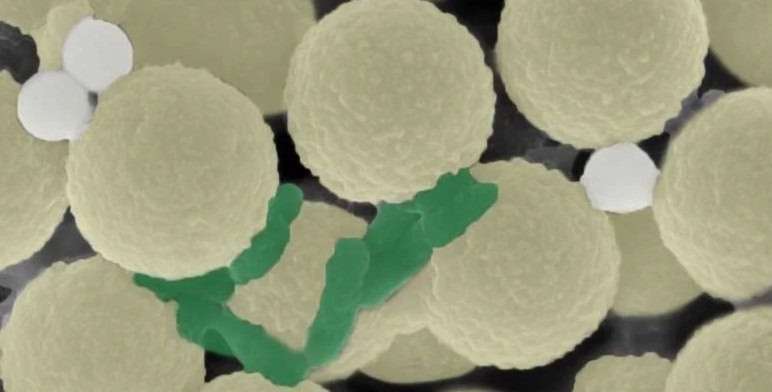
To clean water, researchers have designed swarms of tiny, spherical robots (light yellow) that collect bacteria (green) and small pieces of plastic (gray)
Credit: Adapted from ACS Nano 2024, DOI: 10.1021/acsnano.4c02115

Building The Bots

The creation process of these bots involved connecting positive-charged polymer strands to tiny magnetic particles. These particles respond to magnetic fields, enabling movement.

The polymer strands have an affinity for both plastic materials and microorganisms. The resulting robots, each measuring 2.8 micrometers in diameter, demonstrate remarkable capabilities.

Under the influence of a rotating magnetic field, these robots exhibit collective behavior, forming swarms. Researchers also observed that by controlling the number of robots organizing into flat clusters, they could manipulate the swarm’s dynamics, affecting both movement and velocity.

In a recent series of laboratory experiments, a team of scientists embarked on a mission to replicate the intricate dance between microplastics and bacteria commonly found in our environment.

Their method? Introducing fluorescent polystyrene beads, a mere micrometer in width, along with actively swimming Pseudomonas aeruginosa bacteria – notorious for causing a variety of infections including pneumonia – into a water tank.

The next phase of their investigation involved the introduction of microrobots into the mix. These tiny machines were subjected to a rotating magnetic field for precisely 30 minutes, with intervals of activation and deactivation every 10 seconds.

Capture Rate of Approximately 80%

Among the various concentrations tested, it was observed that a density of 7.5 milligrams per milliliter yielded the most promising results. At this concentration, the microrobots exhibited an impressive capture rate of approximately 80% of the bacteria.

Remarkably, the presence of these microrobots also coincided with a gradual reduction in the number of free-floating plastic beads, as they were magnetically drawn towards the robots.

Following this stage, the researchers employed a permanent magnet to gather the microrobots, subsequently utilizing ultrasound to detach the bacteria adhering to their surfaces. The removed microbes were then subjected to ultraviolet radiation, effectively completing the process of disinfection.

Interestingly, even after undergoing this thorough decontamination process, the microrobots retained their efficacy in capturing both plastic and bacteria, albeit in reduced quantities.

According to researchers the innovative microrobotic system presents a promising avenue for the purification of water contaminated with plastic debris and harmful bacteria.

ByMatthew Giannelis
Follow:
Secondary editor and executive officer at Tech Business News. An IT support engineer for 20 years he's also an advocate for cyber security and anti-spam laws.
Previous Article CSIRO turning red meat into a nutritious powder to give an allergen-free protein boost to snacks and beverages, CSIRO Turns Red Meat Into Nutritious Powder For Use In Protein Products
Next Article Inditeweb.com Ravi Ranjan Singh Found Spamming - SEO SPAM Inditeweb.com Ravi Ranjan Singh Found Spamming Thousands Of Businesses Globally
Leave a Comment

Leave a Reply Cancel reply

You must be logged in to post a comment.

Microrobots have been designed to mimic natural swarms can effectively remove both microplastics and bacterial contaminants from water,

Tech Articles

Top Big Tech Companies 2026

The Big Tech Companies Actually Winning In 2026 — And Numbers That Prove It

Top tech companies in 2026 included AppLovin, AWS, Microsoft, Meta,…

May 20, 2026
Sean Yu, VP of Commercial APAC at EBANX.

The Consumers Driving Global E-Commerce Growth Are Closer to Australia Than Many Businesses Think

The consumers driving global e-commerce growth are closer to Australia…

June 9, 2026
The Internet’s Best Blogs Didn’t Vanish — They Were Stripped for Parts by SEO Parasites

The Internet’s Best Blogs Didn’t Vanish — They Were Stripped for Parts by SEO Parasites

How some of the internet’s best independent blogs were quietly…

June 3, 2026

Recent News

CSIRO Job Cuts 2025: Staff Association Warning Major Job Losses Across Australia
Science

Australia’s Science Agency CSIRO Announces 350 Job Cuts

4 Min Read
Steven Hawking Black Hole
Science

New model shows primordial black holes could account for all dark matter.

8 Min Read
Harvard astrophysicist Avi Loeb 3I/ATLAS may have carried the building blocks of alien life into the Solar System.
Science

Interstellar Object 3I/ATLAS Sparks Debate Over Possible “Directed Panspermia”

5 Min Read
Aussie Tech Moon
Science

Aussie Tech Company First Wave Helps Put Humans Back On The Moon After 50 Years

3 Min Read
Tech News - Technology Business

Tech Business News

In 2026, technology news is shaping business outcomes faster than ever—driven by AI adoption, rising cyber risk, cloud modernisation, data regulation, and constant platform change.
 
Tech News keeps Australian organisations and industry professionals informed with timely reporting and practical coverage across AI, cybersecurity, cloud, enterprise IT, startups, science, people and business, plus major world and local news impacting the tech sector.
 
Tech Business News publishes news and analysis designed to be clear, relevant, and easy to act on. It supports the industry with technology news reports, whitepaper publishing services, and a range of media, advertising and publishing options 

About

About Us 
Contact Us 
Privacy Policy
Copyright Policy
Terms & Conditions

June, 13, 2026

Contact

Tech Business News
Melbourne, Australia
Werribee 3030
Phone: +61 431401041

Hours : Monday to Friday, 9am 530-pm.

Tech News

© Copyright Tech Business News 

Latest Australian Tech News – 2026

Welcome Back!

Sign in to your account

Username or Email Address
Password

Lost your password?