Neural Processing Units (NPUs) are experiencing unprecedented performance improvements with each processor generation, as major semiconductor manufacturers compete to deliver specialised AI capabilities for consumer devices and enterprise applications.
The latest benchmarks reveal substantial gains across the industry’s leading platforms. AMD’s Ryzen AI 300 series boasts 50 TOPS of power from its NPU, compared to Intel Lunar Lake’s 48 TOPS and Qualcomm Snapdragon X Elite’s 45 TOPS.
Theoretical NPU performance figures are increasingly translating into measurable real-world improvements.
Independent testing conducted in October 2024 demonstrated the practical impact of advances.
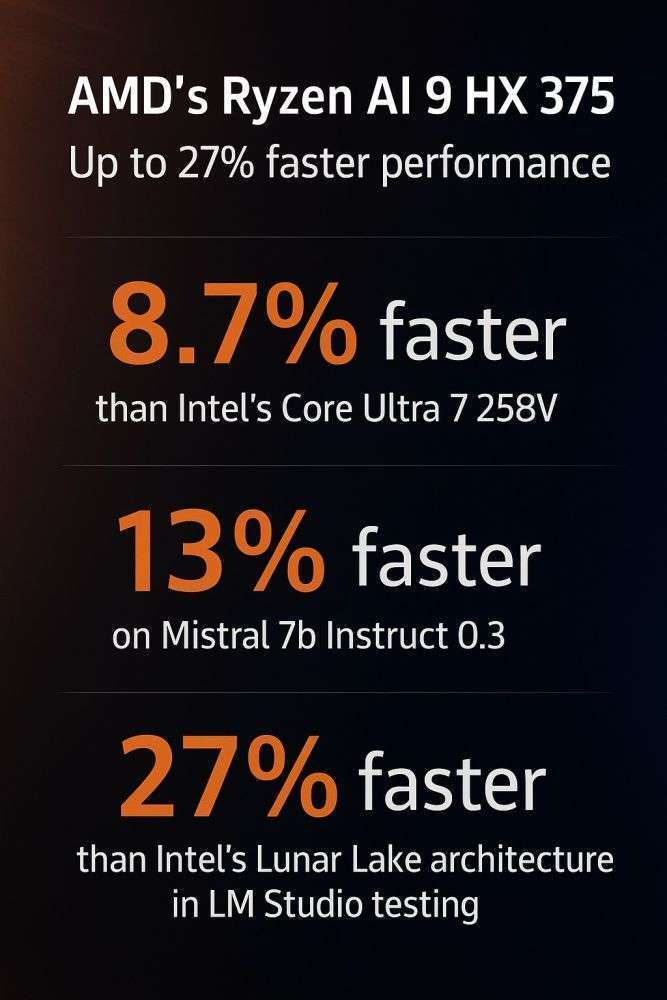
AMD’s Ryzen AI 9 HX 375 processor was up to 8.7% faster than Intel’s Core Ultra 7 258V on Microsoft Phi 3.1 and up to 13% faster on the Mistral 7b Instruct 0.3 model when tested in controlled environments.
In more demanding large language model applications, the Ryzen chip achieved up to 27% faster performance than Intel’s Lunar Lake architecture in LM Studio testing.
Intel has responded with significant architectural improvements in its latest NPU design. The company achieved the fastest NPU response time in MLPerf benchmarks, generating the first word in just 1.09 seconds, meaning it begins answering almost immediately after receiving a prompt.
Intel’s NPU 4 improvements were made possible by achieving higher frequencies, better power architectures, and a higher number of engines, thus giving it better performance and efficiency.
The performance gains extend beyond raw computational power. Testing has shown some NPU performance to be over 100 times better than a comparable GPU, with the same power consumption.
Meanwhile, Microsoft has established new performance thresholds for AI-capable devices. Copilot+ PCs feature Neural Processing Units that can perform more than 40 trillion operations per second (TOPS), enabling AI-intensive processes like real-time translations and image generation.
The competitive landscape continues to intensify as manufacturers pursue different architectural approaches.
NPUs are built from the ground up to handle the neural network computations dominant in AI workflows, and they do so more quickly than CPUs and GPUs while consuming less power and offering better scalability for large-scale AI applications.
Looking ahead, industry analysts project continued exponential growth in NPU capabilities. Industry experts predict performance per watt improvements of 10x or more over the next decade. The gains will enable more sophisticated AI applications in power-constrained environments.
The practical applications of these improvements are already visible in consumer devices. In smartphones and tablets, NPUs enable advanced features such as real-time language translation, enhanced camera functionalities, and improved voice recognition.
By offloading AI tasks from the CPU and GPU, NPUs enhance the overall user experience while conserving battery life. However, questions remain about the practical utility of theoretical performance metrics.
TOPS is a theoretical measurement, with industry critics noting that these numbers are thrown around as if they have substantial meaning for real-world users.
Chip makers are now fighting tooth and nail over NPU specs as AI capabilities become the deciding factor for consumers choosing new devices.
What we’re seeing today makes the early NPU attempts from just two years ago look primitive by comparison – AMD, Intel, and Qualcomm have all managed to deliver meaningful improvements that actually matter in day-to-day use.
The NPU market, estimated at $15 billion in 2025, is projected to witness a Compound Annual Growth Rate (CAGR) of 25% from 2025 to 2033, reaching approximately $75 billion by 2033.