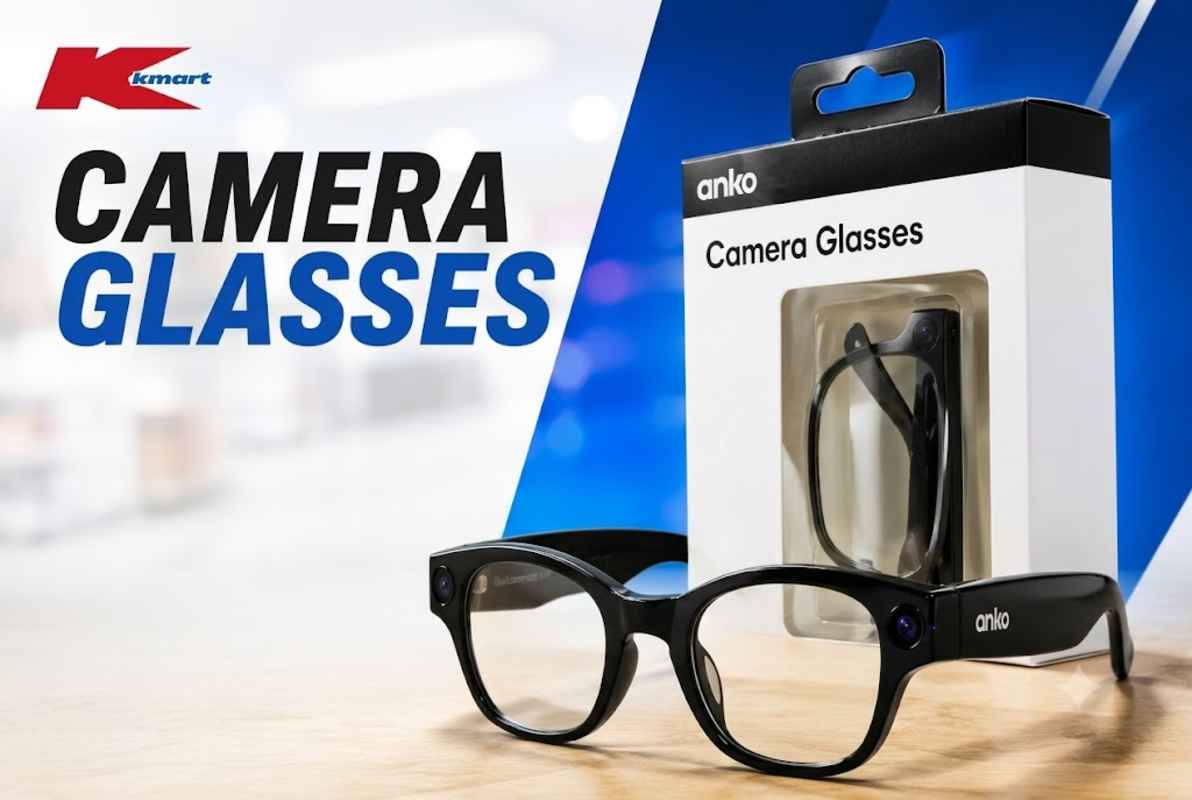
The arrival of low-cost smart glasses in Australian retail stores is raising new questions about privacy, consent and the future of surveillance technology.
Kmart’s rapid sell-out of budget smart glasses has highlighted the growing mainstream adoption of wearable camera technology, while reigniting concerns about the privacy risks that come with devices capable of recording.
The issue is becoming more visible as affordable models reach mainstream consumers, including budget smart glasses sold through major retailers.
What was once a camera held visibly in someone’s hand can now sit on a person’s face, blending into everyday life while capturing the environment around them.
A tool for gendered harassment, not a gadget
The dangers are already playing out. Misogynist men are using camera glasses to covertly film women in public for social media clout and to feed the deepfake porn engines that have turned non-consensual sexual imagery into an industry.
The people wearing them will never be the ones filmed without consent – only the rest of us, especially those of us who are female, non-white, or non-gender-conforming. Every person in Australia deserves to be able to go out in public without being recorded.
There may be a genuine use case for camera glasses as a visual aid for blind and low-vision people, but that isn’t how they’re being designed, marketed, or sold.
Public surveillance; sold to advertisers
There’s also a second, quieter danger: these glasses see everything and everyone. Companies building the hardware aren’t neutral bystanders.
They have every commercial incentive to exploit whatever the camera sees. A camera that recognises your face can profile you: where you shop, who you’re with and what stores you show interest in.
The same “recognise, geolocate, track, act” process has already been adapted for more deadly purposes. Niantic used Pokémon Go players to collect vast amounts of location data, which they then sold to military drone companies.
When recording becomes invisible
Smartphones have already changed how people capture and share moments, but smart glasses introduce a different challenge. A person using a phone to record is usually obvious, while wearable cameras can make recording far less noticeable.
That difference has raised concerns about whether people in public spaces can meaningfully consent when they may not even know they are being filmed.
The risks are particularly significant around the misuse of wearable cameras for harassment and the creation of non-consensual sexual imagery.
RMIT’s Caitlin McGrane says the impact of covert recording is not experienced equally.
“If men had to worry about being covertly filmed in public, these products wouldn’t even be available for sale.” said McGrane
The people wearing the devices are rarely the ones facing the privacy risk. The exposure falls on those around them, including people who may be recorded in public, workplaces or other everyday environments without their awareness.
A new frontier for data collection
The privacy concerns extend beyond individual misuse.
The technology behind smart glasses is moving beyond simple photography and video. With artificial intelligence built into newer devices, they can analyse surroundings, recognise objects, identify locations and process information about what is happening around the wearer.
That creates a new opportunity for companies to collect valuable behavioural data.
A wearable camera that can recognise faces, understand shopping environments and analyse user activity could provide insights into where people go, what they look at and how they interact with the world around them.
Another concern is that surveillance once limited largely to online activity and smartphones could move into public spaces, attached directly to the person wearing the device.
Businesses face new workplace risks
The technology is also creating challenges inside workplaces.
A worker wearing smart glasses could potentially capture confidential meetings, sensitive documents or conversations without the knowledge of colleagues.
Employers may soon need to consider whether existing workplace policies are enough to deal with devices that can continuously record.
The problem is that many workplace privacy rules were written around traditional cameras and recording devices, not wearable technology that can operate discreetly throughout the day.
Australia’s privacy laws face a new challenge
The arrival of smart glasses is exposing weaknesses in Australia’s existing privacy framework, particularly around recording in public spaces.
Tom Sulston, Head of Policy at Digital Rights Watch, says current laws were not designed for a world where anyone could carry an always-on recording device.
“Australia has never properly grappled with the concept of privacy in public space: our laws pre-date the Internet. Our current privacy laws offer us little protection of privacy once we leave the front door.”
“The gap worsens when smart glasses add always-on recording and facial recognition to the mix.” said Sulston
“Our legal framework assumes a world of occasional, visible cameras, not a world where anyone walking past you might be quietly building a searchable, identifiable record of your movements.” he said.
Existing harassment laws may also struggle to address situations involving covert recordings, particularly where harm occurs after footage has already been shared or manipulated.
“While we do have existing anti-harassment laws, these aren’t enough to fill the gap.”
“They generally require a pattern of behaviour to act on, and are used after someone’s been harmed: after the footage has already been uploaded, after the deepfake has already been generated, after the damage is done.”
“None of that helps us the moment we’re standing in a changing room next to a stranger wearing a camera they can’t see.” said Sulston
The proposed response includes stronger privacy protections in public spaces, clearer rules around facial recognition technology, a Children’s Online Privacy Code and greater accountability for companies developing products with foreseeable risks.
The future of wearable technology is now a privacy debate
Smart glasses are no longer just a question of whether consumers want another connected device.
The bigger issue is whether privacy protections can keep pace with technology capable of recording, identifying and analysing people in everyday situations.
Sulston says Australia should consider the consequences before the technology becomes permanently embedded into daily life.
“Smart glasses aren’t inevitable. They’re a product that only exists because our privacy laws haven’t caught up to the last decade, let alone this one.”
“We shouldn’t be racing to accommodate them: we should be asking why they’re on supermarket shelves at all.” he said.
As smart glasses become cheaper and more accessible, the debate is shifting from what these devices can do for the wearer to what they mean for everyone standing nearby.