

A new Harvard Business Review Analytic Services study, sponsored by Appian, finds that 59% of organisations now have AI in production, yet most are still focused on incremental gains such as efficiency and productivity rather than revenue growth.
The research is based on responses from nearly 400 organisations across North America, Europe and the Asia-Pacific.
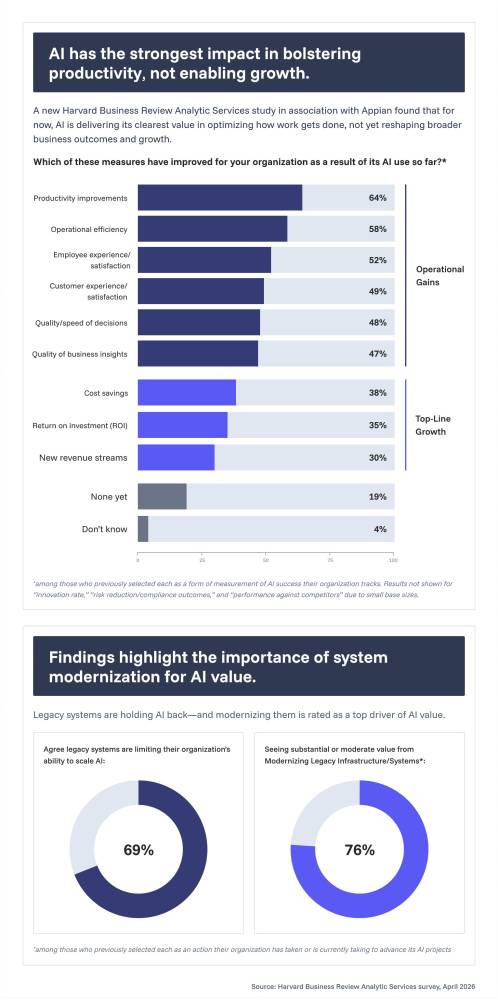
The study shows AI is currently delivering the greatest impact in productivity (64%) and operational efficiency (58%), while fewer organisations report improvements in new revenue streams (30%) and return on investment (35%).
This highlights a significant opportunity for businesses to better leverage AI to drive broader commercial outcomes and growth.
“Enterprises are at an inflection point. Instead of using AI to drive productivity, organisations must evolve to focus on business growth. That’s where Appian comes in,” said Matt Calkins, CEO of Appian.
“The true potential of AI can only be realised when it moves from a standalone tool to an embedded worker that drives revenue,”
“To get there, leaders must prioritise the foundational orchestration and rules-based guardrails required to safely apply AI to high-impact work.” he said.
AI Still Sits Outside the Flow of Work
In most organisations, AI is being used alongside work, not built into how work gets done, limiting its ability to drive higher-level business outcomes.
Only 18% of respondents report that AI is primarily integrated within workflows, while a larger share (34%) continue to use AI as standalone tools alongside processes/workflows, with another 34% reporting a mix of both approaches and 12% not yet using AI in processes/workflows at all.
Most See Some Returns on AI, but Not Yet at Scale.
Most respondents are seeing some returns from AI investments, but only 16% report realising a high degree of measurable value.
The majority describe the impact as moderate (33%), slight (36%), or have no measurable value (8%). Still, expectations remain high, as 86% agree that their organisation is looking to realise more business value from its use of AI.
It’s clear that AI is delivering some results, but translating those results into meaningful, scalable business impact is proving difficult.
AI Delivers Value When Embedded in Workflows
As organisations advance their AI strategies, value is closely tied to how effectively AI is integrated into workflows and applied to operational work. Seventy-one percent of organisations embedding AI into processes realised substantial or moderate value from those efforts, according to respondents.
In parallel, approximately three-quarters report strong returns from modernising legacy infrastructure/systems (76%), integrating data sources (75%), and orchestrating processes/workflows across systems/applications (73%).
Legacy Systems Continue to Limit AI’s Impact
Nearly seven in ten respondents, 69%, agree that legacy systems are limiting their ability to scale AI across the enterprise.
This reinforces the need for modernisation and better integration across systems and data. Siloed or low-quality data (34%), a lack of integration across systems (31%), and a lack of AI talent/skills (30%) are also among the most commonly cited barriers to embedding AI into workflows.
AI Agent Adoption Lags in Core Operations
The research also highlights differences in how AI agents are being applied across the enterprise. Organisations are more actively deploying AI agents in areas such as software development (35%), IT operations (31%), marketing and sales (26%), and customer service (25%).
In contrast, agent adoption is more limited in core operational areas such as procurement (9%), manufacturing (10%), and supply chain (11%), where processes tend to be more complex and require greater control and consistency.
Most Organisations Lack the Guardrails Needed to Scale AI Agents Safely
Ninety-two percent of respondents agree that AI agents need rules-based guardrails to operate safely and effectively, yet fewer than half (48%) agree that their organisation has defined such rules (among those at organisations using, considering or exploring agentic AI).
As organisations explore agentic AI systems (currently used by 25% of organisations and under consideration by 62%), the need for clearly defined processes and guardrails will become even more critical.
Without clear guardrails, agents can act unpredictably across systems, increasing the risk of unintended outcomes.
Process Design Is Emerging as the Key to Unlocking AI Value
Realising the full value of AI and achieving sustainable ROI requires rethinking how work is structured and governed.
According to respondents, organisations are increasingly focused on better defining rules/guardrails that AI must follow (50%), standardising processes/workflows across functions (49%), and increasing cross-functional coordination (47%) to improve the success of AI implementations.
“Organisations are adopting AI, but many haven’t integrated it into the core processes that drive business outcomes,” said Alex Clemente, managing director of Harvard Business Review Analytic Services.
“Those that successfully embed AI into workflows will be better positioned to realise meaningful value.” said Clemente