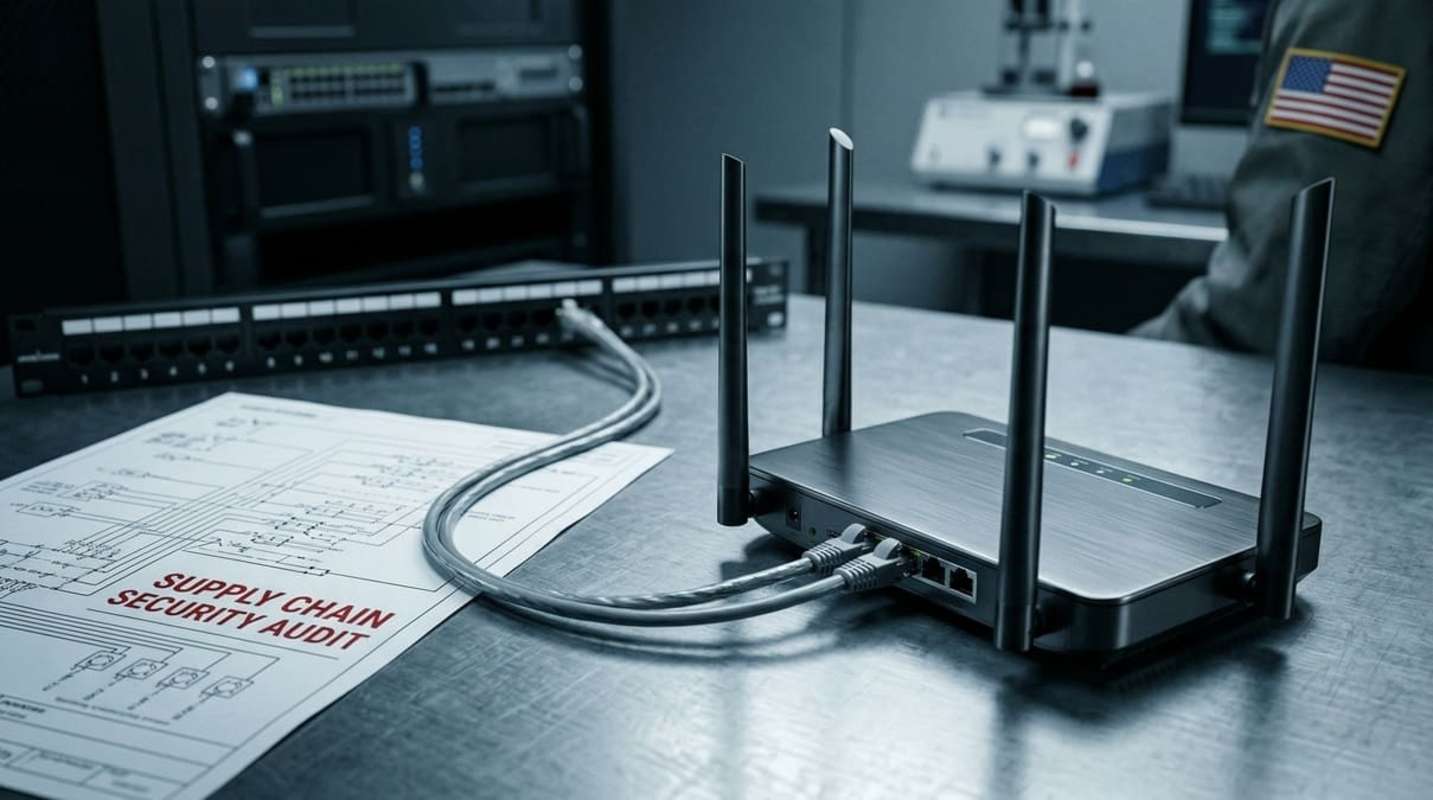


The Federal Communications Commission has announced it will no longer approve consumer-grade routers manufactured outside the United States, citing a directive from Donald Trump aimed at reducing reliance on foreign technology on national security grounds.
The move effectively blocks foreign-made routers from being imported into or sold across the US market.
Routers already approved for sale will remain available, and consumers can continue using existing devices.
However, new models produced wholly or partially outside the US will not receive approval unless the Department of Defense or the Department of Homeland Security determines they pose no national security risk.
The restriction applies broadly to both domestic and international companies if any major stage of production—including manufacturing, assembly, design, or development—occurs outside the United States.
“This action means that new models of foreign-produced routers will no longer be eligible for marketing or sale in the US,” FCC Chairman Brendan Carr wrote on X.
“The determination included an exemption for routers that the Department of War (DoW) or the Department of Homeland Security (DHS) have granted ‘Conditional Approval’ after finding that such device or devices do not pose such unacceptable risks.”
Manufacturers seeking conditional approval must justify why production occurs overseas and outline plans to shift or expand manufacturing within the US, including a detailed, time-bound roadmap.
The FCC says the decision follows a national security assessment by an interagency group of experts.
“Recently, malicious state and non-state sponsored cyber attackers have increasingly leveraged the vulnerabilities in small and home office routers produced abroad to carry out direct attacks against American civilians in their homes,” the determination said.
Covered List expanded to all foreign routers
Previously authorised routers will be allowed to receive software and firmware updates—including critical security patches—until March 1, 2027, with the possibility of an extension.
To enforce the policy, the FCC has expanded its “Covered List” to include all foreign-made consumer-grade routers unless granted conditional approval. These devices are defined as residential networking hardware capable of forwarding data packets between systems.
The regulator warned that compromised routers are a growing cybersecurity threat, often exploited in botnet attacks.
“Compromised routers can enable in-depth network surveillance, data exfiltration, botnet attacks, and unauthorised access to US government or American businesses’ networks.
The United States must have secure and trusted routers. However, currently a majority of the routers in American homes and businesses are produced outside of the United States.
Allowing routers produced abroad to dominate the US market creates unacceptable economic, national security, and cybersecurity risks.”
The FCC’s Covered List already includes equipment from companies such as Huawei, ZTE, and Kaspersky Lab. Rather than targeting individual vendors like TP-Link—which recently relocated its headquarters to the US—the agency opted for a broad, industry-wide restriction.
TP-Link said the decision “appears to affect virtually all new consumer-grade routers being sold in the United States,” noting that most manufacturers rely on global supply chains. The company added it welcomes the scrutiny and remains confident in its security practices.
Security concerns and policy shift
The FCC linked the move to a series of cyber incidents, stating that “malicious actors have exploited security gaps in foreign-made routers to attack American households, disrupt networks, enable espionage, and facilitate intellectual property theft.
At the same time, the Carr-led FCC has rolled back earlier security measures introduced under the previous administration, including a rule requiring telecom providers to strengthen network protections.
Carr credited the latest action to Trump’s broader national security agenda.
“I welcome this Executive Branch national security determination, and I am pleased that the FCC has now added foreign-produced routers, which were found to pose an unacceptable national security risk, to the FCC’s Covered List,”
“Following President Trump’s leadership, the FCC will continue to do our part in making sure that US cyberspace, critical infrastructure, and supply chains are safe and secure.” he said.
The policy aligns with the administration’s 2025 National Security Strategy, which states that the US “must never be dependent on any outside power” for critical technologies.
Industry response
Router manufacturers can still pursue conditional approvals under a framework similar to existing restrictions on foreign-made drones, which have already seen approvals granted to select international and US-based firms.
Despite the sweeping nature of the decision, major vendors have downplayed its immediate impact. TP-Link said it plans to expand US manufacturing, while Netgear praised the move.
“We commend the administration and the FCC for their action toward a safer digital future for Americans,” Netgear said.
“Home routers and mesh systems are critical to national security and consumer protection, and today’s decision is a step forward,“
“As a US-founded and headquartered company with a legacy of American innovation, Netgear has long invested in security-first design, transparent practices, and adherence to government regulations, and we will continue to do so.”