The global enhanced cloud host market is forecast to surge from USD 1.76 billion in 2024 to more than USD 52 billion by 2034, according to new research, marking one of the fastest growth trajectories in the tech sector.
North America currently dominates the market landscape, capturing more than a 34.5% share in 2024 with revenues of USD 0.60 billion, positioning the region as the primary driver of adoption and innovation in enhanced cloud hosting services.
Enhanced cloud host market fundamentally reshaping how businesses manage digital infrastructure.
Enhanced cloud hosting delivers a powerful combination of reliable uptime, scalable resources, automated security protocols, and reduced manual workloads, establishing itself as the de facto standard for organizations seeking agile, always-on IT environments.
The high network uptime guaranteed by these services minimizes costly business interruptions across all sectors, with many providers now offering near-100% operational continuity commitments.
Market momentum stems from three critical factors: cost efficiency, flexible scaling capabilities, and enhanced business resilience.
Enterprises are increasingly migrating from legacy physical servers to cloud hosting platforms, typically achieving infrastructure cost reductions exceeding 40% while gaining the ability to scale resources rapidly based on real-time operational demands.
The accelerating digital transformation wave, coupled with widespread adoption of remote and hybrid work models and the exponential increase in connected devices, continues to drive robust long-term growth projections across the enhanced cloud hosting sector.
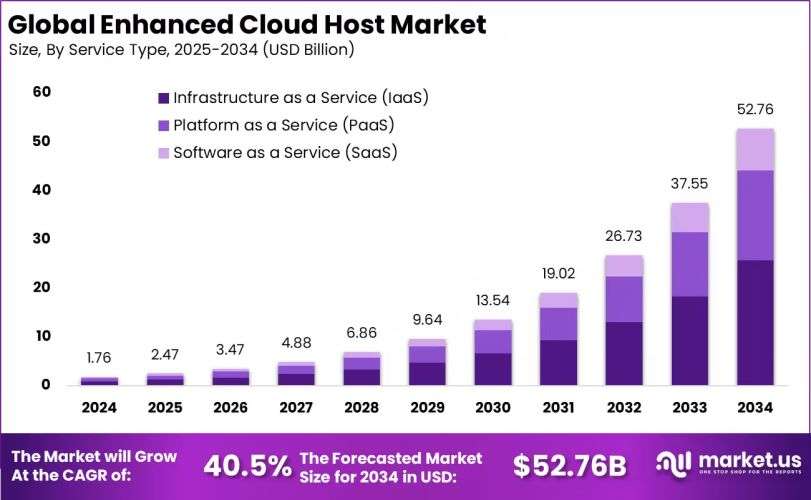
Market poised for explosive growth as enterprises abandon legacy infrastructure for scalable, cost-efficient cloud solutions
As of 2025, more than 86% of organisations are operating multi or hybrid cloud strategies to balance data control, compliance, and scalability.
Demand for enhanced cloud hosting is being driven by businesses grappling with the explosion of data from e-commerce, IoT deployments, and advanced analytics platforms.
Edge computing is seeing significant adoption, bringing data processing closer to end users and dramatically reducing latency for applications like real-time monitoring and customer profiling.
Organisations are increasingly investing in AI-powered cloud platforms, with more than 60% of cloud users now employing automation and machine learning for resource optimisation, predictive maintenance, and cybersecurity improvements.
The most widely adopted technologies alongside enhanced cloud hosting are edge computing, AI/ML platforms, and advanced analytics tools.
Many businesses report that AI-driven workload management helps them reduce cloud operational costs and downtime, with an average improvement of 25% in resource allocation efficiency.
The adoption of security automation and compliance tools has also risen sharply, helping companies face complex regulations and evolving cyber threats with greater confidence.
In a notable industry development, IONOS was announced as a sponsor for the Nextcloud Enterprise Day 2024 in October 2024, scheduled to take place in Frankfurt.
The partnership focuses on enhancing data sovereignty, security, and transparency through open-source software and open standards. IONOS, a leading digitalisation partner for SMBs in Europe, supports Nextcloud hosting within secure, certified data centers.
Market Segmentation Reveals Clear Leaders
Infrastructure as a Service (IaaS) leads the market with 48.8% share, reflecting strong demand for scalable computing and storage resources. Large enterprises dominate adoption at 70.5%, as they drive large-scale cloud transformation initiatives across industries.
Shared hosting holds 42.6% of the market, supported by cost efficiency and accessibility for businesses of all sizes. Subscription-based pricing models account for 65.4%, showing a clear preference for predictable and flexible cloud costs among businesses
The IT & Telecom industry leads sectoral adoption with 39.2%, leveraging cloud hosting for network operations and digital services delivery.
Generative AI Transforms Cloud Operations
Generative AI has emerged as a driving force in enhanced cloud hosting, not just for its ability to automate complex operations but also for transforming how organisations predict and control cloud resources.
By 2025, approximately 85% of business leaders expect to use generative AI for low-value, routine tasks within cloud environments.
Around 77% plan to leverage it for customer service and 74% for operational optimisation, showing just how mainstream AI integration has become in the infrastructure layer. A notable 65% of organizations actively report using generative AI now, nearly doubling in just one year.
This rapid adoption is transforming enhanced cloud hosting from a commodity service to something uniquely adaptive, as predictive AI-driven models greatly reduce downtime, accelerate incident response, and enable cloud platforms to self-optimise without human intervention.
Investment Surge and Tangible Business Benefits
Investment opportunities are especially strong in emerging markets across Asia, Latin America, and Africa, where cloud penetration is still in its early phase but accelerating rapidly.
Mergers and acquisitions are rising as vendors look to integrate advanced capabilities and enter new regions, with technology innovation, sustainability initiatives, and AI-enabled services being the most sought-after areas for investors.
Business benefits are tangible and immediate. Companies report cutting infrastructure costs by up to 60%, reducing carbon emissions by 65% through optimised cloud workloads, and boosting uptime close to 100%.
Enhanced cloud hosting enables seamless remote collaboration and much faster go-to-market cycles for new products, resulting in agile operations and a substantial competitive edge.
Financial Statistics Point to Unprecedented Growth
Financial statistics for enhanced cloud hosting in 2025 show a continuing surge in investment and spending, fueled by broad enterprise adoption and the need for advanced, AI-driven infrastructure.
Spending on cloud services has jumped 21.5% compared to the previous year, with end-user spending now topping USD 723 billion annually.
Public cloud hosting alone is responsible for over USD 980 billion in revenue in 2025, accounting for a dominant share of the global tech economy.
Hybrid cloud remains the preferred model for close to 70% of organizations, mainly because it balances cost efficiency and security.
Enterprises increasingly rely on multiple clouds, with 81% utilising two or more cloud providers, driven by both flexibility and the desire to avoid vendor lock-in.
Cloud spending as a whole has seen consistent, aggressive growth rates, rising 34% year over year to reach almost USD 53 billion per quarter, marking the eleventh time in twelve quarters that growth rates have stayed within the 34% to 40% band.
Monthly costs for a single server average USD 400, while a typical back-office cloud setup is billed at around USD 15,000 monthly, demonstrating how deeply cloud hosting is woven into everyday business operations.
On the infrastructure side, hyperscale providers and enterprises are projected to spend an additional USD 490 billion on AI and cloud infrastructure next year, which is USD 70 billion higher than forecasts from just a few months ago.
The uptick underscores a new trend: many large tech firms are now financing cloud expansions through debt, pointing to both confidence and risk in the financial landscape of cloud hosting.
In the financial services sector, 55% of banks have migrated at least 30% of their critical workloads to the cloud, and around 81% of insurance companies report improved operational efficiency after embracing cloud adoption.
Over 54% of financial institutions use AI for efficiency, 51% for better decisions, and 40% report cost savings from cloud-native automation, driving continued investment in fintech cloud solutions.
U.S. Market Powers North American Dominance
The market for enhanced cloud hosting within the U.S. is growing tremendously and is currently valued at USD 0.52 billion, with a projected CAGR of 37.2%.
The market is expanding rapidly due to the country’s strong focus on technological innovation, digital transformation, and the increasing adoption of cloud-based solutions across industries.
The rise of AI, machine learning, and data analytics is driving demand for more advanced cloud services, while businesses seek cost-effective, scalable, and secure infrastructure.
Additionally, remote work trends and the need for enhanced cybersecurity solutions are fueling further growth, making cloud hosting essential for U.S. companies.
In a significant development, Oracle and Google announced a groundbreaking multicloud collaboration in June 2024 to enhance cloud interoperability.
Te partnership allows customers to seamlessly integrate Google Cloud services with Oracle Cloud Infrastructure (OCI), facilitating smoother application deployments across both platforms.


Key Players in the Enhanced Cloud Host Market
The Enhanced Cloud Host market is dominated by industry giants Amazon Web Services, Google, and Ionos SE. The providers set the pace with enterprise-ready cloud infrastructure designed for performance, scalability, and security.
The platforms support hybrid deployments, managed Kubernetes, and global data distribution, making them the backbone for large-scale operations.
Mid-tier players—among them Bluehost, DigitalOcean, DreamHost, and Hostinger—target startups, small to mid-sized enterprises, and SaaS platforms.
Their appeal lies in cost-effective hosting, streamlined deployment, predictable pricing, and developer-friendly environments, particularly for e-commerce and web-based applications.
Meanwhile, specialised and emerging providers such as Cloudways, xCloud Hosting, and Piwik PRO are carving out niches with tailored offerings.
From managed hosting and advanced control panels to privacy-focused analytics and performance optimisation, these companies are pushing innovation in a competitive market.