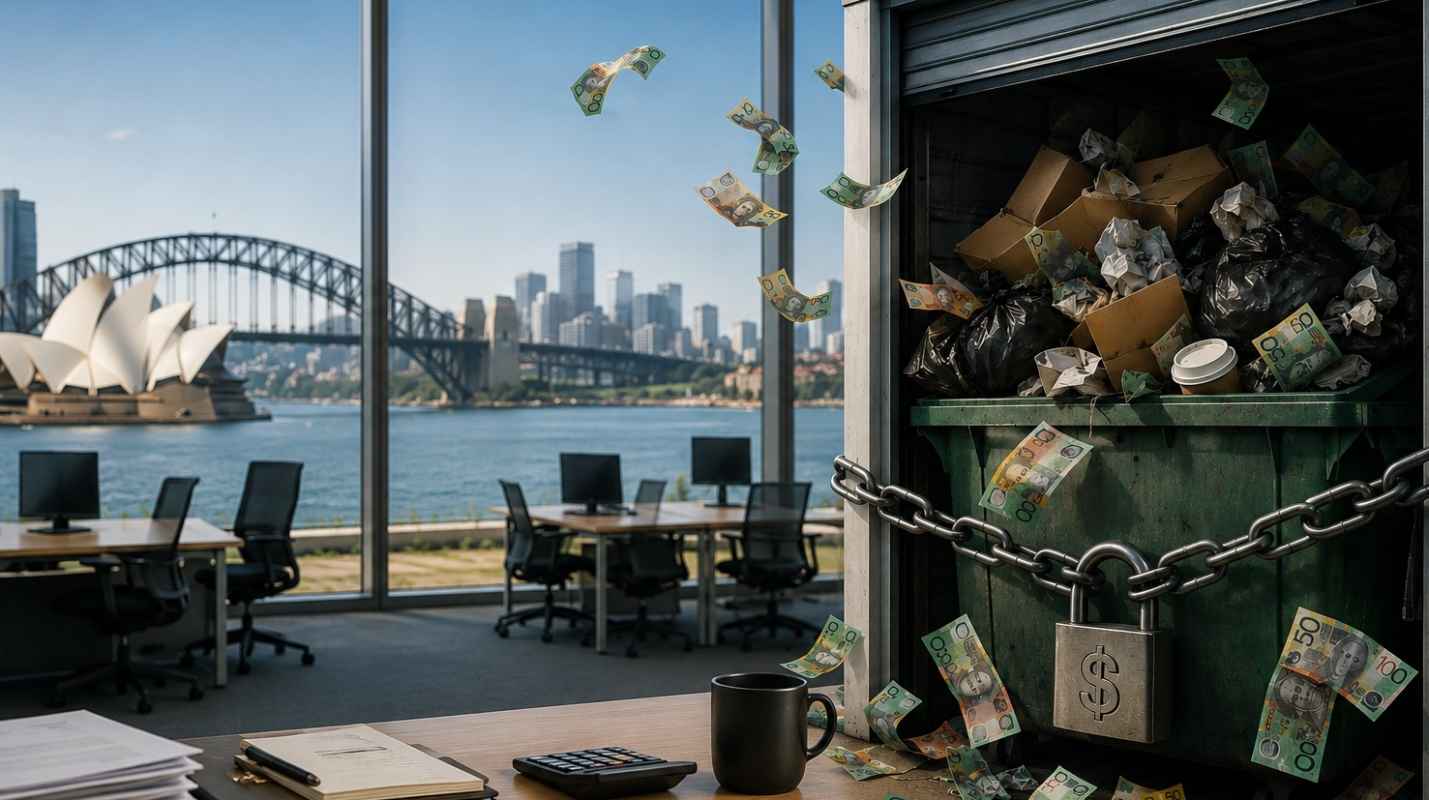


Walk through the back corridors of almost any mid-sized Australian office and the story tells itself. Broken chairs stacked against fire exits.
Boxes of outdated promotional material no one has touched in three years. A printer graveyard tucked behind the server room. And somewhere, an accounts payable team writing cheques every month for the floor space that holds all of it.
It is not a new problem. But in 2026, with commercial rents climbing, landfill levies rising and a wave of new national waste data landing on desks across the country, the financial cost of ignoring it is becoming impossible to dismiss.
Australians generate around 75.6 million tonnes (Mt) of waste annually — roughly 2.88 tonnes per person — a figure that has grown 8 per cent over the past six years.
The commercial and industrial sector accounts for more than 3.3 million tonnes of that total. Offices are a consistent thread running through those numbers: paper, redundant furniture, obsolete electronics and packaging accumulating in storerooms and loading bays, often for years, with no disposal plan in sight.
The timing could hardly be worse. As of March 2026, the median cost of a desk in Sydney’s CBD has reached $1,024 per month.
Nationally, the median price to rent a private office sits at $715 per desk per month. Prime CBD rents are forecast to climb a further 2 to 6 per cent before the year is out.
Every square metre given over to storage rather than staff is, in the plainest terms, money leaving the business with nothing coming back.
Hybrid work has deepened the trap. Research published earlier this year found that 83 per cent of Australian employees now regard flexible arrangements as the permanent standard — not a temporary accommodation, but an expectation.
That shift has quietly left thousands of offices across the country maintaining the full physical footprint of a pre-pandemic workforce that simply no longer shows up five days a week. The desks stayed. The filing cabinets stayed. The equipment stayed. The lease payments stayed too.
What Disposal Now Costs — and What Staying Put Costs More
For businesses that have let the problem sit, the reckoning is arriving from multiple directions at once.
In New South Wales, the metropolitan landfill levy now exceeds $160 per tonne, with Victoria not far behind. Every month a business delays a clean-out, it is not merely deferring an inconvenience — it is allowing a disposal liability to grow.
Paper alone tells a stark story: the average Australian office worker gets through around 50 kilograms, or 10,000 sheets, of paper each year.
For a 20-person office, that is a tonne of paper annually, much of it poorly managed and rarely recycled at the rates businesses assume.
Electronic waste is the other accumulating problem that tends to get ignored until it cannot be. Australia generated 588,000 tonnes of e-waste in 2023, and that figure is on a trajectory to reach 657,000 tonnes by 2030 as device replacement cycles shorten.
Old monitors, laptops, cables and printers cannot legally be thrown into general waste streams — compliance adds both cost and complexity to any clean-out, and the longer it is deferred, the larger the task becomes.
The broader environment has shifted as well. Businesses navigating lease renewals are increasingly finding that sustainability credentials — including how they manage waste — are being weighed by landlords and incoming tenants alongside occupancy costs and fitout standards.
Waste, in other words, is no longer just an operations issue. It has moved into the room where property decisions get made.
A cleaner, well-managed workplace has also been shown to positively affect staff productivity and organisational culture, adding yet another dimension to a conversation that many businesses have been putting off for too long.
According to 1300Rubbish, businesses need reliable and sustainable solutions to effectively manage and remove office waste.
“As organisations continue to prioritise environmental responsibility, implementing efficient rubbish removal practices plays a critical role in maintaining cleaner workplaces and reducing environmental impact”
Professional office rubbish removal services are seeing a steady increase in demand from businesses ahead of relocations, lease renegotiations and office consolidations — a signal that the calculation is changing.
CEO of 1300 Rubbish is Geordie Gill said,” as Aussies, we like to think of ourselves as an environmentally switched-on country,”
“From reusable coffee cups and green bins to kerbside bulky waste pickups, we make an honest effort to be sustainable,” said Gill
“Australia still sends tens of millions of tonnes of waste to landfill every single year. There is no such thing as “away” when we throw something away. It all ends up somewhere,” he said.
Clearing out a storeroom of broken furniture or organising a compliant e-waste disposal run is no longer seen as an ad hoc project for a quiet Friday afternoon. Increasingly, it is being treated as the financial and operational decision it always was.