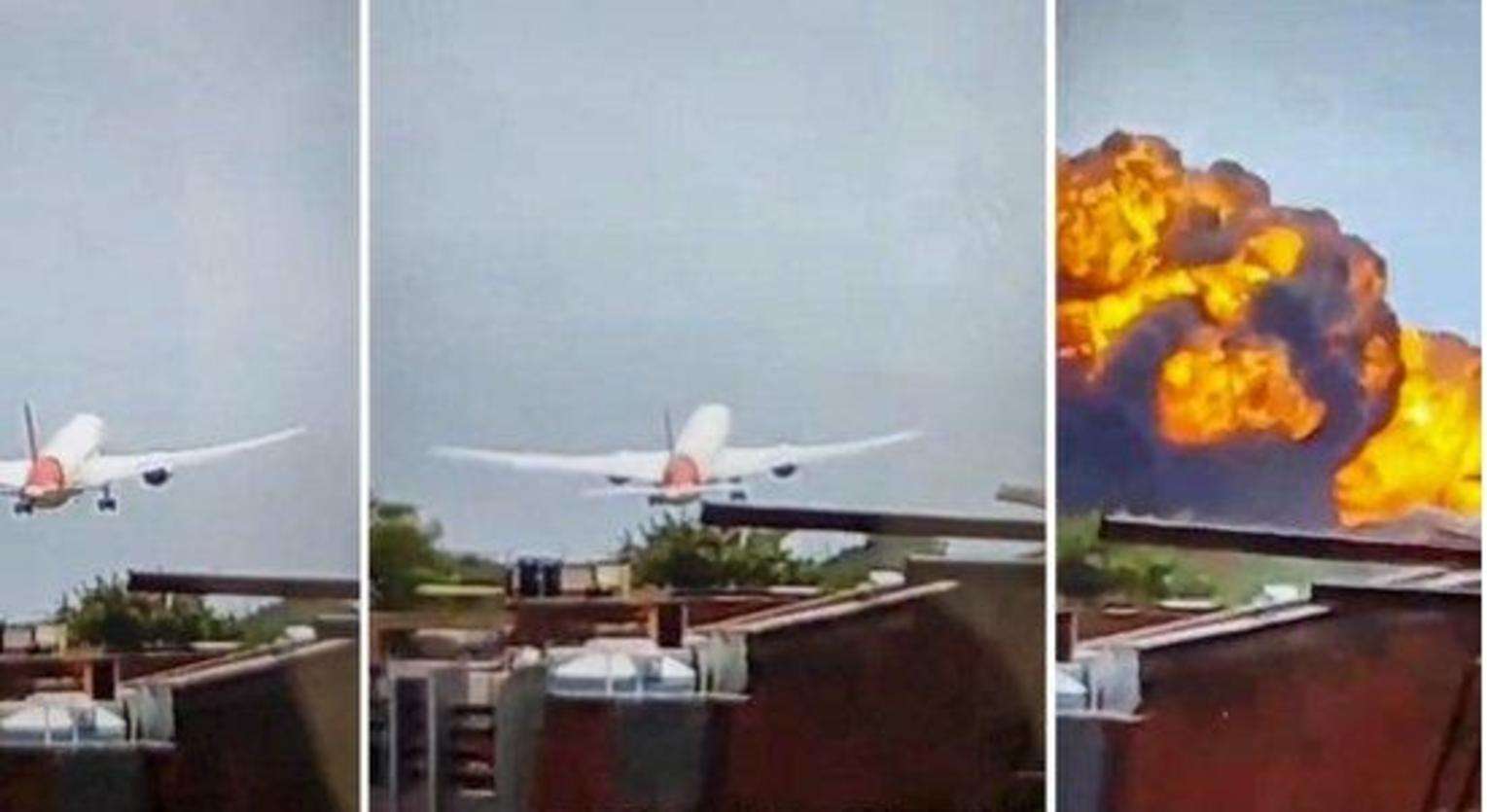


Air India flight AI171, a Boeing 787-8 Dreamliner, crashed in Meghaninagar, Ahmedabad, Gujarat, after takeoff at Ahmedabad International Airport (AMD), India
The aircraft, an early build Dreamliner with manufacturer serial number (MSN) 36279 and line number 26, departed Ahmedabad’s runway 23 at approximately 1:39 PM local time.
After more than two hours on the tarmac parked at Terminal 2 of the sprawling Sardar Vallabhbhai Patel international airport, captain Sumeet Sabharwal, an experienced pilot, taxied on to the single runway and prepared for takeoff.
The Dreamliner, weighing more than 200 tonnes and carrying more than 100,000 litres of fuel, had crashed into accommodation for doctors at the hospital, including a hostel located 1,4 km southwest of the runway
Air India 787 Crash Analysis
Aircraft Data – Boeing 787 – MSN 36279 VT-ANB ; Type, 787-8 ; First flight date, 14/12/2013
The aircraft reached a maximum altitude of 630 feet at and travelling at 175 knots “ground speed” (324 kilometers per hour (km/h) – when it began descending.
It was also observed with a pitch up angle of approximately 41 degrees and wings level when it struck a nearby building before busting into flames.

Analysis of the final moments of Air India Flight AI171 suggests the Boeing 787-8 Dreamliner may have entered a deep aerodynamic stall shortly before crashing.
“It appears there are no survivors in the plane crash,” Commissioner G.S. Malik told the Associated Press. “Exact figures on casualties are being ascertained.”
According to air traffic control at Ahmedabad Airport, the aircraft departed at 1.39pm local time (6.09pm AEST) from runway 23.
It gave a “Mayday” call, signaling an emergency, but thereafter there was no response from the aircraft. Flightradar24 received the last signal seconds after it took off.
Twelve crew members were among the 241 people aboard including 169 Indian nationals, 53 British nationals, seven Portuguese nationals and one Canadian national
Live video footage also captured the twin General Electric GEnx-1B67 engines audibly rolling back to idle shortly before the aircraft began its fatal descent.
The aircraft had accumulated 38,268 flight hours across 7,223 cycles as of September 2024, placing it among the oldest operational Dreamliners in Air India’s fleet.
Though a dual engine failure is considered exceedingly rare, aviation experts are already exploring possible causes such as a bird strike, fuel contamination, or a systems anomaly.
If the aircraft encountered a bird strike during its takeoff roll and had already passed its V1 speed—the critical decision speed after which a takeoff must be continued, the crew would have been committed to becoming airborne despite engine power not being available.
Others are also cautiously raising the possibility of crew error or mismanagement in response to a critical situation although this is only early speculation.
Early analysis of the crash also indicates that the Ram Air Turbine (RAT) was deployed suggesting that the aircraft had lost engine or electrical power. The RAT is designed to automatically deploy in such situations.

The RAT (A small prop) deployed under the aircraft to supply emergency electrical power in the event of power loss from the engines could also be heard spinning in the video.
A single survivor was soon identified – the British man who had been in seat 11A and had somehow escaped the crash almost unharmed except for cuts and bruises.
Ramesh was able to walk away from the crash in a ripped T-shirt with his phone in his hand and boarding card in a pocket. Guided to an ambulance, he was taken to hospital.
“Thirty seconds after takeoff, there was a loud noise and then the plane crashed,” Ramesh told local reporters from his hospital bed.
“It all happened so quickly … When I got up, there were bodies all around me. I was scared. I stood up and ran. There were pieces of the plane all around me.” he said.
The airline has arranged two special relief flights to Ahmedabad—one from Delhi and another from Mumbai—to transport the families of the passengers and crew as investigators begin searching for the cause of the crash, which marks the first incident involving a Dreamliner.
Boeing stated that it is “working to gather more information” about the accident, while both the UK and the US have announced they will send air accident investigation teams to assist their Indian counterparts.
The crash is now under investigation by India’s Aircraft Accident Investigation Bureau (AAIB), with support from Boeing and GE Aviation.