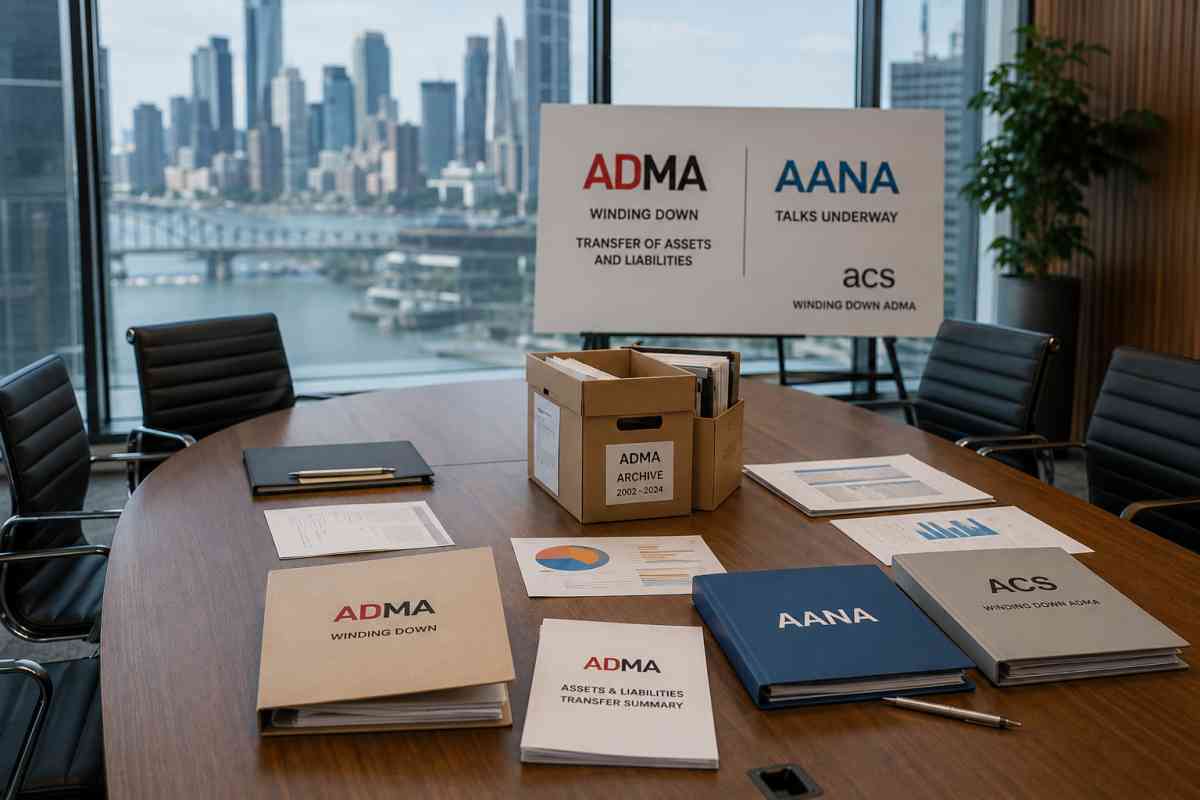
Australia’s marketing and advertising sector is facing a major industry-body shake-up, with the Australian Computer Society preparing to wind down ADMA as it enters talks with the Australian Association of National Advertisers over a proposed consolidation.
Seven years after acquiring the Australian Data-driven Marketing and Advertising Association, the ACS is now in active discussions with the AANA over a proposed sale of ADMA’s assets
The plan being explored would see the groups come together under a new banner, the Marketing Association of Australia.
For an industry dealing with privacy reform, data regulation, greenwashing scrutiny, digital advertising accountability and rapid changes in customer engagement, the move raises a larger question:
Can two long-running associations be merged without weakening the services, advocacy and professional development that members rely on?
ACS Moves To Wind Down ADMA
The proposed change was confirmed in an internal email sent to staff on 9 June
In the note, recently appointed ACS chief executive Dr Prins Ralston said the organisation planned to “wind down” ADMA, along with several of its technology labs, including River City Labs, Ocean City Labs and Something Tech.
Harbour City Labs is expected to continue operating and remain active in the startup community.
“ACS is in discussions regarding a proposed sale of ADMA to the AANA to form the Marketing Association of Australia.” Dr Ralston said.
“We are hopeful this will come to fruition and will continue to support these discussions,” Dr Ralson stated in the email to staff.”
“If this proceeds, the intention is for ADMA members to transition to the Marketing Association of Australia, where they would continue to receive support focused on the marketing community, its evolving needs and future growth.” he said.
Dr Ralston also told staff further updates would be provided “over the next week or two as more information comes to light”, suggesting negotiations are already well advanced.
The email also confirmed that staff directly affected by the decision had been notified. Mi3 reported ADMA has 11 staff, many full-time and others on contract.
“This is a significant decision and one we have not taken lightly. We recognise that this change has a real impact on people,” Dr Ralston stated in the staff email.
“Staff directly affected by this change have been notified, and we will continue to consult with them … space to receive and respond to this news in their own way.” he said.
A Major Shift For Australia’s Marketing Sector
The development marks a dramatic turn for ADMA, a peak body with roots stretching back to 1966, when it was established as the Australian Direct Marketing Association.
It later rebadged as the Association for Data-Driven Marketing and Advertising under former chief executive Jodie Sangster, reflecting the industry’s shift towards data, digital engagement and targeted marketing.
Dr Ralson also noted the “important role” ADMA has played in ACS’s history, and claimed ACS had “invested significantly in ADMA and its community, supporting more than 600 corporate members
“We recognise the work, passion and commitment behind that legacy and the impact ADMA has had on the Australian marketing industry,” he said.
The decision was framed internally as part of a sharper focus on ACS’s core mission: “Strengthening the ACS professional membership, delivering greater member value and building a more sustainable future.”
The sale terms, the exact assets involved and the purchase conditions have not been disclosed.
However, Australian Business Register filings show the AANA registered the name “Marketing Association of Australia” in late March, indicating discussions may have been under way for several months.
AANA Confirms Discussions Are Underway
AANA chief executive Josh Faulks confirmed to Mi3 that discussions are taking place to “explore uniting our capabilities to better support the future of marketing in Australia”.
Faulks also said a final decision had not yet been made on the name of any merged body. He has led the AANA since 2022.
If the proposal proceeds, ADMA would bring around 600 member organisations, along with a growing individual membership base introduced from February 2026. The AANA currently lists 104 company members on its website.
That would create a larger, consolidated body representing a broad cross-section of Australian marketers, advertisers, data-driven marketing specialists and brand leaders.
It could also give the sector a clearer voice at a time when the rules around privacy, consumer data, digital advertising and brand accountability are being rewritten.
The unresolved issue is whether consolidation strengthens the industry or strips away specialised knowledge built over decades.
ADMA Leadership Future Unclear
The future of ADMA chief executive Andrea Martens remains uncertain. Martens has led the organisation for more than seven-and-a-half years, after building a career in FMCG brand and marketing leadership with companies including Jurlique and Unilever.
She has also been building a board career alongside her ADMA role and currently holds non-executive positions with KMD Brands, Kennards Hire and HyGain Holdco.
Mi3 reported that former ADMA chair and current vice-chair Steve Brennen has been an active party in negotiations with AANA on ADMA’s behalf.
Current ADMA chair David Morgan, appointed last November, is understood not to have been involved in the talks.
In a statement sent to Mi3, Brennen said “ADMA is undergoing a period of operational change”.
“It is in discussions with AANA about how its valued capabilities and resources can best contribute to support the marketing industry,”
“Members will be contacted directly about what this means for their services, and we expect to share a further update as soon as more information is available.” he said.
New ACS Boss Moves Quickly
The move comes only months after Dr Ralston took over as ACS chief executive in March. He is the organisation’s fourth CEO in six years and was appointed after the departure of Josh Griggs.
Within two weeks of taking the role, Ralston had cut several executive positions as part of “realignment decisions, driven by the need for a leaner and more appropriately focused organisation”.
In a late-March memo to staff, Ralston warned “this is the beginning of the transition, not the end of it” and told staff they needed “to be prepared for change”.
He described his priority as “staying focused on our members, building a more efficient organisation, and being deliberate about where we invest our energy”.
The memo also made clear ACS wanted to grow in areas such as AI and cyber, “that matter most to the ICT profession”.
The executive cuts were the second round of redundancies at ACS in about 18 months, forming part of a broader and uneven attempt to refocus the technology association.
How ADMA Ended Up Inside ACS
ADMA has been owned by ACS since September 2019, a deal that caused confusion across parts of the marketing, advertising and technology sectors from the beginning.
The transaction had a purchase consideration price of $2.6 million and came with more than $1 million in losses, worsened by a pre-acquisition loss of $2 million in FY19, according to ACS’s FY20 financial report.
The deal originally covered the associations under ADMA’s parent company, the Australian Alliance for Data Leadership.
That umbrella group had been created 18 months earlier and included ADMA, the Institute of Analytics Professionals Australia, the Digital and Technology Collective, and Data Governance Australia.
Together, the AADL associations brought 600 brand members and 25,000 individual member participants. ACS, meanwhile, had 42,000 professional members across the ICT sector.
At the time, the two sides argued that marketing, data, analytics, governance and technology were becoming more closely connected.
They also pointed to the growing need for chief marketing officers and chief information officers to work more closely as customer engagement became increasingly digital and data-driven.
Not everyone was convinced. Marketing and advertising professionals questioned the practical alignment between the two groups, while some ICT professionals were reportedly frustrated by ACS’s move into a sector far outside its traditional base.
ACS Revenue Pressures Add To The Context
ACS’s own financial structure also helps explain why the organisation is sharpening its focus.
In FY25, only $3.37 million of ACS’s more than $56 million in total income came from membership. Most revenue came from Federal Government contracts tied to the Migration Skills Assessment and Professional Year programs.
ACS reported a $4.14 million surplus in FY25, after recording a $6.68 million loss in FY24. It also reported 174 full-time staff.
Ralston’s March memo pointed to possible pressure ahead.
“There will be further decisions ahead as we shape ACS for the future, as external factors such as the 26/27 Federal budget is announced. I will continue to communicate openly as those decisions are made,”
That comment suggests the organisation is preparing for potential changes in government-linked revenue streams while trying to rebuild around its core ICT membership base.
ADMA’s Long History In Data, Privacy And Marketing Standards
ADMA’s significance is not limited to membership numbers. Its history is deeply tied to the development of direct marketing, data-led advertising, privacy standards and marketing education in Australia.
Former ADMA chief executive Rob Edwards, who led the organisation from 1993 for 18 years, played a key role in the development of privacy legislation in 2003 and helped establish benchmarks for the responsible use of data in marketing and advertising.
Under Jodie Sangster, who became CEO in April 2011, ADMA expanded rapidly. It struck an alliance with IAPA in 2014, took over that organisation the following year, acquired AIMIA from administrators in 2016 and relaunched it as the Digital + Technology Collective.
It also launched Data Governance Australia in October 2016 to focus on conduct around the collection, use and management of data.
ADMA also built a major education and capability function, including courses, certifications and the Capability Compass, a skills assessment tool covering 13 core marketing capabilities and 57 underlying skills across strategy, execution and analysis.
AANA Brings Its Own Regulatory Weight
AANA has an even longer history, claiming 1928 as its founding year.
By 1939, it had established the Code of Standards for Medicines. In 1964, it adopted the Australian Code of Advertising Standards.
In 1996, it took over Media Council Australia and assumed its role in the advertising industry’s self-regulatory code and complaints structure. The AANA Code of Ethics followed in 1998.
That history gives the AANA deep roots in advertising standards and industry self-regulation.
Combined with ADMA’s capabilities in data, marketing education and privacy-related industry work, the proposed Marketing Association of Australia could become a more powerful body — if the integration is handled carefully.
The Bigger Question For Marketers
The possible sale is more than an association restructure. It lands at a moment when the marketing industry is under pressure from multiple directions.
Privacy reform is changing how businesses collect and use customer data. Artificial intelligence is reshaping content, media buying, customer segmentation and campaign execution.
Brands face growing scrutiny over greenwashing, gambling advertising, data targeting and digital platform accountability.
Against that backdrop, industry representation matters. Members will want to know whether the proposed merged body can preserve ADMA’s education, data and privacy expertise while drawing on AANA’s regulatory influence and advertiser base.
For some, the move will look like long-overdue consolidation in a crowded and fragmented industry-body landscape.
For others, it will raise concern that a 60-year-old marketing institution is being folded into a new structure after years of strategic uncertainty under ACS ownership.
The next few weeks are likely to determine whether ADMA’s next chapter is a renewal, a rescue or the end of a long-running industry brand.