

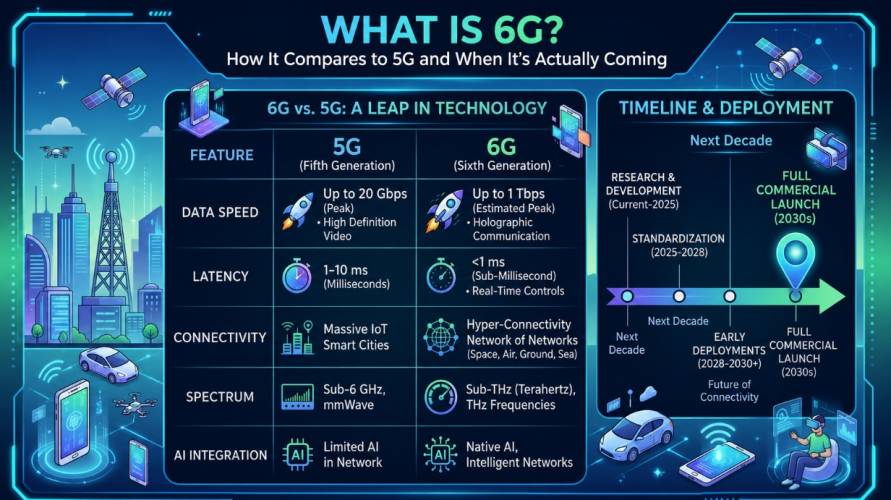
6G, the sixth generation of wireless communication technology, will deliver peak data speeds of up to 1 terabit per second (Tbps) and latency below 1 millisecond — making it roughly 100 times faster than 5G and fast enough to download an entire high-definition film in less than a second.
Commercial deployments are expected to begin around 2030, and the technology will not just be a speed upgrade. It will fundamentally reshape how people, machines, and entire industries communicate with each other.
The evolution of mobile networks has progressed from 2G in the early 1990s to today’s 5G, which delivers peak speeds of up to around 1 Gbps (1,000 Mbps), compared to 4G speeds of roughly 20–100 Mbps.
Looking ahead, 6G is expected to reach speeds of up to 1 Tbps (1,000 Gbps).
India holds a notable number of global patents in 6G technology, and the government aims to position the country as a global leader in defining 6G standards and development.
Top Countries Leading the Race to 6G
| Rank | Country | 6G Patents | Fastest 5G Speed (Mbps) | 6G Readiness Score |
|---|---|---|---|---|
| 1 | South Korea | 760 | 814 | 8.75 |
| 2 | India | 265 | 465 | 7.50 |
| 3 | United States | 2,229 | 363 | 6.88 |
| 4 | China | 4,604 | 142 | 5.00 |
| 5 | United Kingdom | 115 | 392 | 5.00 |
| 6 | Japan | 155 | 298 | 3.75 |
| 7 | Finland | 12 | 452 | 3.75 |
| 8 | Germany | 77 | 55 | 3.13 |
| 9 | Australia | 330 | 296 | 1.20 |
What 6G Actually Is
6G is the planned successor to 5G, currently being developed under the International Telecommunication Union’s IMT-2030 framework.
The ITU-R is coordinating the global standardisation work, with organisations including Ericsson, Nokia, Samsung, Huawei, Apple, and NTT Docomo all running active research programmes.
Governments in the US, China, South Korea, Japan, and across Europe are funding national 6G initiatives in parallel.
Ericsson expects the first implementable technical specification from 3GPP — the body that writes the actual standards — to be finalised in 2028, with the first commercial 6G networks launching in the early 2030s.
- 6G won’t just be faster 5G.
The ambition is to create a network that can serve as the foundation for entirely new classes of applications that 5G cannot reliably support, including real-time holographic communication, autonomous vehicle coordination across entire cities, remote surgical robotics, and sensing applications.
How 6G Works
Expected around 2030, 6G works by using terahertz wireless signals and an AI-native network to deliver 100+ Gbps speeds and microsecond latency—about 100× faster and 1,000× lower delay than 5G.
Smart antennas handle massive data loads, AI routes traffic in real time, and edge computing processes data close to devices to minimise delay. It also works as a distributed sensing system, using network signals to map and interpret the physical world in real time.
The Numbers That Define the Change
Understanding what 6G will do requires grounding it in specific targets rather than general claims.
Speed up to 1 Tbps. The ITU IMT-2030 framework sets a peak data rate target of 1 terabit per second for 6G networks. To put that in practical terms, 5G peaks at around 10 gigabits per second under ideal conditions. 6G would be 100 times faster.
Latency below 1 millisecond. Latency is the delay between sending a signal and receiving a response. 5G brought latency down to around 10 milliseconds. 6G is targeting sub-1 millisecond latency, which is close to the theoretical limits of what current physics permits and is faster than the human nervous system can process a touch sensation.
10 million connected devices per square kilometre. 6G is designed to support a device density far beyond what 5G can handle, which matters because the number of connected sensors, machines, wearables, and embedded devices is growing faster than any individual user count.
A network that was always going to be necessary. The ITU-R has projected that global mobile data traffic will grow from 62 exabytes per month in 2020 to more than 5,036 exabytes per month by 2030. 5G cannot handle that volume at the speeds modern applications will require.
How 6G Will Change Specific Areas of Communication
Healthcare
Remote surgery is currently limited by latency. A surgeon operating a robotic system from another continent needs to know that the command they send will be executed with no perceptible delay.
At 5G latency, there is enough lag to make the precision required for surgery unreliable. At sub-1 millisecond 6G latency, that problem largely disappears.
Beyond surgery, 6G will enable real-time remote diagnostics through connected wearables and implants, continuous monitoring that transmits data to clinical systems without the battery drain that limits current wireless medical devices, and holographic consultations.
Business and Enterprise Communication
The most immediate business impact of 6G will be in the quality and reliability of communication itself. Video calls that currently compress and degrade will be replaced by holographic presence systems — the ability to project a photorealistic representation of a person into a meeting room they are not physically in.
The bandwidth and latency required for convincing holographic communication does not exist at 5G scale but It does at 6G scale.
For manufacturing and logistics, 6G will allow factories to coordinate autonomous systems across an entire facility in real time, with machines making decisions based on continuous data streams from thousands of sensors rather than periodic updates.
Smart cities will use the same infrastructure to manage traffic, energy grids, emergency response, and public safety systems through a single network.
Consumer Communication
For everyday users, 6G will feel initially like an extension of what 5G promised but often under-delivers: truly reliable, high-speed connectivity everywhere, including in dense urban areas, buildings, and eventually rural regions.
The longer-term consumer shift is toward spatial computing — experiences that blend the physical and digital worlds through augmented and mixed reality.
The headsets that exist today are limited in what they can render because they cannot receive and process visual data fast enough to feel seamless. 6G eliminates that bottleneck. Persistent, detailed AR overlays that respond to the physical environment in real time become possible.
Communication applications built for 6G will be less about text and video and more about shared digital environments — spaces where people interact through presence, not just image.
Emergency Services and National Infrastructure
6G will allow emergency response systems to communicate across temporary networks that can be rapidly deployed in disaster zones, maintain precise location tracking for all responding units, and share live video, sensor data, and situational information across agencies without the network degradation.
The Race to Build It
Governments have treated 6G as a matter of national priority in a way that 5G never quite was.
South Korea’s government has allocated $325 million specifically for 6G development, with a pilot project targeting five focus areas: immersive content, digital healthcare, autonomous vehicles, smart factories, and smart cities.
The US Next G Alliance — which includes AT&T, Verizon, T-Mobile, Microsoft, Ericsson, and Samsung — is coordinating North American research to ensure that the US leads rather than follows in 6G deployment.
The competitive dimension matters because whoever builds the dominant 6G infrastructure shapes the protocols, standards, and hardware that the rest of the world adopts.
The same dynamic played out with 5G and resulted in significant geopolitical friction over Huawei’s role in network equipment. 6G is likely to be more contested, not less.
What 6G Technology Will Not Do (Right Away)
6G is not arriving in 2026 or 2027. The first specifications will not even be written until 2028. Commercial rollout in early-adopter markets like South Korea, Japan, and the US is expected to begin around 2030, but full consumer penetration will take years beyond that — global 5G is still below 50% penetration as of 2026.
The applications that 6G enables — persistent holography, remote surgery, city-scale autonomous coordination — will not appear the moment the network goes live. They will be built incrementally as developers and industries learn what the infrastructure can actually do.
What 6G will reliably deliver, from the moment it launches, is a network that does not struggle under load, does not fail in dense environments, and does not require engineering workarounds to achieve performance that the specification promises.
2024–2026
Concept exploration, early research, and prototype development of 6G technologies.
2027
Initial large-scale testbeds and early real-world experimentation begin.
2028
Global trials expand, focusing on interoperability and system refinement.
2029
Standards development accelerates and technical frameworks converge.
2030+
Commercial rollout and early adoption of 6G networks worldwide.
Geopolitics
The global development of 6G is increasingly shaped by geopolitical rivalry and national strategic priorities, with countries diverging in their approaches to infrastructure, suppliers, and standards.
The fragmentation that emerged during the 5G era—driven by concerns over security, supply-chain dependence, and restricted vendor participation—continues to influence early 6G planning.
As a result, there is growing concern among analysts that competing blocs could lead to a divided set of 6G standards, intensifying competition within international telecommunications governance bodies.
At the same time, governments across both Western and Asian economies are positioning 6G as a critical national technology, embedding it within long-term policy frameworks and industrial strategies.
Efforts such as multilateral statements promoting open and secure connectivity, alongside the rise of approaches like Open RAN, reflect attempts to preserve interoperability and reduce vendor lock-in amid geopolitical tension.
Use Cases of 6G Networks
| Use Case | Description |
|---|---|
| Autonomous Systems | Supports self-driving cars and drones, improving safety, coordination, and operational efficiency. |
| Telemedicine | Enables remote surgeries, real-time patient monitoring, and improved healthcare delivery. |
| Virtual & Augmented Reality (VR/AR) | Delivers highly immersive and responsive VR/AR experiences with ultra-low latency. |
| IoT Connectivity | Enhances connectivity for smart homes, smart cities, and urban infrastructure systems. |
| Connected Sustainable World | Helps reduce global carbon emissions and supports the development of a more sustainable future. |
Frequently Asked Questions
What is 6G in simple terms?
How fast will 6G be?
When will 6G be available?
What is the difference between 5G and 6G?
What will 6G be used for?
Which countries are leading 6G development?
Will 6G replace 5G?
How will 6G affect home internet users?
What will 6G mean for businesses?
How will 6G improve mobile gaming and cloud gaming?
Will 6G help people who travel frequently?
Does 6G mean remote areas won’t need satellite internet anymore?
Will 6G improve internet reliability and outages?
Will 6G increase data privacy and security?
Will 6G be expensive for consumers?
6G Wireless Technology Summary Brief
6G is the next generation of mobile communication after 5G, expected to roll out around the 2030s. It will significantly change how devices, people, and systems connect by making communication faster, more intelligent, and more immersive.
In brief, here’s what it will bring:
- Extremely high speeds: Likely up to 100× faster than 5G, enabling near-instant downloads and real-time ultra-HD experiences.
- Near-zero latency: Communication delays will be almost unnoticeable, which is critical for things like remote surgery or autonomous systems.
- AI-native networks: Networks will use built-in artificial intelligence to manage traffic, predict demand, and self-optimize in real time.
- Holographic and immersive communication: Real-time 3D holograms and advanced extended reality (XR) could become practical for meetings and entertainment.
- Massive device connectivity: Everything from smart cities to sensors and vehicles will stay continuously connected at huge scale.
- Integrated space-air-ground networks: 6G may combine satellites, drones, and ground networks into one seamless system.
Overall, 6G is expected to shift communication from “connected devices” to a fully intelligent, always-aware digital environment.