The internet declared another death last week.
According to LinkedIn’s growing army of AI-assisted strategists and self-appointed futurists, the “10 blue links” are finished. Buried. Gone. Everyone grabbed a black suit and started writing obituaries.
But amid the panic, most people missed the part that actually mattered in Sundar Pichai’s comments: user satisfaction.
That’s the metric now. Not traffic. Not rankings. Not your painstakingly sculpted internal linking structure.
Just whether Steve got what he wanted.
The Only KPI That Matters Now
User satisfaction is simple: did the product solve the problem?
Google has made it increasingly clear that it doesn’t care whether your content is “ultimate,” “comprehensive,” or SEO-perfect. It cares whether Steve leaves Search happy.
If Steve gets his answer quickly, Google wins.
If he doesn’t, something in the system failed.
That shift has been happening for a while. AI Overviews merely made it impossible to ignore.
Back on May 14, 2024, when Google rolled out AI Overviews to a wider audience, it quietly signaled that the old rules no longer held the same weight. Bounce rate? Domain authority? Elaborate schema setups?
They suddenly mattered less than reducing friction between question and resolution.
Once that became obvious, the industry spiralled. Publishers, agencies, and SEO consultants launched into an acronym arms race: AEO, GEO, LLMO, STO.
Entire strategies were rebuilt around the hope of earning one of five citations inside an AI-generated answer.
Fear became a strategy so quickly that people stopped distinguishing between the two.
All in service of Steve.
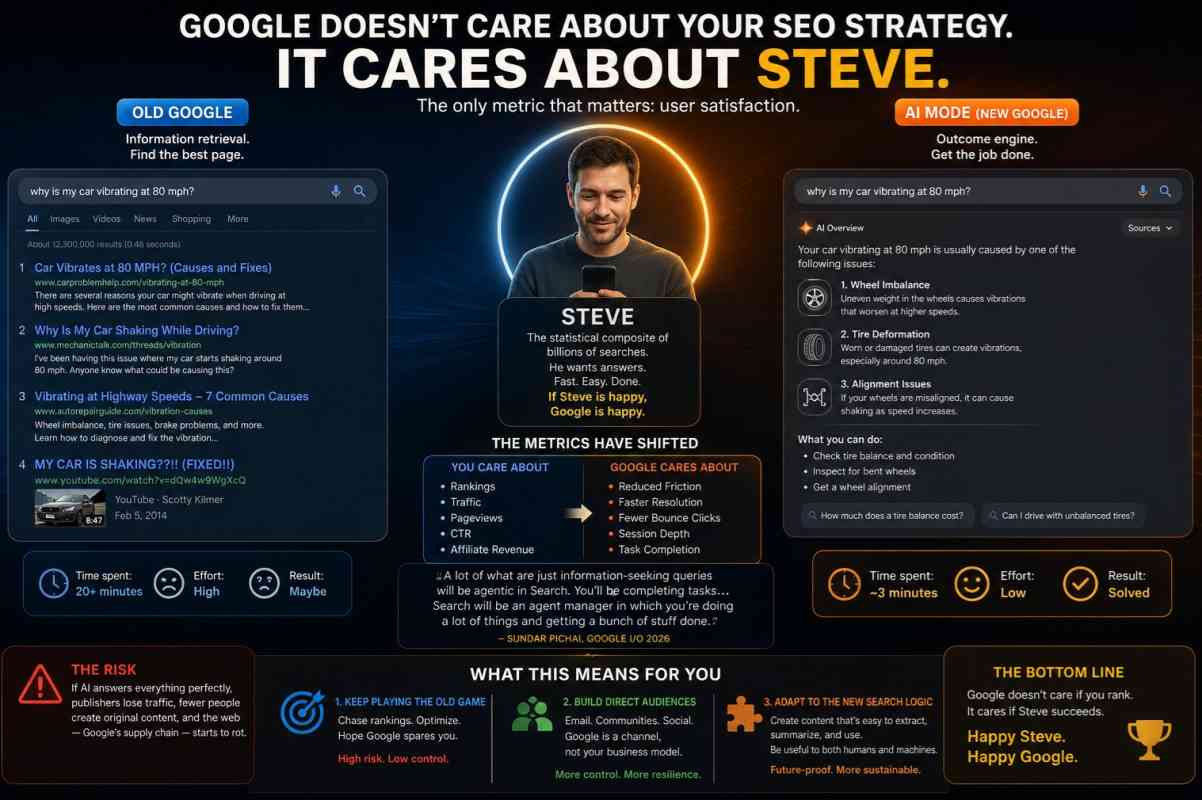
So Who Is Steve?
Steve isn’t real.
He’s the statistical average of billions of searches. The person typing:
“Why is my car vibrating at 80 mph?”
Google watches what happens next.
Did Steve find the answer quickly? Did he stop searching? Did he complete the task?
That’s the game.
Nilay Patel raised this exact tension with Pichai during a conversation about publishers preparing for a zero-click future. Pichai’s response was revealing:
“If they are building content that is high-quality and people like it, I expect us to reflect that in our products.”
Notice what’s absent there.
- No promises about traffic.
- No concern for publishers.
- No reassurance for affiliate businesses.
Only users.
If people are satisfied, Google considers the system healthy.
Search Is Becoming an Outcome Engine
For most of its history, Google was an information retrieval system.
Its job was to find the best webpage for a query.
Success meant relevance, authority, and clicks.
Now the company is moving toward something else entirely: outcome completion.
At I/O 2026, Pichai framed Search less as a discovery engine and more as an execution layer:
“A lot of what are just information-seeking queries will be agentic in Search. You’ll be completing tasks.”
That line explains nearly everything happening in modern search.
Take Steve’s vibrating car problem.
Old Google
- Ten blue links.
- Forum threads from 2012.
- Three SEO blogs saying the same thing.
- A chaotic YouTube thumbnail screaming “FIXED!!!”
Steve spends 20 minutes piecing together an answer.
AI Mode
- Google summarises likely causes.
- Wheel imbalance.
- Tire deformation.
- Alignment issues.
It offers diagnostics, next steps, and follow-up prompts.
Steve solves the problem in three minutes.
From Google’s perspective, that’s a vastly better product.
Whether publishers benefit from it is increasingly secondary.
The Metrics Have Changed
Brands still obsess over:
- Organic traffic
- Pageviews
- Affiliate revenue
- CTRs
Google is optimising for something else:
- Reduced friction
- Faster resolution
- Fewer bounce-back searches
- Task completion
Pichai even referenced “bounce clicks” directly.
To publishers, fewer clicks can mean lost revenue.
To Google, fewer clicks often mean the user didn’t need them.
That’s considered success.
The Risk Google Is Taking
Google is betting that maximising short-term satisfaction strengthens the ecosystem long term.
Maybe it does.
But there’s an obvious tension underneath all this.
Imagine a world where AI Overviews answer 95% of queries perfectly.
Users love it.
- But publishers lose most of their traffic.
- Fewer people invest in original reporting.
- Specialist sites disappear.
- The web gradually stops producing high-quality source material.
Eventually, the knowledge supply chain weakens.
Google knows this risk exists. Pichai repeatedly insists the company still wants to “send traffic to the web,” but not out of sentimentality.
Google still needs the web to produce information.
It just increasingly treats publishers as infrastructure rather than destinations.
The Death of the 10 Blue Links Was Never About Design
When SEOs talk about the death of the 10 blue links, they’re mourning rankings.
When publishers talk about it, they’re mourning revenue.
But Google is asking a different question entirely:
“Did Steve accomplish what he came here to do?”
If the answer is yes, the system is working.
- That’s why AI Mode prioritises summarisation over sourcing.
- Why agentic search flows complete purchases without leaving Chrome.
- Why YouTube clips increasingly outrank long-form written guides in AI citations.
The goal is no longer discovery.
It’s completion.
What Happens Now
You probably have three choices.
1. Keep Playing the Old SEO Game
Chase rankings.
Optimise for updates.
Hope Google leaves your traffic untouched.
Possible.
Not particularly reliable.
2. Build Direct Audience Relationships
Email.
Communities.
Social audiences.
Subscriptions.
Treat Google as a distribution channel, not the foundation of your business.
More publishers are heading this direction for a reason.
3. Adapt to the New Search Logic
Write for extraction as much as readership.
That means:
- Modular answers
- Clear structure
- Useful summaries
- Descriptive captions
- Straightforward language
The content most likely to survive AI search is content that machines can confidently reuse.
Because Google’s priority is no longer sending users somewhere else.
It’s satisfying Steve before he ever leaves.